
Imagine, for a moment, if the world’s biggest search engine, the most comprehensive online encyclopedia, and a cutting-edge university research lab were all rolled into one incredible physical place, funded by royalty, and filled with the brightest minds on Earth. That, in essence, is what made the Library of Alexandria so uniquely great in ancient times.
The simple answer is this: It wasn’t just a building full of books. It was a complete hub for thinkers, dreamed up by powerful kings who knew knowledge meant real power. This wasn’t some dusty archive; it was a lively place for new discoveries, where learning and understanding were celebrated above all else. And knowing how incredibly grand it was helps us understand how big a loss it was when it eventually disappeared.
The story of the Library truly begins with Ptolemy I Soter, a general who took over Egypt after Alexander the Great’s empire broke apart around 323 BC. Picture this: a new king in a new city, Alexandria, which was built to be the main city for ideas and trade in the Greek-speaking world. Ptolemy, a clever and ambitious leader, understood that true power wasn’t just about armies or gold; it was about ideas. So, he set out to create a massive collection of all knowledge, a place that would house every book ever written, translated into Greek, making Alexandria the clear center of learning for the world. His son, Ptolemy II Philadelphus, kept this huge project going with even more passion, turning a grand vision into a breathtaking reality.
What did this look like? Well, the Library wasn’t a standalone building. It was part of an even larger complex called the Mouseion, or “House of the Muses.” Think of it as a government-backed research center mixed with a university campus, but on a scale that was truly new and massive for its time. Inside this huge complex, you’d find lecture halls, observatories for studying the stars, labs for dissections and experiments, and even botanical gardens for studying plants. The Great Library was the magnificent heart of this center for learning, housing scrolls that contained almost all known human knowledge. It was a new way of thinking. It wasn’t just about collecting books; it was about having a special place for serious study and new ideas.
Now, how do you build a collection like that without the internet? The Ptolemies had some truly ambitious and, frankly, bold and clever ways to get scrolls. Here’s what we discovered: one of the most famous strategies involved every single ship that docked in Alexandria. According to historical accounts, including those of the physician Galen centuries later, every ship arriving in the harbor had to hand over all its books and scrolls. Scribes working for the Library would then carefully copy these texts by hand. The copies were returned to the ship’s owners, but the originals, often well-kept or hard to find, were kept for the Library’s collection. Imagine that – it’s like a government demanding to copy every single document on every cargo ship today!
But they didn’t stop there. The Ptolemies also sent people all over the ancient world, like skilled treasure hunters, tasked with buying, borrowing, or even sometimes “persuading” other libraries and scholars to give up their valuable books. They had lots of money to spend and a clear mission: collect everything. This strong policy of getting books meant that the Library built a collection unlike any other. While different stories give very different numbers, people often guess there were hundreds of thousands of scrolls. These weren’t just a few dozen; we’re talking about what would be like millions of pages of text today, covering philosophy, science, medicine, history, literature, epic poems, and every known subject under the sun. It was truly a huge information network, far more expansive than anything else on Earth.
Who Were the Brilliant Minds That Called It Home?
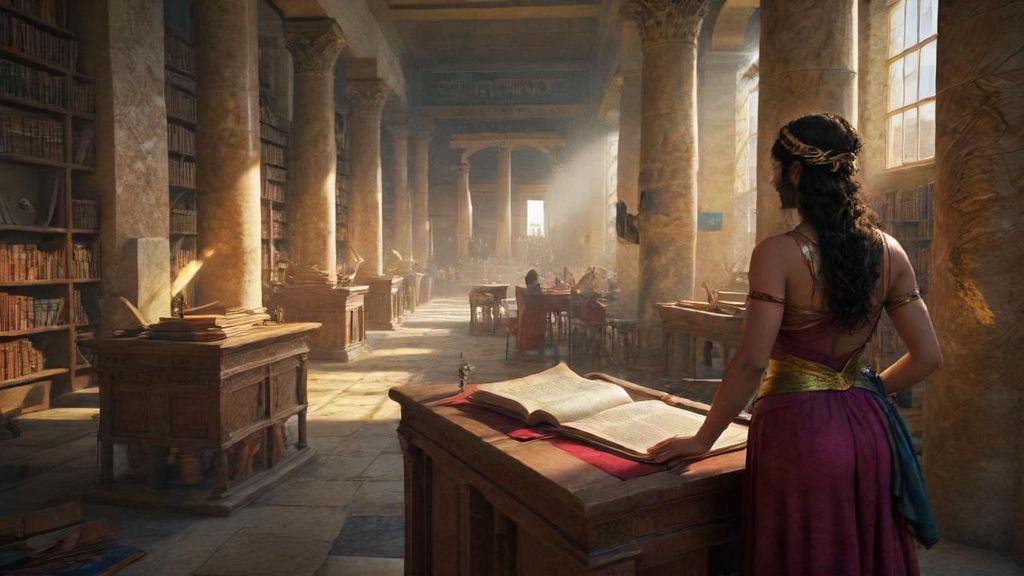
What makes this fascinating is not just the scrolls, but the incredible, amazing thinkers who came to Alexandria, attracted by the Mouseion’s resources and the king’s support. Picture a place where scholars were paid well, given free housing and food, and had the freedom to spend their days purely on research, writing, and debate. It was a scholar’s paradise.
This environment helped some of the greatest thinkers in history grow:
-
Eratosthenes: This brilliant man, head librarian for a time, famously figured out the Earth’s size with amazing accuracy using simple math and observation. Think about it: without satellites or advanced tools, he got remarkably close to the true value! It’s like a modern-day scientific breakthrough in an ancient setting.
-
Euclid: Although he likely taught there before the Great Library was fully established, his main book, the Elements, which laid the groundwork for geometry, was certainly housed and studied there. His clear, logical approach to mathematics influenced thinkers for thousands of years, just like Newton’s Principia changed physics forever.
-
Archimedes: While primarily based in Syracuse, Sicily, Archimedes stayed in touch with scholars in Alexandria, writing to them and sharing his amazing new ideas in mathematics, physics, and engineering. His work on how things float and how levers work was groundbreaking, showing the kind of idea-sharing this place encouraged.
-
Callimachus: He was more than just a poet; he was a librarian who changed everything. Callimachus created the Pinakes, a huge, 120-volume list that organized the Library’s giant collection by subject and author. In simple terms, he invented the world’s first comprehensive library cataloging system, a crucial achievement for finding anything in such a giant sea of knowledge. It’s like building the first version of Google’s search algorithm for the ancient world!
The Library wasn’t just a place to store books; it was a lively center for research. Scholars didn’t just read; they questioned, debated, and experimented. They created new knowledge, leading to breakthroughs in astronomy, medicine, engineering, and literary studies that changed how people thought for centuries. This busy community of thinkers, backed by the rich and forward-thinking Ptolemaic kings, truly made Alexandria the clear center of learning for the ancient world.
The truth is more interesting than you might think: the Library of Alexandria was a complete system where minds could truly grow, a place unlike any other in its dedication to all knowledge and scientific discovery. It was a guiding light for learning, a huge project showing human cleverness and the kings’ big goals, collecting wisdom from everywhere they knew. This amazing center of learning, however, faced challenges that would eventually lead to its sad fall and the loss of so much knowledge that could never be replaced, a story we’ll explore in the next chapter.
Did Julius Caesar Really Destroy the Great Library of Alexandria?
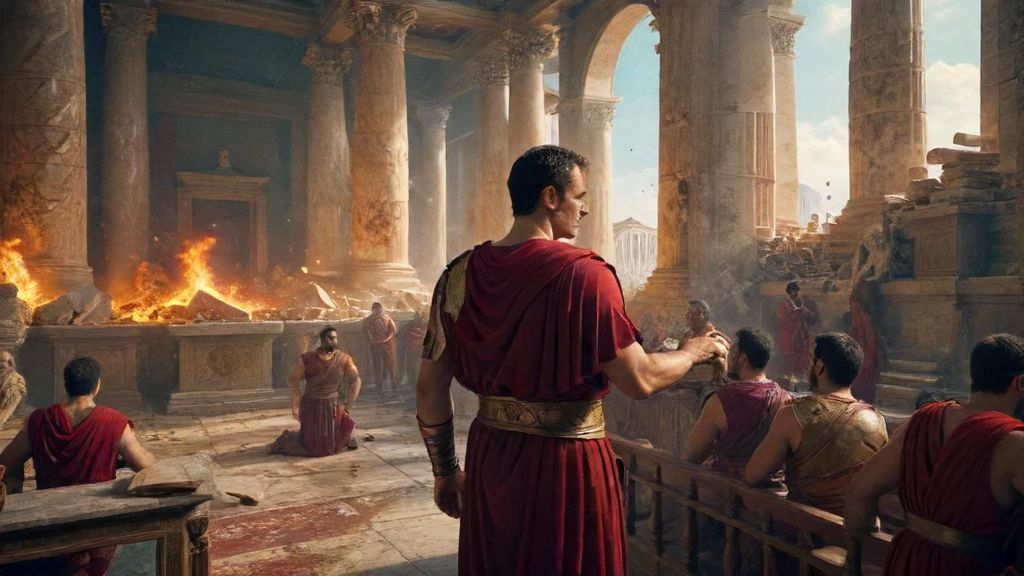
Imagine if a famous story you’ve always believed about history actually wasn’t quite right. We’ve all heard the dramatic tale: Julius Caesar, stuck in Alexandria, set his own ships on fire, and the flames, in a terrible accident, spread to utterly destroy the magnificent Great Library and all its priceless knowledge. It’s a heartbreaking image, one that sticks in your mind. But here’s the surprising truth: while Caesar’s actions did cause damage in Alexandria in 48 BCE, blaming him for completely wiping out the entire Great Library is a huge exaggeration. It’s a story that simply grew bigger and sadder over time. The quick answer is, no, he didn’t. The real story is much more complicated and, honestly, more fascinating than the myth.
So, What Did Happen During Caesar’s Siege?
Let’s set the scene. In 48 BCE, the powerful Roman general Julius Caesar found himself in a tough spot in Alexandria. He was there poking around in Egyptian politics, specifically trying to sort out an argument between the young King Ptolemy XIII and his sister, who would later become Queen Cleopatra VII. Caesar, with his rather small Roman army, ended up trapped in the city’s royal area by Ptolemy’s forces. His situation looked bad. To stop his ships from falling into enemy hands and to cut off their way to get more supplies, Caesar made a hard choice: he ordered his own fleet in the harbor to be set on fire. This wasn’t some evil plan to destroy the city’s intellectual heart; it was a desperate military move.
Here’s what happened next, according to old historians like Plutarch and Cassius Dio. The fires spread from the burning ships to the docks and nearby buildings. These weren’t just any buildings; they included royal warehouses and storage places. Think of it like a modern port today: you’d have ships, alongside big facilities for holding goods and supplies. And in ancient Alexandria, some of those “goods” included scrolls. This is often where people get confused.
The docks of Alexandria would have held scrolls related to trade, official records, and maybe even extra copies or overflow scrolls from the Library itself, kept there for shipping or extra storage. Imagine a huge university today; it has its main library building, but also archives, smaller libraries in different departments, and perhaps even storage away from campus. What likely burned during Caesar’s siege were these extra buildings and their contents, not the main, famous Great Library building itself. That main building was part of the royal complex called the Museion. The Museion was like a huge research center, complete with lecture halls, dining areas, and the grand library, located further inland from the busy commercial harbor.
The most dramatic claim about lost scrolls comes much later from the Roman philosopher Seneca, who wrote about it in the 1st century CE. He dramatically claimed that 40,000 “books” (which really meant scrolls) were burned. While Seneca’s story paints a vivid picture, it’s important to remember he wrote about a hundred years after the actual event. Earlier accounts by people closer to the time, like Caesar himself, didn’t even mention the Library. Later historians like Livy briefly noted the loss of “40,000 books,” but again, they didn’t say these were from the Great Library or how much of the entire collection that represented. The evidence suggests that some scrolls were indeed lost, but it was far from a total disaster that wiped out the entire institution.
What About Other Damage in Roman Times?
The truth is more interesting than you might think, because even if Caesar wasn’t the only one to blame, the Great Library was already slowly fading away during the Roman period. After Egypt became a Roman province in 30 BCE, the political scene changed a lot. The Library was no longer the special project of a proud Ptolemaic royal family, so it lost some of its royal support and dedicated money. Think about a huge public institution today, like a major art museum or a national park. If its main funding suddenly disappears or its political supporters lose interest, it can quickly run into big problems.
History books tell us that Roman emperors, even though they sometimes still helped Alexandria, mostly put their cultural investments into Rome itself. This meant less focus on getting new scrolls for Alexandria, less money for its scholars, and probably less careful upkeep for the enormous collection. Over time, the constant care needed to keep ancient papyrus and parchment scrolls safe—copying, fixing, organizing—would have become harder to manage. It’s like trying to maintain a massive digital archive today; without constant attention, files can get lost, corrupted, or simply become outdated.
What’s more, Alexandria, while still a big center for thinkers, saw a gradual “brain drain” as important scholars and intellectuals increasingly moved to Rome. The lively intellectual atmosphere, the constant flow of new ideas and works, which had made the Great Library so amazing, began to weaken. This wasn’t a sudden, dramatic event, but a slow wearing away, a scattering of its collection as scrolls might have been moved, copied, or just decayed because they weren’t replaced or cared for properly. It was a slow dimming, rather than a sudden snuffing out.
What makes this so interesting is that the Library’s decline during this early Roman era was probably more because of ongoing neglect and changing priorities than any single, dramatic fire. While Caesar’s actions did damage valuable written materials in the harbor, it was just one early moment in a longer, more complex story of a grand institution slowly losing its top spot. It makes it clear that while some damage happened, it was far from a complete destruction of the entire place.
So, while the image of Caesar, the fiery destroyer of knowledge, makes for a great story, the evidence shows a different picture. His actions were limited, affecting specific areas near the docks, and contributed to losing some scrolls, but they didn’t erase the Great Library from existence. Instead, the institution faced a slow and steady decline under Roman rule, a quiet fading that eventually paved the way for later, more serious threats to its very survival.
Next, we’ll explore how these subtle changes set the stage for even bigger dangers and the eventual disappearance of one of the ancient world’s most incredible treasures.
How Did the Library of Alexandria Truly Vanish Over Centuries?
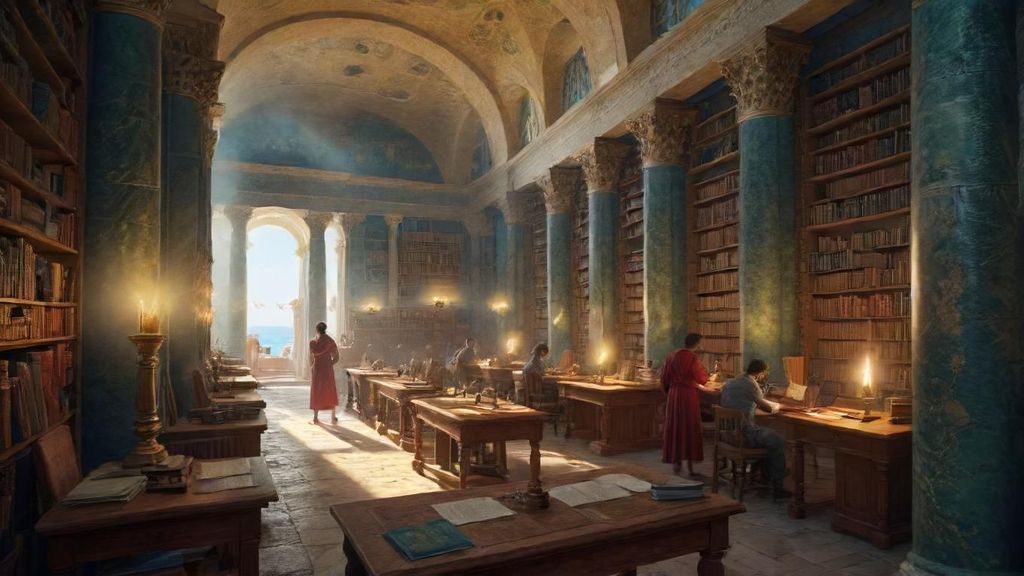
If you’ve always pictured the Great Library of Alexandria disappearing in one huge, dramatic fire—maybe started by Julius Caesar or angry mobs—get ready for a surprise. The real story, as historians have carefully put it together, is far more complicated, much slower, and, arguably, even sadder. This wasn’t a single, explosive event. Instead, it was a drawn-out, painful fading away over hundreds of years, much like a grand old building slowly crumbling into dust.
The simple answer to how the Library disappeared is this: it wasn’t one big disaster. It was a mix of many things: neglect, shifts in how people thought, gradual destruction, and a changing world that simply stopped valuing its enormous collection in the way it once had. It turns out the Library didn’t die quickly; it faded away slowly, piece by painful piece.
Think about a popular online platform today. It might not get hacked and wiped out all at once. Instead, it might slowly lose users, its servers might not get updated, new content stops coming in, and eventually, it becomes an empty shell, forgotten and irrelevant. That’s a bit closer to what happened to Alexandria’s intellectual heart.
The decline started long before any specific acts of destruction. As the Roman Empire grew, Alexandria began to lose its top spot as a primary center for learning. Emperors in Rome often had other priorities. While Alexandria stayed important, the special, almost obsessive, royal support that built the Library began to dry up. Money became scarcer, scholars moved on, and the steady flow of new scrolls slowed to a trickle. Imagine a university today facing huge budget cuts; research slows, departments shrink, and its once-shining reputation starts to dim.
Then came the rise of Christianity. This wasn’t just a new religion; it was a whole new way of looking at the world for the Roman Empire. The old Greek and Roman gods, and the philosophical ideas linked to them, were seen as pagan—meaning non-Christian—and increasingly, as dangerous. This shift really changed things for the Library’s collection, which was mostly made up of these very “pagan” texts.
What Really Happened to the Serapeum?
This is where one of the stories people often mix up comes in. Many point to the destruction of the Serapeum in 391 CE as the moment the Great Library burned. But here’s what we’ve learned: the Serapeum, a magnificent temple dedicated to the god Serapis, also housed a significant collection of scrolls. Think of it like a very important branch library or a specialized research institute, but it wasn’t the main, original Great Library by this point.
In 391 CE, Theophilus, the Bishop of Alexandria, led a group of Christian zealots who indeed destroyed the Serapeum. This was a brutal, politically charged act aimed at getting rid of a major symbol of pagan worship in the city. Historical records tell us that the temple was torn down, and its contents—including any books—were likely destroyed or scattered. This was undoubtedly a massive loss of knowledge, a tragic act of cultural vandalism. However, by this time, the main Great Library (the Mouseion) had already been going downhill for ages. Its collection was dwindling due to neglect, theft, and just falling apart. It’s a clear sign of a changing world, where ancient texts weren’t universally respected anymore.
The destruction of the Serapeum was part of a larger trend. As Christianity became the main religion, texts that didn’t fit Christian ideas were often seen as useless, wrong, or even evil. This led to widespread censorship and a general lack of interest in pagan texts. Why preserve a scroll about Zeus when you’re focused on the Gospels? Why copy a philosophical book that goes against your new faith? This wasn’t always active burning, but often a quiet, sneaky way of destroying them: simply not making new copies. Think of all the digital files we delete today without a second thought because they’re old, outdated, or no longer serve a purpose. This was happening on a massive scale with precious ancient knowledge.
The materials themselves were also vulnerable. Scrolls, made of papyrus, are incredibly delicate. They need constant care, just the right storage conditions, and regular recopying to survive. Without dedicated scholars and money from the rulers to maintain them, these texts would have simply crumbled, been eaten by insects, or become unreadable in Alexandria’s humid climate. It’s like a computer’s hard drive failing; if no one is backing up the data, it’s just gone.
Did the Arab Conquest Burn the Library?
Now, let’s tackle a really persistent myth: the idea that the Arab conquerors, led by ‘Umar, deliberately burned the Library’s books in 642 CE after conquering Alexandria. The story goes that ‘Umar declared that if the books agreed with the Qur’an, they were unnecessary, and if they disagreed, they were harmful, so they should all be burned to heat bathhouses for six months. This makes for a dramatic tale, but it turns out that there’s simply no strong proof it ever happened.
The story only appears in historical writings hundreds of years later, first by a Syrian Christian writer named Bar-Hebraeus in the 13th century. This is almost 600 years after the supposed event! No records from the time of the Arab conquest of Alexandria mention such an order. What makes this fascinating is that the early Muslim world was actually great at preserving and translating ancient Greek knowledge, not destroying it. They valued learning deeply, and many Greek texts were translated into Arabic, laying the groundwork for the Islamic Golden Age. It’s very doubtful such an order would have been given or followed, especially considering how much they valued learning back then.
Recent evidence shows that by 642 CE, when the Arabs arrived, there was probably very little left of any significant library collection anyway. The Library had already been slowly fading away for ages due to the factors we’ve discussed: lack of money, changing cultural values, the rise of a new dominant religion that didn’t care much for books about the old gods, and the simple decay of ancient materials. The truth is more interesting than you might think: the Arab conquest probably didn’t destroy the Library because, by then, it had largely already vanished.
So, the magnificent Great Library of Alexandria didn’t meet a swift, fiery end at the hands of one person or one event. Instead, it was an agonizingly slow demise, a gradual chipping away of its collection and purpose. It was the combined weight of people not caring, things being neglected, changing religious beliefs that saw old texts as dangerous or irrelevant, and the simple fact that papyrus doesn’t last forever without continuous care. The mix of these forces broke up its knowledge, scattered its scrolls, and eventually, left very little to remember it by.
This slow, drawn-out process highlights a critical lesson: knowledge is delicate. It needs constant care, protection, and a society that truly values its existence. The Library’s disappearance didn’t end with a bang, but a whisper, and its story serves as a powerful reminder of how easily our shared history can be lost if we don’t actively protect it. But what did this loss truly mean for the world?