Test your knowledge of chinese history quiz with this comprehensive history quiz! This interactive quiz features 30 carefully crafted questions that will challenge your understanding of key historical facts, dates, and events.
Instructions: Select the best answer for each question. Your score will be calculated automatically at the end.
Interactive Quiz
Ready for the interactive challenge? Take the quiz below and get your score instantly:
Which early Chinese dynasty is primarily known for its advanced bronze metallurgy and the earliest confirmed Chinese writing, found on oracle bones?
Quiz Questions & Answers
Prefer to see all questions at once? Here’s the complete list with answers and explanations:
Question 1
Which early Chinese dynasty is primarily known for its advanced bronze metallurgy and the earliest confirmed Chinese writing, found on oracle bones?
Explanation:
The Shang Dynasty (c. 1600–1046 BCE) is renowned for its sophisticated bronze work and the use of oracle bones (turtle plastrons and ox scapulae) for divination, on which the earliest confirmed examples of Chinese writing are inscribed.
Question 2
What philosophical concept, introduced during the Zhou Dynasty, justified the rule of the emperor and allowed for the overthrow of a corrupt or ineffective ruler?
Explanation:
The Mandate of Heaven (Tianming) was a political and religious doctrine used to justify the rule of the king or emperor of China, asserting that Heaven (Tian) bestowed the 'mandate' on a just ruler. If a ruler became tyrannical or ineffective, Heaven would withdraw its mandate, allowing for a new dynasty to emerge.
Question 3
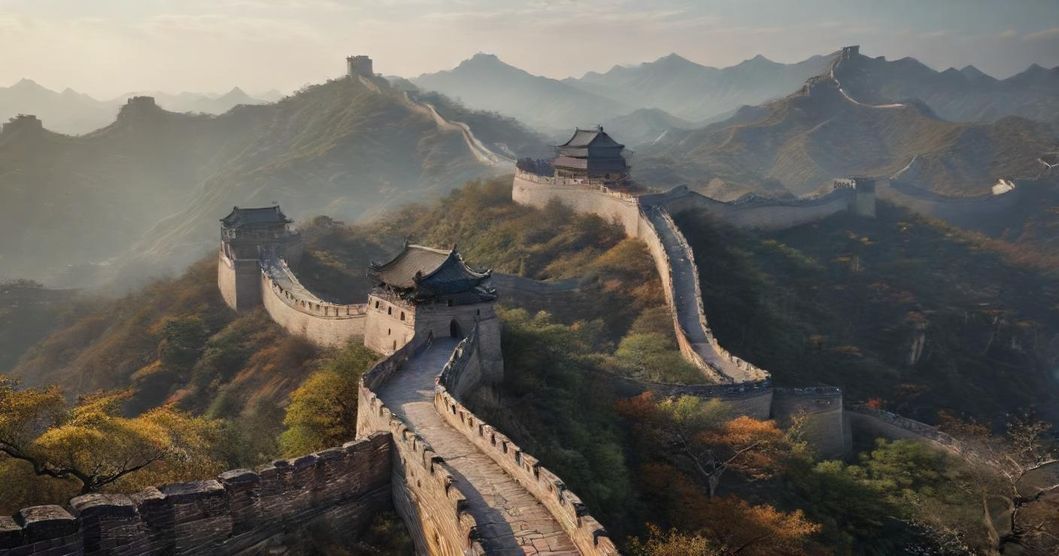
Which emperor is credited with unifying China for the first time in 221 BCE, establishing the Qin Dynasty, and initiating the construction of the Great Wall?
Explanation:
Qin Shi Huang, the First Emperor, unified China in 221 BCE after conquering the Warring States. He established the Qin Dynasty and is known for centralizing power, standardizing weights and measures, creating a unified writing system, and beginning the initial sections of what would become the Great Wall.
Question 4
In what year did the Qin Dynasty successfully unify all of China, ending the Warring States period?
Explanation:
The Qin Dynasty unified China in 221 BCE under Qin Shi Huang, marking the end of the long and tumultuous Warring States period and the beginning of imperial China.
Question 5
During which dynasty did the Silk Road flourish, facilitating extensive trade and cultural exchange between China and the West?
Explanation:
The Silk Road was established and significantly expanded during the Han Dynasty (206 BCE – 220 CE), especially under Emperor Wu, connecting China with Central Asia, India, the Middle East, and Europe, leading to an unprecedented exchange of goods, ideas, and technologies.
Question 6
Which philosophy became the official state ideology of China during the Han Dynasty and profoundly influenced Chinese society for centuries?
Explanation:
Under Emperor Wu of Han, Confucianism was officially adopted as the state philosophy, displacing Legalism. Its emphasis on filial piety, respect for elders, benevolent governance, and a hierarchical social order became foundational to Chinese political and social thought.
Question 7
Following the collapse of the Han Dynasty, China entered a prolonged period of fragmentation and warfare known as what?
Explanation:
After the fall of the Eastern Han Dynasty in 220 CE, China fractured into three rival states—Wei, Shu Han, and Wu—leading to the turbulent Three Kingdoms Period (220–280 CE), a popular subject in Chinese literature and folklore.
Question 8
Which dynasty is famous for reunifying China after centuries of division and for constructing the Grand Canal, a monumental engineering feat?
Explanation:
The Sui Dynasty (581–618 CE) briefly but powerfully reunified China after the period of disunity. Its most significant achievement was the construction of the Grand Canal, which connected the northern and southern regions of China, facilitating trade and troop movements, though its immense labor cost contributed to the dynasty's downfall.
Question 9
Who was the only female emperor of China, reigning during the Tang Dynasty and known for her political acumen and patronage of Buddhism?
Explanation:
Wu Zetian (624–705 CE) was the only officially recognized female emperor of China. She ruled with exceptional authority during the Tang Dynasty, consolidating power, expanding the empire, and promoting Buddhism, even establishing her own 'Zhou Dynasty' for a period.
Question 10
The Tang Dynasty is often considered a 'Golden Age' of Chinese culture, particularly noted for its achievements in what art form?
Explanation:
The Tang Dynasty (618–907 CE) is widely regarded as the golden age of classical Chinese poetry, producing renowned poets like Li Bai and Du Fu, whose works remain cornerstones of Chinese literature.
Question 11
Which dynasty saw significant technological advancements, including the invention of gunpowder, movable type printing, and the magnetic compass?
Explanation:
The Song Dynasty (960–1279 CE) was an era of remarkable technological innovation, witnessing the development and practical application of gunpowder, movable type printing, and the magnetic compass, among many other inventions that would profoundly impact the world.
Question 12
What intellectual movement, gaining prominence during the Song Dynasty, sought to reinterpret Confucianism with Buddhist and Daoist elements, focusing on moral self-cultivation?
Explanation:
Neo-Confucianism emerged during the Tang Dynasty and flourished in the Song Dynasty, becoming a dominant intellectual force. Philosophers like Zhu Xi integrated metaphysical concepts from Buddhism and Daoism into the Confucian framework, emphasizing reason, self-cultivation, and the investigation of things.
Question 13
Who was the Mongol leader who established the Yuan Dynasty and became the first non-Han emperor to rule all of China?
Explanation:
Kublai Khan, a grandson of Genghis Khan, conquered the Southern Song Dynasty and established the Yuan Dynasty in 1271 CE, ruling as the first non-Han emperor over a unified China. He moved the Mongol capital to Khanbaliq (modern-day Beijing).
Question 14
What was a significant impact of Mongol rule (Yuan Dynasty) on Chinese society?
Explanation:
The Yuan Dynasty established a four-tiered social hierarchy: Mongols, Semu (various Central Asians and Westerners), Northern Chinese, and Southern Chinese. This system restricted the opportunities for Han Chinese, especially in government, and maintained Mongol dominance.
Question 15
During the Ming Dynasty, which famous admiral led several large naval expeditions into the Indian Ocean and to the coast of Africa?
Explanation:
Between 1405 and 1433, Zheng He led seven epic voyages for the Ming Dynasty's Yongle Emperor. His massive treasure fleets explored Southeast Asia, India, the Middle East, and the east coast of Africa, establishing tributary relations and showcasing Chinese power.
Question 16
Which iconic Beijing landmark, serving as the imperial palace for over 500 years, was largely constructed during the early Ming Dynasty?
Explanation:
The Forbidden City was built between 1406 and 1420 by the Yongle Emperor of the Ming Dynasty. It served as the imperial palace and administrative center for both the Ming and Qing dynasties until 1912.
Question 17
What series of conflicts in the mid-19th century between China and Western powers led to the forced opening of Chinese ports and the cession of territory?
Explanation:
The Opium Wars (First Opium War 1839–1842, Second Opium War 1856–1860) were fought between the Qing Dynasty and Western powers, primarily Britain. They resulted in China's defeat, leading to the signing of unequal treaties that opened Chinese ports, ceded Hong Kong, and granted extraterritoriality to foreigners.
Question 18
Which massive civil war, lasting from 1850 to 1864, involved a millenarian movement against the Qing Dynasty and resulted in millions of deaths?
Explanation:
The Taiping Rebellion was a vast civil war that challenged the Qing Dynasty, led by Hong Xiuquan, who claimed to be the brother of Jesus Christ. It was one of the deadliest conflicts in history, resulting in an estimated 20-30 million deaths, and significantly weakened the Qing state.
Question 19
The Xinhai Revolution of 1911 led to the overthrow of the Qing Dynasty and the establishment of what form of government in China?
Explanation:
The Xinhai Revolution, which began in 1911, led to the collapse of the Qing Dynasty and the end of over two millennia of imperial rule. It resulted in the establishment of the Republic of China in 1912, with Sun Yat-sen as its provisional president.
Question 20
Who is considered the 'Father of the Nation' of the Republic of China, playing a pivotal role in the overthrow of the Qing Dynasty and founding the Kuomintang (KMT)?
Explanation:
Sun Yat-sen (1866–1925) was a revolutionary leader who played a key role in the Xinhai Revolution and is widely regarded as the 'Father of the Nation' in both the Republic of China (Taiwan) and the People's Republic of China. He founded the Kuomintang (Nationalist Party) and developed the Three Principles of the People.
Question 21
What significant event in 1934-1935 involved the Chinese Red Army's retreat from Nationalist forces, becoming a legendary tale of endurance for the Communist Party?
Explanation:
The Long March (1934-1935) was a military retreat by the Red Army of the Chinese Communist Party to evade the pursuit of the Kuomintang army. It was not a single march but a series of marches by various Communist armies, the most famous being the one from Jiangxi to Shaanxi, solidifying Mao Zedong's leadership.
Question 22
What year marks the official establishment of the People's Republic of China, with Mao Zedong proclaiming its founding in Beijing?
Explanation:
On October 1, 1949, Mao Zedong formally proclaimed the establishment of the People's Republic of China from Tiananmen Square in Beijing, marking the end of the Chinese Civil War and the ascendancy of the Communist Party.
Question 23
What was the name of Mao Zedong's economic and social campaign from 1958 to 1962, aimed at rapidly transforming China from an agrarian economy into a communist society through industrialization and collectivization, but ultimately led to widespread famine?
Explanation:
The Great Leap Forward (1958–1962) was a disastrous campaign initiated by Mao Zedong to rapidly industrialize China and increase agricultural output through radical collectivization and inefficient backyard steel furnaces. It led to an unprecedented famine that caused tens of millions of deaths.
Question 24
The 'Gang of Four' were prominent figures associated with what tumultuous political movement launched by Mao Zedong in 1966 to purge perceived ideological opponents?
Explanation:
The Cultural Revolution (1966–1976) was a violent sociopolitical purge movement in China launched by Mao Zedong. The 'Gang of Four,' led by Mao's wife Jiang Qing, were a powerful faction that played a leading role in directing the Cultural Revolution's most radical excesses before their arrest after Mao's death.
Question 25
Which leader initiated China's 'reform and opening-up' policies in the late 1970s, shifting the country towards a market-oriented economy?
Explanation:
Deng Xiaoping (1904–1997) was the paramount leader of China from 1978 to 1989. He is credited with initiating the 'reform and opening-up' policies that transformed China's economy from a centrally planned system to a 'socialist market economy,' leading to unprecedented economic growth.
Question 26
What was the primary cause of the decline of the Qing Dynasty in the 19th and early 20th centuries?
Explanation:
The Qing Dynasty faced a 'century of humiliation' marked by a combination of severe internal challenges (like the Taiping and Boxer Rebellions, and widespread corruption) and aggressive foreign pressures (Opium Wars, unequal treaties, territorial concessions), which collectively eroded its authority and led to its eventual collapse.
Question 27
The Spring and Autumn Period (771–476 BCE) and the subsequent Warring States Period (475–221 BCE) are known for the emergence of various intellectual traditions and philosophical schools. What collective term is used to describe this period of intellectual flourishing?
Explanation:
The 'Hundred Schools of Thought' refers to the flourishing of various philosophical schools during the Spring and Autumn and Warring States periods, including Confucianism, Daoism, Legalism, Mohism, and others, as thinkers sought solutions to societal chaos.
Question 28
Which major ancient Chinese river is often referred to as the 'cradle of Chinese civilization' due to its role in the development of early Chinese cultures?
Explanation:
The Yellow River (Huang He) is often called the 'cradle of Chinese civilization' because many early Chinese cultures, including the legendary Xia, historical Shang, and early Zhou dynasties, developed along its fertile banks.
Question 29
What was a long-term effect of the standardization policies implemented by Qin Shi Huang (e.g., currency, weights, measures, script)?
Explanation:
Qin Shi Huang's standardization of currency, weights, measures, and a unified writing script, though enforced brutally, created a coherent framework for trade, administration, and cultural identity that significantly contributed to the long-term unity and stability of subsequent Chinese empires.
Question 30
The establishment of the People's Republic of China in 1949 primarily resulted from the victory of which political party in the Chinese Civil War?
Explanation:
The Chinese Civil War (1927–1949) was fought between the Kuomintang (Nationalist Party) and the Chinese Communist Party (CCP). The CCP, under the leadership of Mao Zedong, emerged victorious, leading to the founding of the People's Republic of China in 1949 and the retreat of the KMT to Taiwan.
About This chinese history quiz Quiz
This chinese history quiz quiz covers essential historical knowledge that every history enthusiast should know. Whether you’re a student preparing for exams or simply someone who loves learning about the past, this quiz will test your understanding of important historical events, figures, and dates.
What You’ll Learn
- Key historical facts about chinese history quiz
- Important dates and chronology
- Significant historical figures and their contributions
- Major events and their historical impact
Challenge yourself and see how much you really know about chinese history quiz! Share your results with friends and challenge them to beat your score.