
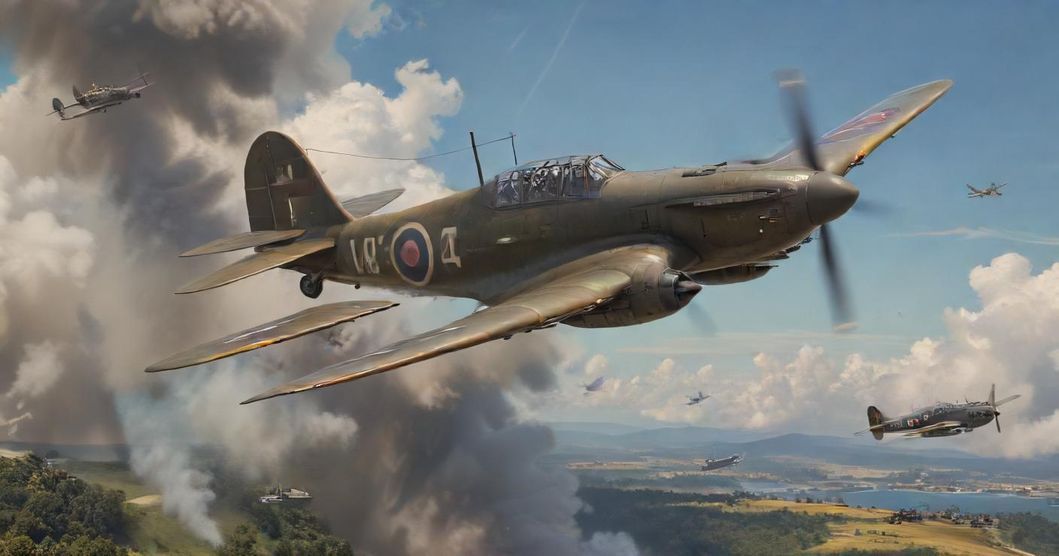
Test your knowledge of world war 2 quiz with this comprehensive history quiz! This interactive quiz features 30 carefully crafted questions that will challenge your understanding of key historical facts, dates, and events.
Instructions: Select the best answer for each question. Your score will be calculated automatically at the end.
Interactive Quiz
Ready for the interactive challenge? Take the quiz below and get your score instantly:
What event is widely considered the immediate cause for the outbreak of World War II in Europe?
Quiz Questions & Answers
Prefer to see all questions at once? Here’s the complete list with answers and explanations:
Question 1
What event is widely considered the immediate cause for the outbreak of World War II in Europe?
Explanation:
Germany's invasion of Poland on September 1, 1939, prompted Britain and France to declare war on Germany, marking the beginning of World War II in Europe. The other options were significant preceding events but not the direct trigger for the declarations of war.
Question 2
On what date did Germany invade Poland, officially starting World War II in Europe?
Explanation:
Germany invaded Poland on September 1, 1939. Two days later, on September 3, 1939, Britain and France declared war on Germany in response, officially beginning World War II in Europe.
Question 3
Who served as the Prime Minister of the United Kingdom for most of World War II?
Explanation:
Winston Churchill became Prime Minister in May 1940, leading Britain through its darkest hours and rallying the nation with his powerful speeches. Neville Chamberlain was his predecessor, known for the policy of appeasement. Clement Attlee became PM after the war.
Question 4
What was the 'Miracle of Dunkirk' during May-June 1940?
Explanation:
The 'Miracle of Dunkirk' refers to the massive evacuation of over 338,000 Allied soldiers (primarily British and French) from the beaches of Dunkirk, France, by a hastily assembled fleet of naval ships and civilian boats, while encircled by German forces.
Question 5
The Battle of Britain, a crucial air campaign, was primarily fought over which location?
Explanation:
The Battle of Britain (July-October 1940) was an aerial battle fought by the Royal Air Force (RAF) and the German Luftwaffe primarily over the skies of the United Kingdom. Its objective was to gain air superiority as a prelude to a planned German invasion.
Question 6
What military strategy, characterized by rapid, overwhelming force, was employed by Germany early in the war?
Explanation:
Blitzkrieg, or 'Lightning War,' was a military tactic designed to create psychological shock and disorganization in enemy forces through the use of surprise, speed, and overwhelming concentration of mobile forces, particularly tanks and airpower. It was highly effective in the early stages of the war.
Question 7
Why is the Battle of Stalingrad (1942-1943) often considered a major turning point on the Eastern Front?
Explanation:
The Battle of Stalingrad was a devastating defeat for Germany, marking the turning point on the Eastern Front. It halted the German advance into the Soviet Union, inflicted immense casualties, and after this point, German forces were generally in retreat.
Question 8
Who was the Supreme Commander of the Allied Expeditionary Force for the D-Day landings in Normandy?
Explanation:
General Dwight D. Eisenhower was appointed Supreme Commander of the Allied Expeditionary Force and was responsible for planning and executing Operation Overlord, including the D-Day landings.
Question 9
On what date did the Japanese launch their surprise attack on Pearl Harbor, drawing the United States into World War II?
Explanation:
The Japanese attacked the U.S. naval base at Pearl Harbor, Hawaii, on Sunday, December 7, 1941. This unprovoked attack directly led to the United States' formal entry into World War II.
Question 10
What was the primary effect of the Japanese attack on Pearl Harbor?
Explanation:
The day after the attack on Pearl Harbor, President Franklin D. Roosevelt asked Congress for a declaration of war against Japan, which was swiftly granted. This marked the official entry of the United States into World War II.
Question 11
What term describes the systematic, state-sponsored persecution and murder of six million Jews by the Nazi regime and its collaborators?
Explanation:
The Holocaust was the genocide of European Jews during World War II. Between 1941 and 1945, Nazi Germany and its collaborators systematically murdered approximately six million Jews across German-occupied Europe.
Question 12
The D-Day landings on June 6, 1944, took place on the beaches of which French region?
Explanation:
Operation Overlord, better known as D-Day, involved the Allied invasion of Normandy, France. The specific beaches were codenamed Utah, Omaha, Gold, Juno, and Sword.
Question 13
On what date did the Allied forces launch the D-Day invasion of Normandy?
Explanation:
D-Day, the largest seaborne invasion in history, occurred on June 6, 1944. It marked the beginning of the liberation of Western Europe from Nazi control.
Question 14
What was the name of the Allied strategy in the Pacific that involved bypassing heavily fortified Japanese islands to seize strategic locations?
Explanation:
Island Hopping, or Leapfrogging, was a military strategy employed by the Allies in the Pacific War against the Axis powers (primarily Japan). It involved selectively attacking and capturing enemy-held islands that were strategically important, while bypassing others, in order to rapidly advance towards mainland Japan.
Question 15
Who was the scientific director of the Manhattan Project, responsible for the development of the atomic bomb?
Explanation:
J. Robert Oppenheimer was the scientific director of the Los Alamos Laboratory during the Manhattan Project and is often referred to as the 'father of the atomic bomb' for his role in its creation.
Question 16
What was the ultimate significance of the atomic bombings of Hiroshima and Nagasaki?
Explanation:
The atomic bombings of Hiroshima (August 6, 1945) and Nagasaki (August 9, 1945), combined with the Soviet invasion of Manchuria, led to Emperor Hirohito's announcement of Japan's unconditional surrender on August 15, 1945, formally ending World War II.
Question 17
On what date did Germany officially surrender to the Allied forces, known as V-E Day?
Explanation:
Victory in Europe Day (V-E Day) was celebrated on May 8, 1945, marking the formal acceptance by the Allies of Nazi Germany's unconditional surrender of its armed forces.
Question 18
When did Japan officially surrender, marking the end of World War II (V-J Day)?
Explanation:
Japan formally surrendered on September 2, 1945, aboard the USS Missouri in Tokyo Bay. While Emperor Hirohito announced surrender on August 15 (V-J Day in some countries), the official signing ceremony that concluded the war was on September 2.
Question 19
Which post-World War I treaty is often cited as a contributing factor to the rise of Nazism and World War II due to its harsh terms imposed on Germany?
Explanation:
The Treaty of Versailles, signed in 1919, imposed severe reparations, territorial losses, and military restrictions on Germany. Many historians argue that these punitive terms fostered resentment and economic instability, creating fertile ground for extremist ideologies like Nazism to gain power.
Question 20
Who was the leader of the Soviet Union throughout World War II?
Explanation:
Joseph Stalin led the Soviet Union from the mid-1920s until his death in 1953, including during the entirety of World War II. Lenin died in 1924, Trotsky was exiled and assassinated, and Khrushchev came to power after Stalin.
Question 21
What was 'Operation Barbarossa'?
Explanation:
Operation Barbarossa was the codename for the Axis invasion of the Soviet Union, launched on June 22, 1941. It was the largest land invasion in history and opened the Eastern Front, which became the largest theater of war.
Question 22
The decisive Battle of El Alamein, a key Allied victory in North Africa, took place in which country?
Explanation:
The First and Second Battles of El Alamein were fought in Egypt in 1942. The British Eighth Army, under General Montgomery, decisively defeated the Axis forces, ending their threat to Egypt and the Suez Canal.
Question 23
What policy did Britain and France initially pursue towards Hitler's aggressive expansion, hoping to avoid war?
Explanation:
Appeasement was a diplomatic policy aimed at avoiding war by making concessions to an aggressor. Britain and France pursued this policy towards Nazi Germany's territorial demands (e.g., Rhineland, Austria, Sudetenland) in the 1930s, hoping to satisfy Hitler and prevent a larger conflict.
Question 24
What was a significant political outcome for Germany immediately following its defeat in World War II?
Explanation:
After Germany's unconditional surrender, it was divided into four occupation zones administered by the United States, Great Britain, France, and the Soviet Union. Berlin, located within the Soviet zone, was also similarly divided.
Question 25
Which German field marshal, known as the 'Desert Fox,' famously led the Afrika Korps in North Africa?
Explanation:
Field Marshal Erwin Rommel, often referred to as the 'Desert Fox' for his brilliant leadership and tactical prowess, commanded the Afrika Korps during the North African Campaign.
Question 26
Why was the Battle of Midway (June 1942) considered a crucial turning point in the Pacific War?
Explanation:
The Battle of Midway was a decisive naval battle in the Pacific Theater. The United States Navy inflicted a devastating defeat on the Imperial Japanese Navy, sinking four of their aircraft carriers. This victory severely crippled Japan's offensive capabilities and marked a turning point in the Pacific War, shifting the strategic initiative to the Allies.
Question 27
What was the significance of the Lend-Lease Act, passed by the US in March 1941?
Explanation:
The Lend-Lease Act allowed the U.S. to 'lend or lease' war supplies to any nation deemed vital to the defense of the United States. This bypassed the neutrality acts and allowed the U.S. to support Allied nations like Great Britain, the Soviet Union, and China with arms, food, and other materials, effectively making the U.S. the 'arsenal of democracy' before its formal entry into the war.
Question 28
What term describes the period from September 1939 to May 1940, characterized by a lack of major military operations on the Western Front?
Explanation:
The 'Phoney War' was the eight-month period at the start of World War II, from September 1939 to May 1940, during which there were no major land operations on the Western Front after the German invasion of Poland. This period ended with the German invasion of France and the Low Countries.
Question 29
The infamous Wannsee Conference, where the 'Final Solution to the Jewish Question' was coordinated, took place in which city?
Explanation:
The Wannsee Conference was held on January 20, 1942, in a villa in the Berlin suburb of Wannsee. During this meeting, high-ranking Nazi officials discussed and coordinated the implementation of the 'Final Solution,' the plan to systematically exterminate the Jewish people.
Question 30
Who chaired the Wannsee Conference in January 1942, where the 'Final Solution' was formalized?
Explanation:
Reinhard Heydrich, head of the Reich Security Main Office (RSHA) and a key architect of the Holocaust, chaired the Wannsee Conference. While Himmler oversaw the SS, and Göring had authorized Heydrich, Heydrich himself led the meeting.
About This world war 2 quiz Quiz
This world war 2 quiz quiz covers essential historical knowledge that every history enthusiast should know. Whether you’re a student preparing for exams or simply someone who loves learning about the past, this quiz will test your understanding of important historical events, figures, and dates.
What You’ll Learn
- Key historical facts about world war 2 quiz
- Important dates and chronology
- Significant historical figures and their contributions
- Major events and their historical impact
Challenge yourself and see how much you really know about world war 2 quiz! Share your results with friends and challenge them to beat your score.