
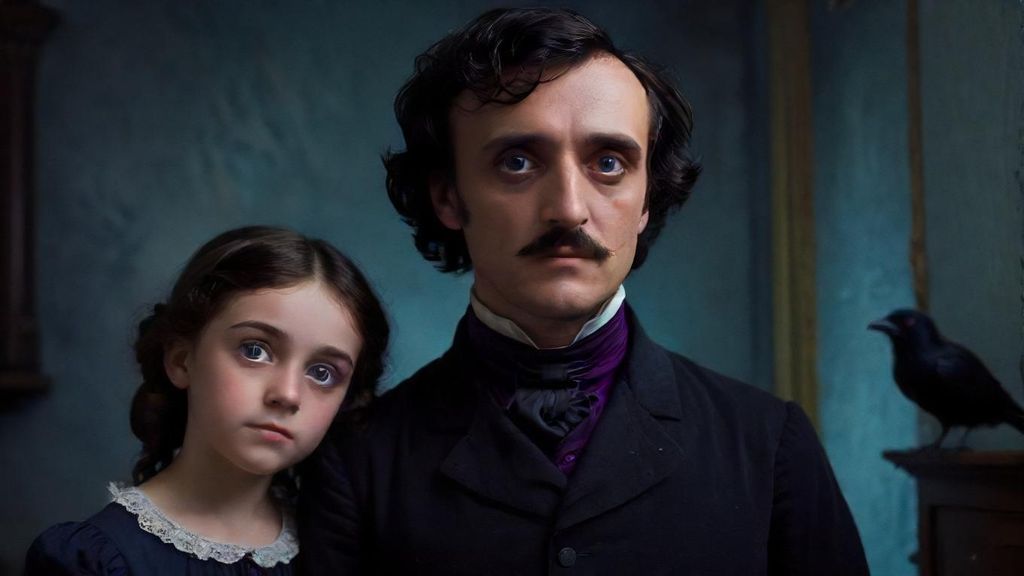
It’s easy to imagine Edgar Allan Poe as a lonely figure, lost in his dark thoughts. But the truth is, his life was much harder and more desperate than many people realize. Picture this: after a tough childhood and a huge fight with your rich guardians, you’re suddenly cut off, broke, and homeless. That’s exactly where Poe found himself. And that’s the simple reason he ended up sharing a home with his young cousin, Virginia. This wasn’t a powerful choice, but a desperate search for family and a stable place to live. This chapter will show you the difficult path Poe took, leading him right to his widowed aunt’s door in Baltimore. This meeting set the stage for a relationship that still gets people talking today.
Poe’s early years were a constant struggle to find somewhere he truly belonged. Born Edgar Poe in 1809, he became an orphan before his third birthday when both his actor parents died. A wealthy merchant family, John and Frances Allan, in Richmond, Virginia, took him in. But they never officially adopted him. This meant he had the Allan name but none of the legal rights of a son. While Frances Allan showed him kindness, his relationship with John Allan was often tense and difficult. It was like being brought into a successful family business but never quite becoming a partner; you were always on the outside looking in. After Frances died, the already strained relationship between Poe and John Allan got even worse, eventually reaching a breaking point.
Poe tried going to the University of Virginia, but John Allan gave him so little money that Poe quickly built up serious gambling debts just trying to get by. This led to a huge argument, and Allan pulled him out of school. In a desperate move, Poe even joined the army using a fake name, Edgar A. Perry. Later, he tried West Point, a famous military academy. But he purposely didn’t do his duties there, probably hoping to force Allan to support his dream of becoming a writer. When Allan refused, Poe was kicked out. He was left with no family support and no money. He was truly lost, a young man in his early twenties with amazing talent but no secure place in the world.
His immediate answer for survival lay in Baltimore with his biological aunt, Maria Clemm. She was his father’s sister, and Poe lovingly called her “Muddy.” Maria Clemm was a widow herself, struggling greatly to keep her own home going. Her household included her elderly, sick mother, Elizabeth Poe (Poe’s paternal grandmother), and her young daughter, Virginia Eliza Clemm. This wasn’t a grand mansion offering safety; it was a simple home often on the verge of poverty. Poe moved in with them sometime between 1831 and 1833. Simply put, it was a practical solution for struggling relatives in the 19th century—family was often the only help available.
The Clemm household became Poe’s safe place, though money was always a worry. Maria Clemm quickly became like a devoted mother to him. In turn, Poe became the main man of the house and, more and more, the family’s hope for money. Think of it like a modern family where an older sibling or aunt takes in a younger relative who’s hit hard times. Everyone works together, relying on each other for emotional and often financial help. This was a very close-knit arrangement, built on shared problems and affection.
Inside this small, struggling home, Poe formed a deep connection with his young cousin, Virginia. Born in 1822, Virginia was only about 9 to 11 years old when Poe, then in his early twenties, first moved in. He had mostly grown up without steady parental love, and with Maria Clemm and Virginia, he found the unconditional affection he longed for. He was like a big brother, a protector, and a playmate to Virginia, often drawing her pictures and writing her letters. Their relationship was one of deep friendship and innocent affection, born out of living together and needing each other. Letters from the time show that Maria Clemm herself expressed huge thanks and reliance on Poe, often calling him her “dear Eddy” and her “son,” which shows just how close their family was.
How Do We Know This Actually Happened?
We know these details not from guesses, but from old records that historians have carefully looked at. The evidence appears in many letters written by Edgar Allan Poe, Maria Clemm, and other family members, along with legal papers from that time. These letters give us a direct look into the daily lives, money troubles, and feelings within the Clemm home. We can see the deep affection and how much they depended on each other, written in their own words, giving us strong proof of their living situation and how their relationships grew.
Poverty was a constant shadow over the Clemm household. Poe’s efforts to earn a living as a writer, a famously tough job, often weren’t enough. His presence, while offering emotional comfort, also meant another mouth to feed. Maria Clemm, always practical, was very aware of the need to secure a stable future for her daughter, Virginia. It’s like a small business just starting, where everyone has to contribute to survive and succeed. Living so closely, under constant money worries, and with strong emotional ties, their family dynamic naturally changed. As Virginia grew into a young woman, what started as loving family connections began to shift, setting the stage for a truly unusual proposal.
This journey, pushed forward by personal sadness and desperate need for money, brought Edgar Allan Poe to the most stable home he had ever known. His deep bond with Virginia, built through shared struggles and affection, created a home life ripe for an unconventional connection. This unique household, born out of necessity, was the perfect ground for the surprising whispers of a possible marriage to begin. This leads us to question the very idea of family and what was considered normal back then. Next, we’ll explore how these whispers turned into a startling reality and what it meant for Poe, Virginia, and their world.
Did Edgar Allan Poe Really Marry His 13-Year-Old Cousin?
So, did Edgar Allan Poe really marry his 13-year-old cousin? The short answer is yes. He married his cousin, Virginia Clemm, when she was indeed about 13 years old. Today, learning this shocks most people because of the huge age difference. While the full story isn’t as dramatic as some rumors, it’s definitely complicated and very different from what we consider normal today. Understanding it means stepping back into the 19th century.
Here’s what we found out about their marriage. It’s a bit like digging into an old mystery, with layers of surprising details.
How Do We Know This Actually Happened?
The path to their marriage is clear, even if it had a few twists. Poe and Virginia, who was his first cousin, lived together in Baltimore with Virginia’s mother, Maria Clemm (Poe’s aunt). Many believe they had a private, perhaps unofficial, marriage ceremony in Baltimore in September 1835. But to make things official and legal, they needed a formal ceremony. This is where the story gets really interesting.
The strongest proof comes from Richmond, Virginia. On May 16, 1836, Edgar Allan Poe, who was 27 at the time, and Virginia Clemm had a public marriage ceremony. What makes this so fascinating is a legal paper called a marriage bond, filed just two days before. This bond was a legal promise that nothing stood in the way of their marriage. On this document, Virginia Clemm’s age was clearly listed as 21 years old. But here’s the truth: Virginia was born on August 15, 1822. This means she was actually almost 14 in May 1836. Her mother, Maria Clemm, seemingly lied by signing the document that claimed Virginia was 21. This action suggests her mother knew Virginia’s real age might cause some questions, even back then.
What Did 19th-Century Law Say About This?
To fully understand if their marriage was legal and accepted, we need to think about laws and social norms in 19th-century Virginia. Imagine how different things were then; it’s like comparing today’s internet rules to how telephones first worked. It turns out that marrying a cousin, while unusual in many places today, wasn’t against the law or considered scandalous in the 1800s. In fact, it happened quite often, especially in country areas or among families who wanted to keep land or family lines together. It was something society accepted, which seems shocking to us now.
The age of consent for marriage was also very different in 19th-century Virginia. For girls, the legal age to marry with parental permission was often as young as 12 years old. For boys, it was usually 14. So, even though Virginia was only 13, her marriage—with her mother’s consent and provided the age on the bond was considered legal—would have technically followed the law. It looks shocking through modern eyes, but it was legal. The age fudged on the marriage bond was probably to avoid any potential awkwardness or questions, not because it was completely illegal.
It’s surprising that while official records showed Virginia as 21, her family and close friends knew her real, younger age. This situation shows how legal details, social expectations, and personal choices all mixed together in a very different time.
The facts show us that Poe’s marriage to Virginia, while very unusual by today’s standards, wasn’t a one-off scandal or something everyone condemned at the time. Instead, it was a union that happened within the specific laws and social customs of the mid-1800s, with a little bending of the rules to make things smoother. Next, we’ll look at how their unique relationship unfolded and the deep impact it had on Poe’s life and his writing.
How Did Edgar Allan Poe’s Marriage to Virginia Influence His Literary Work?
Edgar Allan Poe’s marriage to his young cousin, Virginia, was far more than just a strange historical detail. In fact, their unusual bond and especially Virginia’s long illness and tragic death, deeply influenced the dark, haunting themes found in his most famous stories and poems. The pain Poe went through became the very spark for the sad beauty that defines his work, showing he was more than just a writer of creepy tales. The real answer lies in his personal heartbreak and the unique connection they shared.
Many people ask what their relationship was really like. Was Poe like a father figure or an older brother to Virginia, or something else? History experts and people who knew them say their connection changed over time. It was a mix of deep love and a strong need for each other. Poe, who was often sensitive and easily upset, found a steadying influence in Virginia. She was, in many ways, his rock. Imagine a struggling artist today whose partner gives them not only love but also a peaceful, stable place to create, protecting them from the world’s harshness. Virginia gave Poe that same kind of safe haven.
The Turning Point: Virginia’s Illness
The big moment that truly changed Poe, and with it, his writing, was Virginia getting sick with tuberculosis. This wasn’t a fast illness; it was a slow, painful fading away that lasted five years. Imagine this: one cold evening in January 1842, Virginia was singing and playing the piano when a tiny drop of blood appeared on her lips. It was the first sign of the disease that would eventually take her life. This moment stuck with Poe forever and marked the start of his own deep sadness.
How Her Suffering Became His Art
What’s amazing is how Virginia’s pain became a direct theme in Poe’s writing. Her long illness and eventual death from tuberculosis (or consumption, as it was called) became the main reason he so often wrote about a beautiful woman dying. This wasn’t just a story trick; for Poe, it was a constant, real-life nightmare. He watched the love of his life slowly fade away, unable to do anything. This experience ignited his deep dive into feelings of loss, intense sadness, and the terrifying truth of how easily life can be taken away – in a way no other event ever could.
Think about his haunting poem, Annabel Lee. It came out shortly after Poe himself died, and it feels like a direct tribute to Virginia. The person speaking in the poem grieves for his ‘beautiful Annabel Lee,’ a love ‘more than a love’ for a ‘child’ by the ‘sounding sea.’ The poem mentions angels being jealous of their love and a ‘wind that came out of the cloud by night / Chilling and killing my Annabel Lee.’ It’s easy to see Poe’s own sadness here, his feeling that fate itself worked against their happiness. This poem isn’t just about sadness; it’s about a deep belief that the universe can be cruel and uncaring.
Another strong example is Lenore, a poem that speaks directly about grief and mourning. While it might not be as directly about his own life, it shares the same strong pain of losing a beautiful woman too soon. Poe’s short stories also show this influence. Even if they don’t openly mention Virginia, you can feel the constant presence of loss, characters slowly losing their minds because of sadness, and the hard fight to deal with a loved one’s absence. Think of characters troubled by their past, chased by dark thoughts, or pushed to do wild things by overwhelming sorrow – these ideas all came from the dark times Poe faced in his own life.
Poe’s Devotion and Despair
History shows us that Poe was completely dedicated to Virginia during her illness. Even his literary rival, Rufus Wilmot Griswold, who later became a critic, admitted Poe’s deep sadness. Stories from people at the time describe Poe’s desperate attempts to keep her warm and cozy in their small home, often wrapping her in his own overcoat. Poe himself, in letters to friends, wrote about the terrible pain of watching her slowly get worse, saying,
“My love for her was the one strong principle of my life.”This simple quote tells us so much about how deeply he cared for her.
The huge impact of Virginia’s life and her slow death can’t be stressed enough. This long time of sadness and despair truly sharpened Poe’s way of writing, giving his stories about love, loss, and the supernatural a creepy, personal touch. Her death wasn’t just a tragedy; it became the sad, lingering tune heard throughout his most lasting works. Next, we’ll look closer at some specific literary creations, exploring how Poe carefully turned his pain into art we still remember today.