
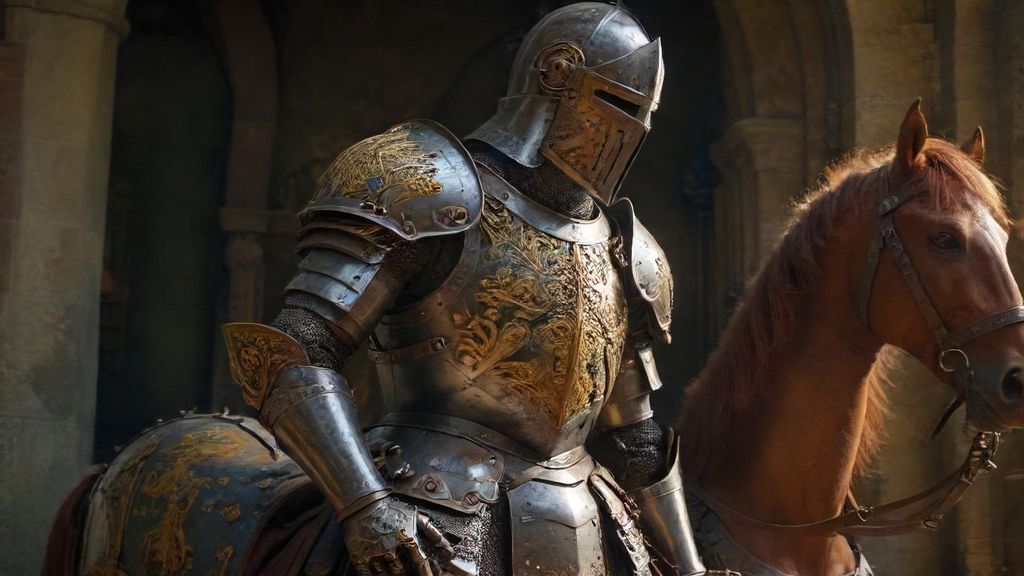
Imagine if today’s super-rich tech leaders hired a brilliant inventor to build something so advanced, so mind-blowing, that it mixed art, engineering, and pure magic. That’s pretty much the world Leonardo da Vinci lived in during the late 1400s. The main reason he designed a mechanical knight wasn’t just a random idea; it was a perfect blend of his amazing genius, the era’s love for grand shows, and the clear demands of powerful people who supported him.
The truth is even more interesting than you might think. Leonardo wasn’t just a painter; he was an engineer, a scientist who studied the human body, an architect, and a showman. His goal to create a knight that could walk, or at least move, came straight from the exciting world of the Renaissance. Back then, pushing the limits of what was possible was highly praised. It was like the space race of its time, but with gears and levers instead of rockets.
What inspired Leonardo to create moving machines?
The answer goes deep into the heart of the Renaissance itself. This was a time of amazing curiosity, when people wanted to understand how everything worked, from the human body to the stars. Leonardo, more than anyone, showed this spirit. He studied how nature worked with incredible detail. His notebooks are full of drawings of birds flying, water flowing, and, most importantly for our story, human anatomy. He carefully took apart bodies to understand how muscles and bones moved, essentially figuring out how the ultimate biological machine was built.
This deep understanding of the human body, combined with his skill as an engineer, gave him a unique edge. Think of it this way: he wasn’t just guessing how a robot might move; he had a detailed blueprint from nature itself. We now know that mechanical figures – moving statues powered by springs, gears, and weights – were already popular in Europe. They often appeared in clock towers or as part of fancy court entertainment. These were the original “wow” factor, like early special effects.
Historians tell us that one of Leonardo’s most important patrons, Ludovico Sforza, the Duke of Milan, played a huge role. Sforza loved putting on a grand show and needed to impress important visitors and his own court. He hired Leonardo for everything from paintings to big theatrical performances. Picture a royal dinner where, suddenly, a life-sized knight stands up and bows to the duke – that’s the kind of amazing show Sforza expected.
“Leonardo’s mechanical inventions were not just engineering feats; they were often conceived as theatrical devices, designed to astound and entertain, fitting perfectly with the lavish demands of his patrons,” explains historian Silas K. Smith in Renaissance Robotics.
The Duke wanted new ideas, spectacle, and even military breakthroughs, and Leonardo was just the person to deliver. It wasn’t just about entertainment, either. Some think that a moving mechanical figure could have been used in war, perhaps for signaling or even as a scary weapon to intimidate enemies on the battlefield. Even though technology back then was simple compared to ours, it was incredibly advanced for its time. Skilled workers were good at metalwork, clockmaking, and creating complex gear systems. Leonardo simply brought all these elements together with his amazing vision.
What makes this so fascinating is how Leonardo didn’t just copy other moving figures; he pushed the idea much further, using what he knew about the human body. He imagined a machine that moved like a person, not just with simple, repeated actions. His designs show an understanding of links, cams, and levers that would allow for complex, multi-jointed motion, much like the human body. He truly started the idea of what we now call biomechanics, hundreds of years before the word even existed. It’s like seeing the earliest drawings for a sophisticated humanoid robot in an age of horse-drawn carriages.
This closer look at why Leonardo did what he did, and the world he lived in, helps us understand that his mechanical knight wasn’t a random daydream. It was a natural, almost expected, result of his unique genius meeting the exciting, demanding world of ideas in the Renaissance. This background sets the stage for the big question: did this incredible design ever leap from paper into reality?
How did Leonardo da Vinci’s mechanical knight design actually work?
Leonardo da Vinci’s mechanical knight, designed in the late 1400s, worked using a clever system of gears, pulleys, and cams. Instead of modern electronics, Leonardo relied on wood, ropes, and basic metal tools, much like building a complex robot today with simple parts. Most people know him as an artist, but his notebooks, especially the vast collection known as the Codex Atlanticus, show he was also a brilliant engineer. In these pages, he carefully drew every part of his knight, revealing how this amazing automaton was meant to move.
When we look closely at these drawings, we see that Leonardo’s mechanical knight was far more than just a fancy costume. It was a clever system designed to move much like a real person, using the same basic machines that power many things around us today. Imagine it having an internal frame, probably made of wood or light metal, just like a puppet. This frame would then be covered with armor, making it look like a powerful warrior.
What made the knight move?
But the real cleverness was in the parts hidden inside. Leonardo designed a system that worked using several smart pieces. For example, he used gears to pass on power and change how fast or in what direction things moved. Think of bicycle gears: turning a big one makes a smaller one spin faster. He also used pulleys. These are like wheels with grooves where ropes or cables run, helping to lift heavy things or change the direction of a pull – just like the way window blinds work. These pulleys would have been key for the knight’s arms, letting it raise a sword or salute.
The real ‘magic,’ especially for tricky, repeated movements like sitting or standing, came from cams. A cam is like a spinning wheel with a bump on one side. As the wheel turns, this bump pushes against a lever, changing a smooth spin into a controlled up-and-down or back-and-forth push. This is how Leonardo planned for the knight to bend its knees, sit down, and stand back up. Picture cams pushing rods connected to the knight’s legs, making it perform a surprisingly lifelike series of actions. His notes, sometimes called ‘robotic’ designs – like those on folio 1025r of the Codex Atlanticus – even show detailed drawings of these inner workings, almost like a step-by-step guide.
To power such an amazing machine, Leonardo probably planned for a hand crank or a spring, similar to the clockwork systems that were getting popular back then. This would have given the energy to turn the main gears, which then made the cams and pulleys do their job. Think of winding up a giant old clock – but instead of telling time, it made a knight move! While robots existed before Leonardo, his designs pushed the limits of what machines could do, adding much more advanced movements.
Building such a complex design using 15th-century tools, however, came with huge challenges. The hardest part was getting everything perfectly accurate. For the gears and cams to work without jamming, they needed to be cut and shaped with extreme precision. Doing this by hand, with the tools available back then, would have been incredibly difficult. Also, friction would have caused a big problem. Without today’s smooth bearings or lubricants, the metal and wooden parts rubbing together would have created a lot of drag, making smooth movement hard and wearing parts out quickly. The knight’s heavy weight, plus the limited power from a spring or crank, meant it would have struggled to move consistently and smoothly.
So, while Leonardo’s plans were incredibly detailed and far ahead of their time, actually building a fully working, self-moving knight that could do many actions was probably too much for the workshops of his day. His drawings were more like a vision of what could be built, an amazing idea on paper, rather than a practical guide for making many of them. Still, these designs powerfully show his incredible vision and his ability to imagine things others couldn’t even dream of.
Leonardo’s mechanical knight, found in the detailed pages of the Codex Atlanticus, truly marked an unmatched step forward in robot ideas for its time. It shows us a mind that didn’t just look at the world, but actively tried to copy and improve it using clever machines. His detailed drawings set the stage for robots to come, even if the finished, working knight mostly stayed as drawings during his lifetime. Next, we’ll find out what happened to these amazing plans and if anyone later managed to bring them to life.
Did Leonardo da Vinci’s robot knight ever actually work?

When people imagine Leonardo da Vinci’s robot knight, they often picture it clanking around a Renaissance party, amazing guests with how lifelike it looked. It’s a wonderful idea, making us think of a real robot from hundreds of years ago. But here’s the surprising truth: even though Leonardo’s designs were super smart and way ahead of their time, there’s no clear proof he ever actually built one that could walk, sit, or open its visor by itself. The simple answer is, we don’t know for sure. Most historians believe it was just a brilliant idea on paper, or maybe he started building it but never finished. Let’s explore why the evidence, or lack of it, shapes what we understand about this legendary invention.
How Do We Know What We Know (Or Don’t)?
To find out, we have to look at what Leonardo himself wrote and what people said about him back then. Leonardo was someone who took tons of notes. His famous notebooks are packed with drawings, plans, and things he noticed. These aren’t just doodles; they’re like amazing engineering blueprints. They show detailed plans for his mechanical knight, which people often call Leonardo’s automaton. He wrote down exactly how the gears should fit together, how pulleys would make it move, and even how the armor would make it look impressive.
What’s really interesting is that even with all these detailed drawings, nowhere in his notes does he say, “I finished my knight, and it walked!” or “I showed my robot to the Duke of Milan!” Leonardo usually wrote about his finished projects, or even when things didn’t work out. Imagine a modern inventor shouting about a new discovery! The fact that his own papers are silent about a working knight tells historians a lot. Also, people who knew him or saw his work at the time don’t mention a walking, talking metal man either. Other amazing things he built, or paintings he was paid for, pop up in letters and journals from that time. But the robot knight? It seems to have stayed just an idea on paper.
Could It Have Actually Worked?
Even though we don’t have direct proof it worked while Leonardo was alive, his designs are still mind-blowing. What’s really cool is that, yes, it absolutely could have worked! Think of a super-smart engineer today designing a cool concept car. The plans might be perfect, and the science all checks out. But actually building that car and getting it to drive smoothly on a busy road? That’s a whole different challenge.
That’s why modern-day builders stepped in. Over the last few decades, engineers and robot fans – like Jim Lapeer, who rebuilt a big part of it in the early 2000s – have taken Leonardo’s detailed drawings and actually built them. They used the same kinds of materials and methods available in Leonardo’s time to build working models. And guess what? They actually moved! These models could stand, sit, wave their arms, and open their visors, all powered by cables, pulleys, and gears, exactly how Leonardo imagined. This strong proof shows that Leonardo wasn’t just dreaming. His idea could totally have been built using the technology from the 1400s. These modern projects help us see the real genius in his plans. They confirm his vision wasn’t just make-believe, but something that could actually be built.
So, while we can’t say for sure that Leonardo’s robot knight ever walked into a room all by itself, most historians agree that his design was an amazing example of early robotics – something that could definitely have been built and made to work. It really shows off his amazing foresight and engineering skill, even if the real thing mostly stayed on paper. This incredible invention, which might never have been built, still captures our imagination. It cements Leonardo’s place as a visionary who was far ahead of his time, making us wonder what could have been and what other amazing things his mind might have dreamed up.