
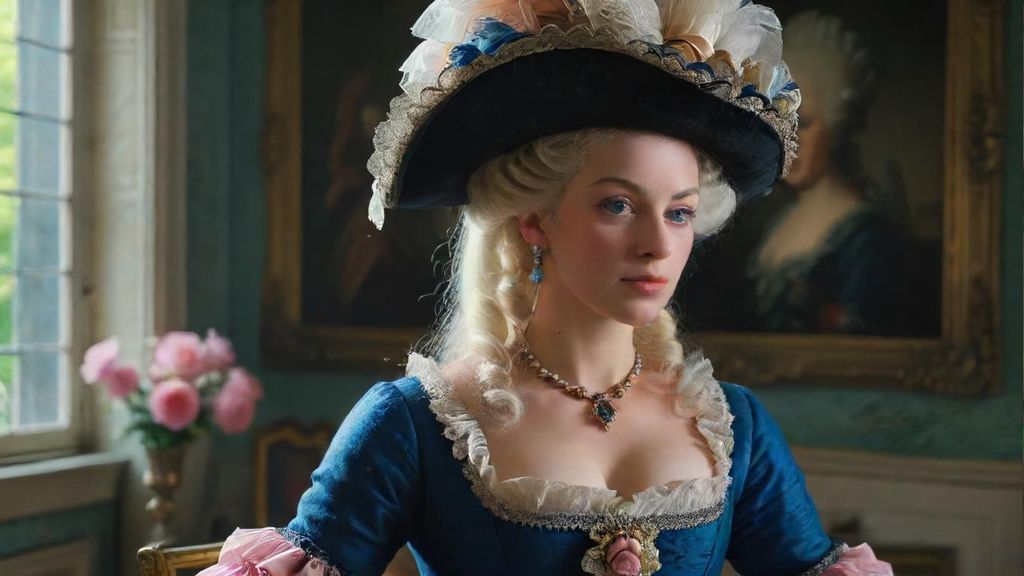
Many people today think Marie Antoinette became unpopular because of the famous “Let them eat cake” quote (which she probably didn’t say) or during the intense final days of the French Revolution. But actually, her public image was already a mess, filled with distrust and anger, long before the revolution even started. Her troubles began almost the moment she arrived in France, years before anyone even thought of a guillotine.
Picture a famous celebrity today, known for spending a lot, who’s always tied to a rival country and seems to ignore their fans’ problems. That’s a bit like Marie Antoinette when she first came to France. She arrived in 1770 as a fourteen-year-old Austrian princess, set to marry the future King Louis XVI. Their marriage wasn’t about love; it was a political deal to make peace between France and Austria, two countries that had often been enemies. But many French people saw her as an “Austrian” enemy, and they never truly trusted her.
Being from Austria was a constant problem for her. People often called her L’Autrichienne—meaning “the Austrian woman”—a name full of disrespect. This wasn’t just a teasing nickname; it was a constant reminder that she was an outsider, someone whose loyalty was always doubted. Think about it: France and Austria had been fighting for generations. Suddenly, the queen-to-be was from the very family they’d just been at war with. Building trust was incredibly hard from the very beginning.
What Fueled the Public’s Fury?
Several things made the public furious, starting with the incredibly fancy life at Versailles. The royal court lived in a dazzling world of extreme spending, completely cut off from the harsh poverty that most French people faced. When Marie Antoinette became Queen in 1774, she fit right into this extravagant lifestyle, maybe not fully realizing how it looked to others. She loved clothes, gambling, and building projects, like her private getaway, the Petit Trianon. These weren’t mean things to do, but in a country struggling with money, her carefree spending felt like a huge insult.
Historians say that her early inability to have children also worried the public. For the French royal family, the queen’s most important job was to give birth to a son who could become king. For the first seven years of her marriage, she had no children. This sparked widespread rumors and fears about whether the monarchy would remain stable. People saw this as her personal fault, which made her seem less legitimate and gave more reasons for those who already disliked her Austrian roots to feel even angrier.
But maybe the worst thing was the constant flow of nasty satirical pamphlets, called libelles, that filled Paris. These anonymous, often crude writings fiercely attacked her personality, her private life, and how she spent money. They showed her as a wasteful, immoral woman who controlled the king and threw away France’s riches. Think of social media today, where rumors and fake news can spread everywhere instantly; these pamphlets did the same thing, spreading false information and turning people against her.
For example, one pamphlet from the 1780s openly questioned her goodness and loyalty, twisting even her innocent actions into proof of corruption. These weren’t scholarly papers; they were shocking, dramatic stories meant to anger people. They made her a symbol of everything wrong with the royal family. History shows that people eagerly read these stories, solidifying an image of a queen who was completely out of touch with their everyday hardships.
So, long before anyone even thought about a revolution, Marie Antoinette was already a target of hate and suspicion. Her Austrian background, fancy lifestyle, early struggles to have children, and the endless stream of bad propaganda created deep anger. This intense dislike meant that when France’s political and money troubles got worse, she became an easy target. She was a person onto whom everyone could blame all of France’s problems. This set the stage for how easily future myths about her, like the famous cake quote, would spread and confirm what many people already believed.
Next, we’ll look at how these quiet rumors and printed attacks turned into specific accusations that would define her legacy, even long after she died.
Did the phrase ‘Let them eat cake’ predate Marie Antoinette?

Did Marie Antoinette really say the famous words, “Let them eat cake”? The short answer, which might surprise many, is a definite ‘no.’ This well-known quote, often seen as the perfect example of how out-of-touch royalty was, was actually being passed around in France long before she ever arrived at Versailles. This chapter will take us on a fun historical detective hunt. We’ll trace where this powerful idea actually started and why it ended up getting stuck to the Queen so firmly. The truth is more interesting than you might think, showing how stories can change over time and attach themselves to new people.
So, Where Did This Idea Actually Come From?
The first time we see an idea very similar to “Let them eat cake” was in a surprising place: the writings of the famous philosopher Jean-Jacques Rousseau. In his autobiography, Confessions, which he wrote between 1765 and 1767 and which was finally published in 1782, Rousseau tells a story.
He wrote about a “great princess” who, when told that peasants had no bread, replied:
« Je me rappelai le pis-aller d’une grande princesse à qui l’on disait que les paysans n’avaient pas de pain, et qui répondit: Qu’ils mangent de la brioche. »
In simple terms, this means: “I remembered the make-shift solution of a great princess who was told that the peasants had no bread, and who responded: Let them eat brioche.”
So, why is brioche a big deal? Well, it’s a rich, sweet bread, sort of a pastry. It’s not exactly cake like we think of it today, but it was certainly a fancy, expensive treat. It was much nicer and more costly than the basic, plain bread that was a daily necessity for most people. So, the main idea is exactly the same: an out-of-touch royal suggesting a luxurious alternative when people just needed something basic.
What makes this fascinating is the timeline. Rousseau wrote these words at least five years before Marie Antoinette even arrived in France as a teenage princess in 1770. It was almost a decade before she became Queen in 1774. She was just a child in Austria when this story was already being written down. This clearly shows that the quote, or at least its core idea, was already part of the common talk in France. It was a well-known story about royal insensitivity.
Why Did It Get Attributed to Marie Antoinette?
The evidence shows that the phrase wasn’t just given to Rousseau’s unnamed “great princess.” It appears to have been a popular, floating story, often linked to different French queens and princesses from earlier times, like the wives of King Louis XIV or Louis XV. Imagine it like a popular meme or an urban legend that gets passed down through generations, but with the specific person in the story changing depending on who’s currently unpopular or fits the narrative best.
So, if it was an older story, how did it become so strongly connected to Marie Antoinette? The reason comes down to the super tense political times right before and during the French Revolution. Marie Antoinette, a foreign-born queen known for her lavish spending and what people saw as indifference to the struggles of ordinary people, became the perfect person to blame.
The quote, with its powerful message of royal callousness, was a devastating piece of propaganda. There are simply no trustworthy records from that time – no letters, no diary entries from courtiers, no official documents – that suggest Marie Antoinette ever said these words. Historians who have searched through countless old documents have found no strong proof linking her to the phrase.
Instead, it seems the story really took off and was clearly stuck to her after the Revolution had begun. Revolutionaries used it to make the monarchy look bad and explain why they were doing what they were doing. It was a strong tool, making her seem heartless and ignorant.
This teaches us something important: history isn’t just about what happened, but also about how stories are told and retold. A story being passed around, packed with a strong message, eventually found its perfect villain in a queen who was already being watched closely by the public. This example clearly shows how a strong phrase, even one from an earlier time, can become permanently stuck to a historical person. It can shape how people remember them for hundreds of years. Next, we’ll look at how this myth grew and became fixed in people’s minds, lasting long after the French Revolution was over.
Why did the ‘Let them eat cake’ myth become so strongly associated with Marie Antoinette?

Did Marie Antoinette actually say, “Let them eat cake?” Almost certainly not. The reason this famous, callous phrase became so strongly linked to her wasn’t because she said it, but because of a powerful mix of revolutionary passion and public opinion. Even though the quote isn’t hers, it became a powerful symbol – like a viral meme before the internet. It perfectly captured the anger of starving people against a monarchy they saw as uncaring. It stuck to her because it painted a picture of exactly what the revolutionaries wanted people to believe: that she was the ultimate symbol of royal excess and detached privilege.
Why did this story hit so hard? Because it perfectly showed the huge gap between the suffering common people and the super-rich royal family. Think about today: if a billionaire influencer, during a tough economic time, casually suggested a totally out-of-touch solution to an everyday problem, the internet would explode. That’s basically what happened in the 1700s.
The saying itself wasn’t even new. Historians found it was linked to other French princesses long before Marie Antoinette. For example, in Jean-Jacques Rousseau’s 1765 book, Confessions, he wrote about a “great princess” who, when told peasants had no bread, said, “Then let them eat brioche.” Brioche is a rich, sweet bread, similar to cake, and this story was already going around.
How did this specific myth become so powerful for the revolutionaries?
So, how did this specific story become so strong for the revolutionaries? It picked up speed and was actively used as powerful propaganda during the French Revolution, which started in 1789. Marie Antoinette was already disliked for many reasons. She was from Austria, a foreigner, and seen as too extravagant. People even called her “Madame Deficit” because of her spending.
The idea that she was totally clueless about her people’s suffering fit perfectly with the story the revolutionaries wanted to tell. They needed a villain, a real person to blame for all the injustice and poverty. The “cake” quote, true or not, made her that villain.
The propaganda worked because it wasn’t about facts; it was about feelings. When people are starving, cold, and feel ignored by their leaders, a story like “Let them eat cake” hits them right in the gut. It cemented Marie Antoinette’s image as someone totally out of touch, someone who truly believed her people could just switch to expensive pastries when they couldn’t even get basic bread. This simple, memorable statement poured fuel on the public’s anger and helped build strong support for a complete overhaul.
Why does the ‘cake’ myth still matter today?
What’s really fascinating is how this myth has lasted for centuries. It became a quick way to describe something, a symbol used everywhere for leaders who are out of touch. Even today, we use it to talk about politicians or company bosses who don’t seem to care about everyday people’s struggles.
It’s a clear example of how a story, even if it’s not true, can become more powerful than facts when it perfectly connects with people’s deep frustrations and beliefs. The real story is more interesting than you might guess. It tells us less about what Marie Antoinette actually said and more about the revolutionary way of thinking, and how powerful a great story can be, even if it’s not true.
So, here’s the final answer: Marie Antoinette did not say “Let them eat cake.” Historical records suggest she was actually more aware of the poor people’s struggles than the myth lets on, and she even helped support charities. But by the time the revolution was really going strong, the story had grown a life of its own. It became a super important tool for those who wanted to tear down the old system.
This lasting myth is a powerful reminder that what people believe, especially when fed by strong stories, can shape history much more than real facts. But setting the myth aside, what was Marie Antoinette truly like? And what really led to her tragic end?