
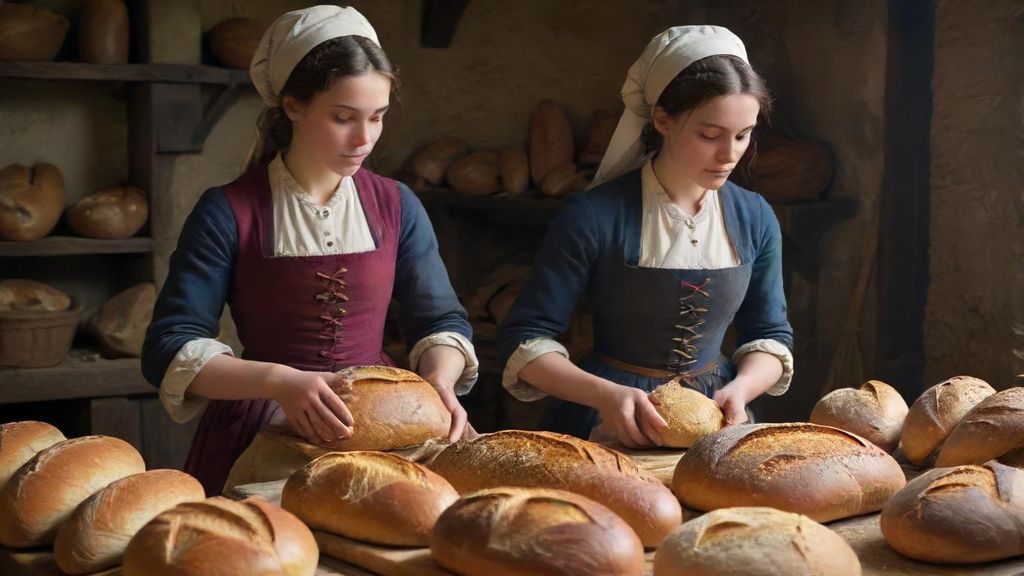
Imagine if your local grocery store suddenly had no milk, no eggs, no rice, and no potatoes – only a few expensive, rare items. That’s a good way to picture just how vital bread was to daily life in 18th-century France. For most people, bread wasn’t simply one food among many; it was the food. It provided nearly all their calories, energy, and, frankly, their survival. Without it, everything ground to a halt. The simple truth is: they needed it to live.
Imagine a time with no supermarkets, no packaged snacks, and hardly any food choices for ordinary folks. For most French citizens – the farmers, workers, and poor city dwellers – grains, especially wheat and rye, were the very foundation of their meals. It wasn’t unusual for an adult to eat one to two pounds of bread every single day. That’s a huge amount, accounting for 70-80% of their total daily calories. For countless families, their whole lives revolved around getting enough flour to bake that daily bread, often at home or using shared ovens in their village. This wasn’t a preference; it was simply how they survived.
How Did a Loaf Hold So Much Power?
This massive dependence on bread wasn’t just about what people preferred to eat; it was a tough economic truth deeply tied to France’s social order. Picture society in pre-revolutionary France as a stiff pyramid. At the very top sat the King, the rich nobles, and the powerful church leaders, enjoying incredibly luxurious lives. Below them came the smaller, but still influential, middle class – shopkeepers, lawyers, and other professionals. But the vast majority, known as the Third Estate, were common people, many barely surviving in poverty. For these folks, bread was often the only thing stopping them from having a tiny meal or simply starving.
Records from history show us, for example, that a working-class family in Paris might spend half their daily pay just on bread when things were good. If grain prices shot up, that amount could easily leap to 70%, 80%, or even higher. This left them with almost nothing for rent, clothes, or anything else they needed to live.
Here’s something even more interesting: this central role of bread also created a powerful, unwritten social agreement called the ‘moral economy‘. This wasn’t a rulebook written down by lawyers. Instead, it was a deep, shared expectation among ordinary people. They firmly believed that the government, and especially the King, had a duty to make sure grain was available and affordable. They expected bread to be sold at a fair price, even if it meant the government had to step in and control the markets.
Think of it like today: we expect vital services such as water or electricity to always be available and reasonably priced, no matter what the market does. Back then, bread was that kind of essential service. So, when the price of bread suddenly shot up, people didn’t just see it as bad luck. They viewed it as a betrayal of this basic moral deal, a terrible injustice from those in charge.
What we learn from countless records and official papers from the 1770s and 1780s is this: France was already like a tinderbox, quietly burning with deep-seated anger long before any major bread shortage even began. The wealthy lived with immense perks, paying almost no taxes. Meanwhile, the poor carried the heaviest burden, facing taxes, church tithes, and old-fashioned feudal payments to their local lords. The divide between the ‘haves’ and ‘have-nots’ was enormous.
Farmers were stuck with old obligations, and city workers faced wages that never seemed to grow. Bad harvests in earlier years and costly wars had already pushed the country’s money situation to its absolute limit. This led to more taxes and less sympathy for the struggling people. Every money choice the King made, every tax hike, simply piled more dry wood onto this already dangerous situation, making everyone even more frustrated.
So, when grain harvests predictably failed, sending bread prices sky-high, it wasn’t just a minor problem. It was the spark that set off generations of anger. The feeling that their very survival was under threat, combined with the belief that the powerful elite simply didn’t care – or even worse, were actively harming them – ignited a terrifying sense of betrayal.
Experts like historian Steven Kaplan, a top scholar studying bread in French history, explain that the link between bread and a stable government was so strong that even small changes in its price could send waves of unrest throughout the country. This helps us see that the bread shortage didn’t create all these complaints; instead, it brought them to the surface and made them much louder, turning widespread hunger into a powerful tool for political change.
To put it simply, bread was the crucial piece holding everything together: public order, a stable economy, and even the King’s right to rule. Keeping bread affordable wasn’t just about feeding people; it was about deeply held ideas of fairness and what people expected from their leaders. As we’ll explore next, when this vital support started to break down, the whole structure of French society began to collapse, clearing the path for a revolution.
What Caused Bread Prices to Skyrocket and Spark Unrest in Pre-Revolutionary France?

Imagine if, suddenly, your daily groceries cost so much that you couldn’t feed your family, no matter how hard you worked. It’s like a crucial item, say, milk or rice, becoming a luxury overnight because farms stopped producing enough, and the government seemed unable to fix it. That’s pretty close to what happened in France just before the Revolution. The simple answer to what caused bread prices to skyrocket and make people so angry is a terrible mix of awful weather, failed crops, and a royal government that simply couldn’t manage to feed its own people. This wasn’t just bad luck; it was a perfect storm for disaster.
Here’s what happened: France had seen its share of bad harvests over the centuries, but the late 1780s hit the country with two devastating blows unlike anything before. First, the summers of 1787 and 1788 were disastrous. Unpredictable weather, including severe hailstorms and unseasonal droughts, ravaged grain fields across the country. These weren’t just poor harvests; these were wipeouts. Historical records tell us that entire regions saw their wheat, barley, and rye crops completely destroyed. This meant a huge part of the country’s main food simply didn’t exist.
But the real crushing blow came with the winter of 1788-1789. It was one of the coldest and longest winters anyone could remember. Rivers, which were super important for transporting grain from areas that might have had a decent harvest to cities in desperate need, froze solid. Roads became impossible to use. This wasn’t just a minor hassle; it completely broke France’s already weak system for getting food around. Think of it like a modern trucking strike during peak holiday season, but without any alternative routes or ways to get essential goods moving. Crops that had survived the bad harvests were now impossible to move, and many stored supplies spoiled in the intense cold. It’s fascinating how quickly these natural events turned into terrible human suffering.
How Did the Government Make Things Worse?
With food running out, you’d expect a strong government to step in, right? The truth is more interesting than you might think. The royal government under King Louis XVI generally tried to let the grain market regulate itself, hoping competition would keep prices fair. However, when food was extremely scarce, this approach went horribly wrong. There were no good systems to import enough grain from abroad or to efficiently share out the little that was available.
Instead, a sneaky, awful practice known as grain speculation became a huge problem. Imagine powerful individuals or groups buying up what little grain was available, then hiding it in warehouses. They’d wait for prices to shoot up due to desperation, and only then would they release their supplies onto the market, making enormous profits. This was like a few tech giants cornering the market on vital computer chips, then charging crazy high prices when demand is highest. Ordinary people saw this happening and felt completely betrayed, fueling intense anger against the rich and powerful.
The impact on everyday French citizens was immediate and harsh. Bread wasn’t just food; it was life itself. The average laborer normally spent over 50% of their income on bread in good times. But during this crisis, that figure soared to 70%, 80%, or even 90%. Picture nearly your entire paycheck going to just one essential item, leaving nothing for rent, clothes, or other food.
Historian George Rudé, who studied popular movements closely, famously said that the cry for “Bread!” was often “indistinguishable from the cry for ‘Justice!'”
This economic hardship directly sparked political anger. Faced with starvation, people didn’t just quietly suffer. They rioted. These weren’t organized political protests at first, but sudden bursts of rage: attacks on bakeries, taking grain from carts, and fighting with local officials. These early clashes, often called the “Flour Wars” by some, were clear signals that the old system was failing. An empty stomach, it turns out, is a powerful reason for revolution, transforming money troubles into a burning political demand for change.
The terrible bread shortage, caused by a perfect storm of environmental disasters and government blunders, pushed ordinary people past their breaking point. Their hunger wasn’t just a personal tragedy; it became a shared anger that demanded a big, new solution. The stage was now set for the first major confrontation with the king, a story we’ll explore next.
You might read in history books about big ideas like the Enlightenment or unfair taxes causing the French Revolution. But here’s the real kicker: the direct spark wasn’t some deep philosophy or political debate. It was far simpler and harsher: the price of a loaf of bread. Imagine if the cost of your daily groceries suddenly skyrocketed to the point where feeding your family meant sacrificing everything else. That was the daily nightmare for ordinary French citizens, and it fueled a rage that would bring down a monarchy.
So, did a lack of bread really send French women marching on Versailles? Absolutely, yes. The immediate trigger for many of the Revolution’s most iconic moments was the very real problem of empty stomachs and outrageously high bread prices. For decades, bread wasn’t just food; it was life itself. The average working-class person spent up to 80% of their income on bread during the crisis years of the late 1780s. When poor harvests hit in 1788, the cost of flour soared, pushing bread prices to unbearable levels. Think about today’s gas prices or housing costs – now imagine that kind of pressure applied to the single most important item on your dinner table, the one thing keeping you and your kids alive. It was a pressure cooker waiting to explode.
How Did a Loaf Become a Symbol of Revolution?

This desperate hunger turned ordinary daily struggles into a fiery desire for revolution. Even the famous Storming of the Bastille on July 14, 1789, wasn’t just about freeing political prisoners or finding gunpowder. People were also desperately searching for grain. Paris was starving, and many believed the King’s officials were hiding food. Taking the Bastille, a symbol of royal tyranny, also represented a challenge to the King’s control over the food supply. It was a powerful act of rebellion against a system that seemed not to care about its people’s suffering.
But the clearest example of bread’s power to move people came just a few months later. On October 5, 1789, thousands of women from Paris, mostly market women and working-class mothers, marched a tough 12 miles to the opulent royal palace at Versailles. Why women, you ask? Because they were the ones who faced the bread crisis directly every day, waiting in lines, trying to feed their children. Historical records tell us that their cries weren’t for abstract political rights, but a simple, urgent demand: “Du pain! Du pain!” – “Bread! Bread!“
This wasn’t just a sudden burst of anger; it was an organized protest born from pure desperation. As historian George Rudé noted in his work,
“The women of Paris were the traditional arbiters of the markets, and as such they bore the brunt of every shortage and high price.”They were fed up with seeing their children go hungry while the royal family lived in unimaginable luxury. The famous quote (though probably untrue) often said by Queen Marie Antoinette, “Let them eat cake,” perfectly showed how out of touch the royals seemed, even if she never actually said it. It clearly showed the huge gap between the starving people and the monarchy that seemed to ignore their pain.
What makes this story truly gripping is how this hunger strike grew. The women, eventually joined by thousands more, including parts of the National Guard, broke into the palace. They demanded that King Louis XVI and Queen Marie Antoinette come back with them to Paris. Their goal was to make sure the King would personally guarantee the city’s food supply. And he did. Under immense pressure, the royal family was forced to leave Versailles and relocate to the Tuileries Palace in Paris. This moment cemented the Revolution’s start, making the demand for ‘bread’ mean the same thing as the demand for political change and an end to royal indifference.
The King and Queen’s move to Paris, essentially as prisoners of their own people, was a huge turning point. It wasn’t just a political win; it was a deeply symbolic one, achieved purely through the power of hunger and the never-ending cries for food. The Revolution, which had deep philosophical roots, found its first, undeniable push from the raw, urgent need for a daily loaf of bread. But what would happen now that the King was living under the watchful eye of his Parisian subjects?