
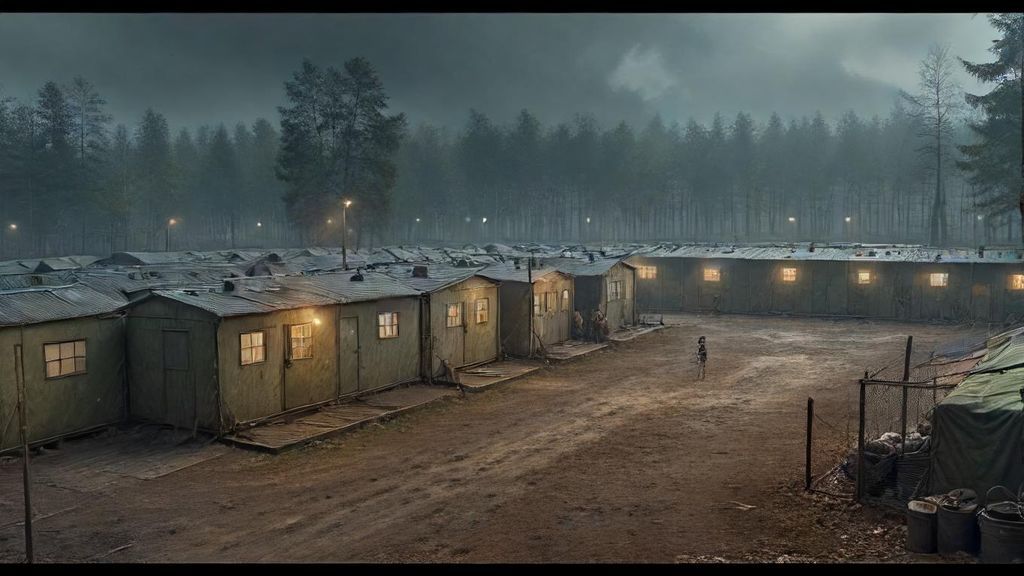
You might think all Prisoner of War camps were pretty much the same. But Stalag Luft III, hidden away in a pine forest near Sagan, Germany, was special. The Germans, especially their air force (the Luftwaffe), proudly called it ‘escape-proof.’ They spent a lot of time and money building a place they thought no Allied airman, no matter how clever, could ever break out of. These airmen were famous for trying to escape! What’s amazing is that the prisoners didn’t see these strong defenses as impossible barriers. Instead, they saw them as a giant challenge, a puzzle just waiting to be solved. This chapter will show you just how sure the Germans were that their prison was unbreakable, and how the POWs immediately started looking for ways to beat their clever plans.
The Germans were so confident about Stalag Luft III, which opened in 1942, mainly because of its smart location and how it was built. Unlike many other camps, it wasn’t on solid earth. Instead, it sat on sandy, gravelly soil – a really clever security trick. This meant any tunnel dug there would be super shaky and likely to cave in. Imagine trying to dig a hole in a giant sandpit; the walls would just fall apart. To make things even harder, this loose, bright yellow sand was easy to spot if prisoners tried to hide it on the dark surface soil. It was like trying to hide a bright yellow Lego brick in a pile of dark brown dirt; it would stick out like a sore thumb.
Besides the tricky soil, the Germans used many other security tricks. The fences around the camp were strong, but the biggest dangers were often out of sight. Guards walked on elevated platforms, always keeping a sharp eye out. There were also ‘snoopers’ – German guards who were specially trained to pretend to be prisoners and listen for any secret talks. Imagine having a spy right there with you, always watching. Underground, the Germans buried sensitive microphones. These were like basic earthquake detectors, designed to pick up even the quietest sounds of digging. Records show that the Germans thought these gadgets couldn’t be beaten. On top of that, a ‘warning wire’ ran around the camp, about 10 feet inside the main fence. If you crossed it without permission, you’d get an immediate warning shot, and then, if you kept going, they’d shoot to kill.
How Did the POWs Plan to Beat an ‘Escape-Proof’ Camp?
Here’s the interesting part: while the Germans built a really clever prison, they completely misjudged how smart and determined their prisoners were. Many of these airmen had already tried breaking out of easier camps. When they got to Stalag Luft III, they quickly saw this was a whole new challenge. But instead of giving up, a strong, organized will to escape spread through the camp. Historians and those who survived say this unique situation brought everyone together with a shared goal of fighting back.
At the center of this defiance was a brilliant leader named Roger Bushell, a British Squadron Leader. Everyone knew him as ‘Big X.’ Bushell, who was a lawyer before the war and had already escaped from other camps, had an incredible, almost obsessive drive. He realized that to beat Stalag Luft III, they couldn’t just start digging anywhere. They needed a highly organized, almost military-style plan. So, he created the ‘X-Committee,’ a secret group focused entirely on planning and carrying out large-scale escapes. This wasn’t just a couple of guys with shovels; it was a completely new way of thinking, like running a secret company right inside the prison.
With Bushell leading the way, the X-Committee set up a very detailed organization. They had departments for everything you could imagine: ‘security’ to keep an eye on the guards, ‘surveying’ to draw maps of the camp and planned tunnel paths, ‘disposal’ for getting rid of thousands of cubic feet of sand, ‘forgers’ to make fake papers, and ‘tailors’ to turn uniforms into civilian clothes. Nobody had ever seen this level of teamwork in a POW camp before. Bushell famously announced that they wouldn’t just dig one tunnel; they would dig three at the same time – named Tom, Dick, and Harry. This was a brilliant plan: if the Germans found one tunnel, the others could keep going, taking German attention away. It was a huge risk, much like a tech company creating three different products at once, knowing only one might make it big but giving themselves the best chance.
This careful early planning, built on really understanding German security and trusting their own skills as a group, created the perfect starting point for the huge triple-tunnel project. It was clear the prisoners didn’t see the ‘escape-proof’ label as a warning to stop, but as an exciting challenge they couldn’t resist. What’s truly amazing is how such a complex plan even started to come together while their captors watched every move. Next, we’ll dive into how they began the enormous job of actually digging, inch by slow inch, right under the noses of their unsuspecting guards.
How did Allied POWs secretly dig tunnels and forge documents under Nazi surveillance?

Imagine trying to build a secret underground city – with tools, lights, and fresh air – all while your landlords are constantly looking for anything out of place. That’s pretty much what Allied POWs did during the Great Escape. How did they pull it off? It came down to amazing teamwork, clever ways to reuse everything they could find, and a whole lot of courage. What makes this story so fascinating is just how massive the project was, like a huge, hidden factory working right under the Germans’ noses.
This wasn’t a sudden, unplanned escape. It was a massive, highly organized project. We know this from the detailed stories the POWs themselves carefully wrote down after the war. These accounts show that their planning was as detailed as any big business operation.
The whole escape plan centered on three big, daring tunnels: “Tom,” “Dick,” and “Harry.” Tom and Dick were started first. Their job was to distract the guards while Harry, the actual escape route, was painstakingly dug. Each tunnel entrance was hidden with amazing cleverness. For example, Harry’s entrance was right under a stove in Hut 104. Imagine this: a heavy concrete slab, usually hidden by the stove, could be lifted and replaced without anyone ever noticing. It was like a secret door from a spy movie, but real, and built with only simple tools.
How did they hide mountains of dirt?
Digging three tunnels meant moving a huge amount of dirt – about 100 tons of sand, to be exact! This was probably the hardest part. The solution was a clever system called “stooging.” Imagine a human conveyor belt, but instead of packages, they moved sand. Tunnelers filled small cloth bags, made from old socks or trousers, with sand. These bags were then passed to “penguins” – POWs who would walk around the camp, quietly letting out a little sand at a time into flowerbeds, under buildings, or making it look like regular garden soil. They even carried sand in trousers that had been altered with secret pockets, releasing it with a string when no German guard, or “ferret” as they called them, was looking. Historian Paul Brickhill, in his book The Great Escape, described this dirt disposal as a never-ending, scary game, with ferrets always searching for any sign that the ground had been disturbed.
They had to reuse every single item in the tunnels in a new way. Bedboards became supports to stop the tunnels from caving in. Tin cans were flattened and shaped into digging tools or air pipes. The camp’s limited electrical wires were “borrowed” to create a simple lighting system. For fresh air, they built a really clever hand-pumped air system from old kit bags and bed slats. This pushed fresh air down the narrow tunnels. It was like building a tiny, working subway system using only junk, and it clearly showed how incredibly clever they were.
How did they make fake IDs look real?
But digging was only half the battle. Once they got out, the escapees needed to blend in. This is where the forgery department, often called the “passport factory,” stepped up. It was a secret workshop that turned scraps into believable civilian clothes, maps, and identity papers. The men working there were like artists and detectives combined. They studied real German documents, carefully copied official stamps using carved linoleum or even boot heels, and aged paper with coffee or dirt to make it look old and used. Squadron Leader Roger Bushell, the main planner of the escape, knew that without believable papers and clothes, even getting out of the tunnel wouldn’t matter. The truth is stranger than fiction: they checked and copied every single detail, from the type of thread on a uniform button to the exact shade of ink on a transit pass.
The constant threat of German “ferrets” and surprise inspections was a danger every single minute of the operation. These guards were specifically trained to find anything unusual. They would poke the ground with sticks, check floorboards, and watch the POWs’ every move. Yet, the network of lookouts, diversion teams, and pure courage kept the secret safe for months. Recent information shows that the Germans suspected something was happening, but they could never figure out exactly what or where.
The real answer to how they managed all of this lies in their never-give-up spirit and incredible teamwork. Each POW had a role, from digging tunnels to hiding dirt, from forging documents to standing guard. Together, they built a secret community all focused on one goal. This brings us to the terrifying night when all that hard work finally paid off, and the first men crawled out into the freezing March air.
What were the consequences of the Great Escape, and what is its legacy today?

The Great Escape was more than just a daring plan; it was an incredible test of human limits that ended in tragedy, sending shockwaves across the Allied world. So, what truly happened once the men squeezed out of ‘Harry’ and into the cold German night on March 24, 1944, and how do we remember it today?
Imagine crawling out of a cramped, dark tunnel after months of digging, only to find the world outside completely different from what you’d planned. That’s exactly what faced the 76 men who made it out of Stalag Luft III. Their main goal was simple: disappear into the busy German population or make it to neutral countries. But almost immediately, things went wrong. The exit from ‘Harry’ wasn’t hidden in the nearby woods as planned; instead, it was frustratingly close to a guard tower, making every shadow a potential risk.
What followed is more interesting than you might think. Most escapees headed for train stations, trying to blend in with travelers using fake papers and uniforms they’d altered. Some even wore civilian clothes made from smuggled bits and pieces. It was like trying to navigate a foreign country today without a smartphone, relying only on a shaky map and hope. A few did manage to get far, like Per Bergsland and Jens Müller, two Norwegian pilots who remarkably made it all the way to Sweden, becoming among the very few to reach freedom.
But for the vast majority, freedom didn’t last long. The alarm went off quickly, kicking off one of the biggest manhunts in German history. Thousands of Gestapo, SS, and local police spread out across the country. They checked every train, every bus, and stopped anyone who looked even slightly suspicious. Within days, 73 of the 76 escapees were recaptured. Many were found simply because they couldn’t speak German well enough or their fake papers didn’t hold up under close inspection.
The aftermath was horrifying. Hitler, furious and humiliated by the escape, ordered the immediate execution of more than half of the recaptured officers. This wasn’t just blind anger; it was a cold-blooded crime against the Geneva Convention, which protects prisoners of war. Simply put, killing unarmed POWs is a war crime, plain and simple. Fifty Allied officers—British, Canadian, Australian, New Zealander, South African, and others—were singled out and murdered by the Gestapo in small groups. They were shot, often on remote roads, and their bodies cremated, with false stories concocted about their deaths.
How did the world react to this war crime?
News of the killings slowly reached the world, first through neutral countries like Switzerland. When the full horror of Hitler’s atrocity became clear, the Allied nations were outraged. The British government, led by Prime Minister Winston Churchill, immediately launched an investigation, promising to bring those responsible to justice. This wasn’t just about getting even; it was about sticking up for international law and making sure such cruel acts didn’t go unpunished. Like a major corporate scandal today, it demanded accountability.
The Great Escape had a lasting impact. For one, it meant stricter security at POW camps. But oddly, it also made the Allies even more aware of just how far the German command would go. After the war, a dedicated British Special Investigation Unit hunted down and brought to justice many of the Gestapo officers involved in the murders. Several were found guilty and executed for their roles in what became known as the Great Escape Murders. It showed the world that war crimes would not be forgotten.
What’s really interesting is how the Great Escape’s legacy has evolved. It’s far more than just a historical footnote. It became a powerful symbol of Allied defiance and courage, even against impossible odds and terrible consequences. Think about how a tragic event today can inspire films or books that explore themes of resilience and injustice; the Great Escape did exactly that. The 1963 film, starring Steve McQueen, cemented its place in popular culture, often romanticizing the escape itself while clearly showing the incredible bravery and sacrifice of those involved.
Today, the Great Escape reminds us of the human cost of war and the importance of international humanitarian law. It’s a powerful reminder of the sacrifices made and the terrible things that happened, making sure we never forget the 50 officers who were murdered. It’s a story not just about escape, but about justice, legacy, and the enduring human spirit, paving the way for our next look into what happened after the war.