
Imagine a substance so amazing, so seemingly miraculous, that people believed it could cure everything from joint pain to wrinkles. That’s how many saw radium in the early 20th century. It wasn’t just a scientific wonder; it became a trendy health craze. Tragically, this widespread fascination is exactly how radium factory workers unknowingly faced deadly dangers.
The truth behind this glowing element, discovered by Marie Curie, is more chilling than you might think. Radium was truly revolutionary, and its eerie, persistent glow captured everyone’s attention. This led to its use in countless products, from toothpaste to cosmetics. People genuinely thought they were dealing with a wonder substance, not a silent killer. This misplaced trust is the simple answer to why hundreds of young women were unknowingly put in harm’s way.
What Made Radium Seem So Safe?
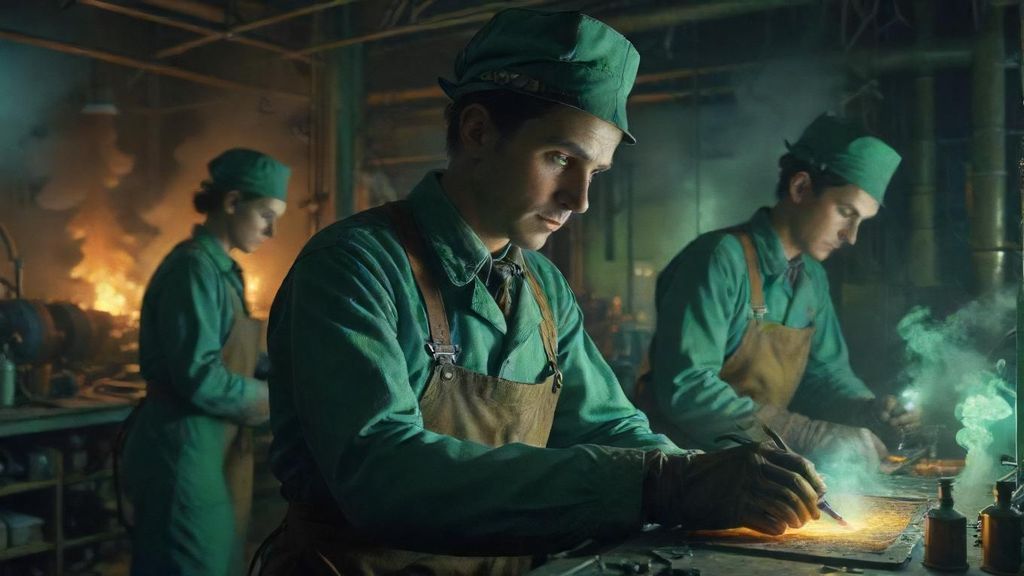
Radium earned its amazing reputation because it glowed in the dark all by itself, without needing light or electricity. Imagine this: just a tiny bit could make watch faces, clock dials, and even airplane gauges easy to read in total darkness. It was a game-changer for seeing things at night, especially during World War I when soldiers in the trenches needed to check their watches. This glowing paint was called ‘Undark,’ and factories quickly popped up across the U.S. to make it, particularly the United States Radium Corporation in Orange, New Jersey, and Radium Dial Company in Ottawa, Illinois.
Here’s what happened: These factories mostly hired young women, often teenagers, to apply the glowing paint. People saw it as good, clean work—precise, delicate, and often better paying than other factory jobs. These women, known today as the Radium Girls, sat at long tables, brushes in hand, painting tiny numbers onto dials. They weren’t working in dirty or dangerous conditions like many male factory workers. Instead, it was considered respectable, even glamorous, work because they were handling such a modern, exciting material.
Their main exposure to radium came from a specific technique their bosses insisted on. To get a super fine point on their paintbrushes, supervisors told the girls to ‘lip-point’ them. Simply put, they would lick the brush to reshape it between each number they painted. With every lick, they swallowed a tiny, invisible amount of radium. This was a common practice, and no one—not even the scientists working with radium—seemed to grasp how dangerous it was to get the element inside your body.
Think about how we sometimes use new technologies today without fully understanding their long-term effects. In the early 1900s, scientists were just beginning to understand radioactivity. While they knew radium gave off radiation, the immediate dangers of touching it seemed clearer than the hidden threat of swallowing it. No one had done long-term studies on what happened when radium got inside the human body. The common belief, boosted by its supposed health benefits, was that it just passed right through, or even “purified” your system.
Historical records show that the girls would even paint their nails, teeth, and eyelids with the glowing substance just for fun. They’d innocently show off their ‘Undark’ glow to friends and family in the dark. They were literally glowing with the very element that was slowly destroying them from the inside. According to historians, this casual handling really highlights how little anyone—workers and employers alike—knew about radium’s hidden dangers when it entered the body.
The slow, hidden way radium poisoning worked is what makes this story so fascinating yet heartbreaking. Unlike a sudden accident, the symptoms didn’t show up overnight. It was a slow, agonizing process. The first signs were often subtle: constant toothaches, jaw pain, or feeling extremely tired. Imagine the terror as these young women, who had once celebrated radium’s glow, began to experience strange, unexplained illnesses. Their bones, especially their jaws, started to literally crumble away—a condition later called ‘radium jaw.’ This was no quick, merciful end, but a drawn-out deterioration of their bodies.
This growing health crisis, born from a mix of ignorance and wild excitement for a new technology, set the stage for profound personal tragedies. The initial belief that radium was safe and the factory jobs harmless would soon give way to unimaginable suffering. Next, we’ll explore how these horrifying symptoms evolved into a baffling medical mystery that stumped doctors and instilled fear throughout their communities.
Imagine your friends, all working the same job, suddenly getting terrifying, mysterious illnesses. That’s exactly what happened to the Radium Girls. In the 1920s, young women painting watch dials with glow-in-the-dark radium paint started suffering horribly. Slowly, they realized their glowing work was killing them. Despite their declining health and powerful opponents, these brave women fought for justice by refusing to stay silent, banding together to expose the truth, and taking their powerful employers to court.
Here’s what happened: Women like Grace Fryer from Orange, New Jersey, and Katherine Schaub began to suffer terribly. Their teeth fell out, jaws rotted, bones crumbled, and they developed severe anemia. The glow they once loved, which often lit up their clothes and hair, became a chilling sign of their pain. At first, company doctors and employers like the U.S. Radium Corporation and Radium Dial Company quickly brushed aside their complaints. They often blamed other illnesses, even spreading lies about syphilis to ruin the women’s names and avoid taking responsibility. This was a clear tactic: deny everything, shift the blame, and discredit the victims.
How Did They Prove Radium Was the Culprit?

The real story is more captivating and far sadder than you might imagine. For a long time, not everyone saw the clear link between the radium paint and the women’s symptoms, especially those who benefited financially from the denial. But for the women and their families, the pattern was impossible to ignore. Friend after friend, sister after sister, fell victim to the same horrifying illnesses.
According to historians, a crucial turning point came when a few brave women decided to look for answers outside of the company’s doctors. They found allies, like Dr. Harrison Martland, a medical examiner in Newark. He performed autopsies on several deceased dial painters. What he found was truly shocking: the women’s bones were full of radium, still giving off radiation years after they had died. He even detected radium in their breath!
This powerful proof was convincing. However, turning it into a lawsuit against powerful corporations felt like trying to move mountains. Many lawyers were nervous to take on such a complicated case, especially one that seemed impossible to win against companies with deep pockets and strong connections. The idea of “radioactive poisoning” was new and frightening to everyone.
It’s like today when a new technology appears, and no one fully understands its long-term health effects. Proving who is responsible can be incredibly difficult. Because of this, the women, whose health was getting worse by the day, struggled for a long time to find a lawyer willing to represent them.
What made this story so amazing, and ultimately so important, was the sheer courage of women like Grace Fryer. Even though doctors told her she only had a few months to live, she became the face of the struggle, filing a lawsuit in 1927. Her determination, along with Edna Hussman, Albina Larice, Quinta McDonald, and Katherine Schaub—who became known as the ‘New Jersey Five’—was truly inspiring.
They faced huge challenges. The companies’ legal teams used every trick in the book, including delaying tactics designed to drag out the cases until the women were too sick to speak in court. A major problem was the “statute of limitations,” a legal rule that sets a time limit for filing a lawsuit after an injury. The companies argued that the women had waited too long, even though the women only discovered the real cause of their illness years later.
Simply put, their fight became a public spectacle. It forced people to see the dark side of industrial progress. Their failing bodies were living proof of the danger. The amazing bravery of these women, some of whom had to be carried into court, speaking out through terrible pain, slowly started to break down the companies’ denials. They publicly challenged their employers, not just for money, but to get justice and recognition for the awful wrong done to them.
Their important court cases, even though they were slow and frustrating at first, set the vital stage for change. They forced the entire country to talk about how companies should be responsible for keeping their workers safe.
The first legal battles of the Radium Girls weren’t just about winning money. They were about revealing a hidden danger and demanding that someone be held responsible. This early, difficult fight for recognition clearly showed the reality of workplace illnesses. It would soon completely change how people thought about protecting workers.
Next, we’ll explore how their fight grew bigger and ultimately led to major new laws and ethical changes that transformed American workplaces forever.
How did the Radium Girls’ legacy forever change U.S. labor laws?

Imagine if, today, a major company knowingly exposed its employees to a dangerous chemical, claiming it was harmless, only for those workers to develop horrific, debilitating illnesses years later. That scenario, shockingly similar to what the Radium Girls endured, sounds like a nightmare from a bygone era, right? The truth is, it wasn’t so long ago that corporations often escaped accountability for such betrayals. But thanks to the Radium Girls, that kind of blatant disregard for human life began to change, profoundly and permanently. Their fight wasn’t just for themselves; it fundamentally reshaped how America protects its workers, forever altering our understanding of corporate responsibility.
The main reason their story is so pivotal lies in how it dragged a dark secret into the light: the existence of “occupational diseases.” Before these women spoke up, if you got sick from your job, companies often argued it was your fault, or just bad luck, not something they were responsible for. It was like blaming a factory worker for their failing lungs while they breathed in asbestos daily, saying it was just a regular cold. The Radium Girls, with their glowing jaws and disintegrating bones, provided undeniable, horrifying proof that their work was killing them. The radium was literally a part of their bodies, making the connection impossible to deny. This tragic evidence forced a complete change in thinking, pushing society to acknowledge that jobs themselves could be dangerous, not just “accidents” on the factory floor.
Here’s what we discovered through their brave stand: it set a new standard for employer liability. Think about the landmark 1927 lawsuit in New Jersey, where five of the Radium Girls—including Grace Fryer and Katherine Schaub—sued their employer, the United States Radium Corporation. This wasn’t a simple case; it was a battle against a giant corporation trying to bury the truth. According to historians, the publicity around this case made it impossible for the public to ignore the devastating effects of industrial negligence. The eventual settlement, though initially modest, was a massive victory. It didn’t just give the women some compensation; it declared, for the first time in a major way, that a company could be held directly responsible for chronic illnesses caused by its work environment.
What Was the Big Deal About Occupational Disease?
Before the Radium Girls, workers’ compensation laws were pretty limited. They typically covered “accidents”—a lost limb, a fall, something sudden and obvious. But what about a slow, creeping poison that took years to manifest? That was a blind spot, a huge loophole for companies. The Radium Girls’ lawsuits pushed states, one by one, to expand these laws. Their legal battles showed how unfair it was that workers who were slowly poisoned on the job had no recourse. It turns out that their courage directly led to states amending their workers’ compensation statutes to include occupational diseases, a protective net that simply didn’t exist for long-term health issues before them. This was a critical shift, moving from just protecting against immediate injury to acknowledging the insidious threats to health.
The impact didn’t stop there. While organizations like the Occupational Safety and Health Administration (OSHA) wouldn’t be established until 1970, decades after the Radium Girls’ primary battles, their cases laid vital groundwork. Imagine a society without safety regulations, where companies police themselves. That’s essentially what it was like. The Radium Girls’ suffering, and the subsequent public outcry, cemented the idea that strong industrial safety regulations and federal oversight were not just desirable, but absolutely necessary. Their legacy helped create a cultural and legal environment where the need for a protective agency like OSHA became undeniable. It’s like building the foundation for a skyscraper, even if the actual building comes much later.
Ultimately, the Radium Girls’ legacy orchestrated a complete change in thinking regarding corporate responsibility for employee health and safety. The notion that an employer had a fundamental duty to protect its workers, not just pay them, gained undeniable traction. It moved from a “worker beware” mentality to one where companies were expected to proactively ensure a safe environment. Their story, and the legal precedents it established, helped forge stronger laws to prevent such a betrayal of trust from ever happening again, protecting countless future workers who would never know their names.
This seismic shift, born from unimaginable suffering, forced industries to confront their moral obligations and laid the groundwork for modern worker protections. Yet, as we’ll see next, the fight for true safety and justice continued to evolve, revealing new challenges even as old ones were addressed.