
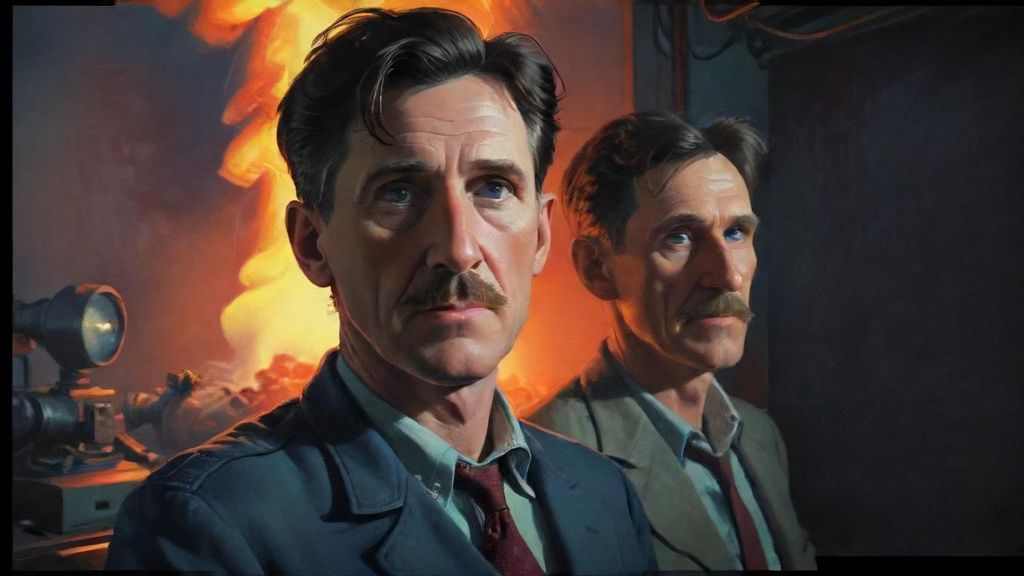
Imagine your phone isn’t just for talking, but a two-way mirror, always watching and listening, reporting your every sigh or frown. That creepy idea gets us close to what George Orwell warned about in his famous book, 1984. Simply put, he painted a grim picture where a person’s freedom was completely crushed by a government that saw everything. This power controlled not just what people did, but what they thought—the ultimate goal of a totalitarian system that aims for total control over every part of life.
Eric Blair, better known as George Orwell, wrote 1984 right after World War II. What he saw deeply scared him. He had fought in the Spanish Civil War and witnessed firsthand how brutally effective controlling governments could be. He was especially worried by Soviet communism under Joseph Stalin—its secret police, widespread propaganda, and constant rewriting of history. Memories of fascism, like in Nazi Germany, also showed how states could run every aspect of people’s lives. For Orwell, these were clear examples of how humanity might lose its very core, its ability to think freely, in the future.
How Did Orwell Imagine Control Would Work?
Orwell’s novel doesn’t just describe a miserable place; it carefully explains a system designed for absolute power. At the very top was Big Brother, the mysterious leader who was everywhere at once. His face was plastered on every wall, always watching. This wasn’t just a catchy phrase; it was a terrifying reality:
BIG BROTHER IS WATCHING YOU.
Below him, the Inner Party, a tiny group of powerful people, truly held the reins, enjoying luxuries most people could only dream of. Then came the Outer Party members, like Winston Smith, who were watched all the time. Finally, the proles, the vast working class, were mostly left alone but kept busy with cheap entertainment, much like how some people argue modern media distracts us from bigger problems today.
The methods of control were incredibly clever and frightening. The telescreen, found in every home and public space, worked like a television but also sent back everything you did or said. Imagine a smart speaker in every room, constantly checking your behavior, ordered by the government, with no way to escape. Orwell also introduced Newspeak, a simplified language meant to make thoughts smaller. If words for “freedom” don’t exist, how can someone even imagine being free? It turns out that controlling language is a strong way to control what people think.
The Party crushed personal identity, hunting down “thoughtcrime“—simply thinking disloyal thoughts. They did this through constant mental attacks and public hate events like the Two Minutes Hate, where citizens yelled their anger at the government’s enemies.
Here’s what we learned about Orwell’s foresight: he wasn’t just making things up. He was taking real events and imagining where they could lead. Historians say the Soviet Union used a lot of spying and propaganda to control what people believed. Their secret police, the NKVD, were famous for being brutal and watching everyone. Orwell saw how governments would purposefully twist the truth, creating their own versions of reality to stay in power—a tactic now sometimes called “gaslighting” on a huge scale. The truth is more interesting than you might think: Orwell wasn’t predicting exact gadgets, but rather the human potential for unfair power and the scary systems that allow it.
Simply put, Orwell warned of a future where your own thoughts and feelings were no longer private. Privacy was gone, and history became a flexible tool for those in power to change. This constant mental attack, combined with being watched everywhere, made it almost impossible to truly disagree. His warning still feels important today, decades later. He built a world that felt suffocating and completely without hope, designed to make you doubt what’s real.
This closer look at 1984‘s harsh world helps us understand how surprisingly accurate some of Orwell’s ideas would turn out to be. Next, we’ll explore the specific ways the real world began to look like his grim vision, examining the striking similarities between his made-up story and actual developments in spying, propaganda, and control that came after.
How Did Orwell’s Vision of Mass Surveillance Become a Modern Reality?

Imagine a world where every screen in your home watches and listens, sending your every move and word to a powerful authority. This chilling idea, central to George Orwell’s 1984, isn’t just a grim fantasy anymore. The simple answer is that Orwell didn’t just invent surveillance; he described its basic tools and methods so clearly that, in unsettling ways, they’ve become a foundational part of our modern world. His vision of constant oversight – from ‘telescreens’ to the very idea of controlling thoughts – now mirrors our reality through countless cameras, government digital tracking, and the massive data collected from our online lives.
The physical “eyes” of Big Brother are now everywhere you look. Just think about the countless CCTV cameras that cover our cities, streets, and even private businesses. Like the constant ‘telescreens’ in Oceania, these cameras record where we go and sometimes even who we’re with. While often explained as necessary for public safety, the sheer amount of visual data means that in many urban areas, it’s increasingly hard to go through your day without being recorded multiple times. It’s like having a silent, ever-present guard watching over you.
How Did We Find Out About This?
But beyond the cameras we can see, the hidden digital ‘ears’ and ‘brains’ of surveillance are even more widespread. The truth here is more fascinating than you might imagine. We know this thanks to brave whistleblowers who revealed secret government programs. For instance, in 2013, former National Security Agency (NSA) contractor Edward Snowden exposed astonishing details about how governments were collecting huge amounts of digital information. This wasn’t just about watching suspected criminals; it involved gathering phone records, emails, and internet activity from millions of ordinary people around the globe. It was like a digital fishing net, very similar to the Thought Police in 1984 who watched for even the slightest sign of disagreement.
What’s truly fascinating is how we willingly help gather our own data. Just think about your use of social media. Every photo you post, every ‘like’ you click, every search you make on sites like Facebook, Instagram, or Google, helps build an incredibly detailed profile of you. These companies then use clever computer programs to take this data and influence what you see, read, and even think. It’s like a quiet form of mind control. Personalized content gently guides your opinions, making it harder to find different ideas – a digital echo of how the Party in 1984 controlled all information.
Adding to all of this, the difference between physical and digital surveillance keeps blurring with technologies like facial recognition. It’s not just for unlocking your phone anymore. Police and security systems are using it more and more to identify people in crowds, connect them to large databases, and track their movements instantly. When you combine this with the widespread tracking of our online activities—through things like cookies, tracking pixels, and device fingerprinting—our digital trails create a nearly perfect copy of Big Brother’s constant watch. Every website you visit, every online purchase, and every app you use, adds to a detailed file about your habits, preferences, and even your mood.
So, while we might not live under a government that controls everything, with ‘telescreens’ in every home dictating our every thought, the core idea of Orwell’s Big Brother watching us is undeniably here. Modern technology has given governments and big companies incredible new ways to monitor, analyze, and even influence individuals. The challenge now is to find a careful balance between real security needs and our basic right to privacy and freedom – a struggle Orwell saw coming with startling clarity. This control over information and visibility is a key way societies are managed, a topic we’ll explore further when we look at how Orwell predicted the manipulation of truth itself.
Picture this: You’re scrolling through social media. You see a news story. Then, just a day later, it’s completely changed or even gone, with no explanation. Or maybe a politician denies saying something you clearly remember them saying, and everyone else backs them up. Sound familiar? George Orwell didn’t just imagine such a world in his novel 1984. He chillingly showed us exactly how truth could become a weapon for those in power.
So, did Orwell get it right? The answer is a definite yes. He was incredibly accurate. He predicted how truth and language would get twisted in modern politics, turning what’s real into a constant fight.
What’s really fascinating is how precisely Orwell laid out how this would happen. Think of Newspeak. This was a language designed to make rebellious thoughts literally impossible. How? By removing any words that could express them. It’s a lot like today’s intense focus on the words we use. Certain phrases can be “canceled” or pushed out of mainstream discussions. We don’t have a formal “Newspeak” committee. But the battles over what words are okay, and how words are loaded with specific meanings, often feel like a digital version of Newspeak. These battles shape public thought in subtle, yet powerful, ways.
How Does Orwell’s Vision Connect to Today’s World?

Orwell also showed us doublethink. This is the ability to believe two totally opposite things at the same time and accept both as true. Here’s what we see: In our modern “post-truth” world, where facts often feel less important than strong feelings or personal beliefs, doublethink is everywhere. It’s like when someone strongly believes one thing, then hears strong proof against it, but still holds onto their original idea. They might even accept both opposite views without feeling conflicted. We see this with “alternative facts.” This is information presented as truth, even when it directly goes against real proof. It challenges what most people think about how we process information. It shows a deep ability to only believe what we want.
In 1984, the Ministry of Truth constantly rewrote history. Their job was to make it fit whatever the Party wanted people to believe right then. Old newspapers, books, and records were all changed. Any inconvenient facts just vanished down the memory hole. History shows us that harsh, controlling governments have always done this. But Orwell’s genius was predicting it would become normal, even in a seemingly advanced society. Today, we’re seeing something similar with digital content. What makes this so unsettling is how easily online articles can be edited, deleted, or buried in search results.
Political gaslighting is a direct echo of the Ministry’s work. This is when leaders or groups try to make you doubt your own memories or what you know is real. They try to control our shared memory and deny things said or done in the past. Recent findings show just how powerful this can be. Especially when propaganda is used like a weapon in the digital age. Social media algorithms, for example, can create “memory holes.” They do this by burying information that doesn’t fit or by boosting specific stories. This makes it seem like everyone agrees with one viewpoint. Historians say that creating and spreading false information, often disguised as “news,” has never been easier or more widespread. It’s like our shared understanding is constantly being rewritten, bit by bit. This makes it harder to agree on even basic facts.
The truth gets even more interesting when you consider identity politics. Different groups focus on their unique experiences. Sometimes, they struggle to agree on objective reality. Each group might claim its own “truth,” which can challenge facts most people accept. This fits with Orwell’s idea of battles over truth and meaning. Different groups fight to control the story. This blurs the lines between fact and opinion, making it harder to find common ground. Orwell saw these intense ideological fights coming. He understood that the very nature of reality would become a tool in a bigger power struggle.
This chapter has shown how Orwell’s warnings about controlling truth, history, and language still ring true in today’s politics. The purposeful blurring of lines, the rewriting of stories, and the fight for control over language are no longer just dystopian fiction. Next, we’ll look at how Orwell’s ideas about surveillance and the loss of privacy also turned out to be eerily accurate.