
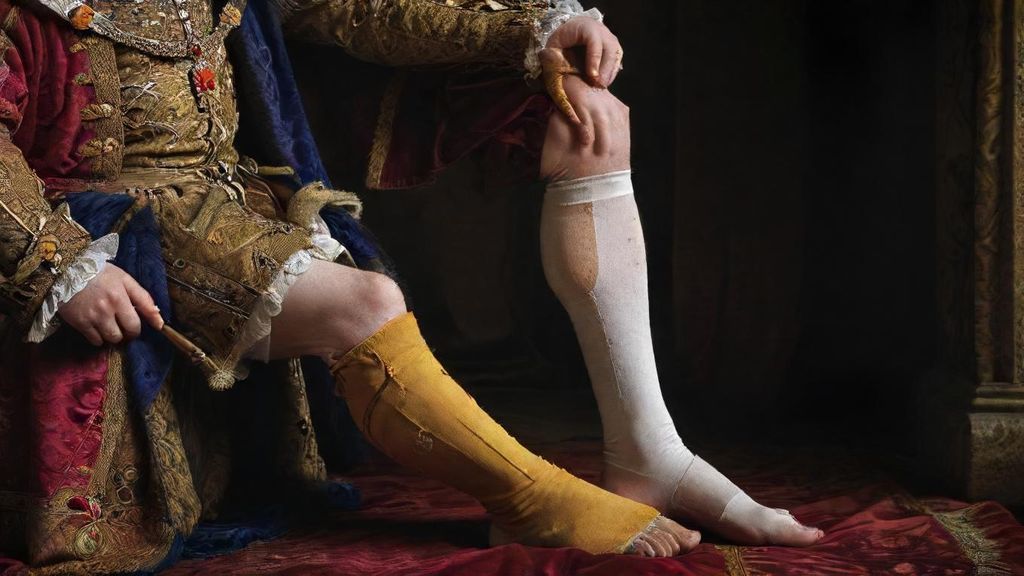
Yes, strong evidence suggests King Henry VIII’s chronic, agonizing leg ulcer played a truly profound role in transforming him from a charismatic, athletic “Renaissance Prince” into an unpredictable and demanding monarch. It wasn’t just ambition or aging that changed him; this relentless physical suffering warped his personality, body, and ultimately, the course of English history forever.
Most people picture King Henry VIII as a larger-than-life, red-faced tyrant, always getting his way. But this popular image might miss a crucial, deeply painful truth. We’re going to explore how a debilitating wound, which just wouldn’t heal, led to the slow, relentless erosion of his physical and mental well-being. This quiet agony reshaped England’s most famous king long before his famous first divorce, known as the “Great Matter,” even took hold.
Henry’s long-term pain started with a jousting accident in 1527. Jousting was the extreme sport of its day, full of danger and spectacle. During one such event, a lance struck Henry’s right thigh, creating a deep, nasty wound. For a king celebrated for his powerful build and athletic prowess – he loved hunting, wrestling, and tennis – this was a huge blow, not just physically but to his very sense of self.
While the initial wound seemed to heal on the surface, the story took a much darker turn nearly a decade later. In January 1536, Henry suffered another, far more serious jousting accident. This time, his horse fell on him, pinning him down and leaving him unconscious for hours. Crucially, this accident reopened the old wound on his right leg. It wasn’t just a re-injury; it turned what was once a contained problem into a chronic, open sore – what we would call a venous leg ulcer today.
Imagine this: a wound that constantly oozed pus, sometimes blood, and was almost certainly infected and foul-smelling. Picture living with an open sore on your leg, day in and day out, never truly healing. In an era without antibiotics or even basic antiseptic practices, such a wound was a medical nightmare. The agonizing pain wasn’t something that faded; it was a constant, throbbing presence, making every step, every movement, a torment. What makes this fascinating is how little relief was available – mostly herbal poultices and desperate remedies that likely did little more than add to his discomfort.
This persistent physical problem began to visibly wear down his once-powerful body. The active, energetic king, who used to dance for hours and ride across the countryside, became increasingly unable to move. His leg would swell, making movement excruciating. This forced inactivity, combined with his famously huge appetite, led to significant weight gain. Simply put, his body was failing him, and his mind followed. This constant, unyielding pain, historians suggest, contributed heavily to a growing irritability, a shorter temper, and an increasing paranoia that slowly chipped away at his once-charming personality.
We see a clear shift from the charismatic, cultured Renaissance prince, adored by his court and people, to a more unpredictable and demanding monarch. The years leading up to the ‘Great Matter’ – his efforts to annul his marriage to Catherine of Aragon – matched almost perfectly with the appearance of this chronic, debilitating condition. Think of it this way: imagine a high-performing CEO, brilliant and well-liked, suddenly suffering a chronic, excruciating illness that makes every day a battle. Their patience would wear thin, their focus might waver, and their tolerance for perceived slights would plummet. Henry was no different.
How Do We Know This Actually Happened?
You might wonder, how do we know so much about a king’s leg ulcer from nearly 500 years ago? The truth is more interesting than you might think. We know this because of detailed historical records, particularly the reports from foreign ambassadors stationed at the English court. These diplomats were keen observers, noting everything about the king’s health, mood, and habits, knowing that even minor changes could have significant political effects.
For instance, Eustace Chapuys, the Imperial Ambassador, frequently reported on Henry’s health and mood. Historical records tell us that he wrote extensively about the King’s “humour” becoming “so altered” that people were afraid to speak to him, and he often mentioned the chronic leg wound as a source of great pain and discomfort. These aren’t just guesses; they’re strong proof from eyewitnesses who were actively reporting back to their own monarchs about the state of affairs in England.
In simple terms, Henry’s ulcer wasn’t just a personal bother; it was a huge factor reshaping the man himself. This constant agony transformed him from a dynamic, approachable leader into someone increasingly isolated, prone to rages, and suspicious of those around him. This change in personality, fueled by relentless physical suffering, would have enormous consequences for his court and, critically, for his desire to secure a male heir and dissolve his first marriage. Next, we’ll see how this dramatic shift played directly into the tumultuous events of his first divorce, forever altering the religious and political landscape of England.
How Did King Henry VIII’s Leg Ulcer Directly Lead to the English Reformation?

Imagine a CEO of a huge company, feeling immense pressure to secure its future. Now, imagine this CEO also suffers from a terribly painful problem that never stops, day or night. How might that constant physical torment change his decisions, making him desperate, stubborn, and quick to make big changes? This isn’t just a made-up idea; it’s how we can really understand how King Henry VIII’s painful leg ulcer didn’t just bother him, but became a hidden force that pulled England away from the Catholic Church forever. The truth is more interesting than you might think: this never-ending pain directly pushed him to get a male heir and, finally, his split from the Pope, starting the English Reformation.
For years, Henry suffered from a sore on his leg that kept coming back, likely from a jousting accident in 1527 that reopened an old wound. This wasn’t a small cut; history books tell us it was a deep, infected wound that would get worse now and then, causing terrible pain, swelling, and maybe even more infections. Think about how even a persistent toothache can make you irritable and unable to think straight. Now imagine that, but much worse—a constant, burning pain in your leg, making it hard to move and sleep, day after day, for years. According to historians, this constant suffering deeply changed Henry’s well-known personality, turning him from the charming, athletic “Golden Prince” into a ruler who got angry easily and was hard to guess.
Here’s what we discovered: Henry’s greatest obsession was having a proper male heir to make sure the Tudor family stayed in power. His marriage to Catherine of Aragon, after many years, had only produced one surviving child, a daughter named Mary. This was a huge problem for England’s future, as no queen had ever ruled on her own before. With his painful ulcer bothering him all the time, Henry began to think that God was unhappy with him because he didn’t have a son. He focused on a part in the biblical book of Leviticus, which seemed to say it was wrong to marry your brother’s widow – Catherine had first been married to Henry’s elder brother, Arthur. In Henry’s mind, clouded by pain, this wasn’t just a suggestion; it was God’s direct punishment on his marriage, giving him no male heir for a union that wasn’t right in God’s eyes.
How Did Pain Cloud a King’s Judgment?
This terrible pain didn’t just make Henry irritable; it seems to have made it harder for him to think clearly and made him even more stubborn. When he sought an annulment from Catherine – which, in simple terms, meant declaring his marriage had never been real in God’s eyes – Pope Clement VII refused. The Pope was, at the time, almost a prisoner of Catherine’s nephew, the Holy Roman Emperor, Charles V, who certainly didn’t want his aunt to be shamed. But for Henry, whose leg pain likely made him feel even more desperate and rushed, the Pope saying no was something he couldn’t stand. The constant suffering might have made him less willing to compromise, less able to see other solutions, and more convinced that his chosen path was the only one.
What makes this fascinating is how a physical pain directly fueled his religious belief, turning it into a stubborn resolve. His constant pain, perhaps made worse by early signs of other health issues or even mercury treatments (which were common then), pushed him past the point of negotiating anymore. He wasn’t just frustrated; he was suffering, and that suffering became mixed up with his belief that God was on his side. He genuinely believed God was on his side, and the Pope was blocking God’s will. This stubborn position, born partly from desperation and perhaps made worse by his terrible pain, led him to go against hundreds of years of tradition. He declared himself the Supreme Head of the Church of England, essentially telling the Pope, “No, I’ll do it myself.” This single, huge decision directly caused the English Reformation.
The ulcer, therefore, wasn’t just a small side note in Henry’s life; it was a major player in one of the biggest changes in English history. It made his worries bigger, made him more determined, and ultimately pushed him to challenge the most powerful religious leader in Europe. Without that never-ending, burning pain, it’s quite possible Henry might have sought an easier way out, or perhaps given up entirely, leaving England’s religious situation – and its future – looking entirely different. Next, we’ll explore what happened right away after this huge split and how Henry began to change England to be just as he wanted it.
What Lasting Impact Did King Henry VIII’s Leg Ulcer Have on England’s Future?

Could one person’s chronic pain truly rewrite the destiny of an entire country for centuries? Yes, it did in England. King Henry VIII’s severely infected leg ulcer, and his desperate hunt for a male heir, didn’t just cause him personal suffering; it completely changed England. This constant health issue fueled his obsession with getting a divorce, which didn’t just affect his private life. Instead, it pushed England down a new path of huge religious, political, and social changes, making it the separate, Protestant nation we know today.
Here’s what happened: Henry badly needed a son to keep his family line strong. But he couldn’t get a divorce from Catherine of Aragon through the usual Church rules. This forced him to a drastic solution: he decided to cut England’s ties with the Roman Catholic Church. This move changed absolutely everything. Think of it like a massive company suddenly breaking up with its main partner; the effects spread everywhere.
How Do We Know This Actually Happened?
The first massive change was the dissolution of the monasteries, which started in 1536. Historical records show us that Henry, now the head of the new Church of England, didn’t just want spiritual control; he also desperately needed money. The monasteries were incredibly rich, owning vast lands and treasures. Imagine them as huge, ancient landowners with enormous assets. Henry’s agents systematically closed them down, took their wealth, and sold off their properties. This wasn’t just about breaking religious power; it was the biggest redistribution of wealth and land in English history.
Historians explain that this act flooded the market with land, making the King richer and creating a new group of wealthy landowners. These new landowners owed their fortunes to the King, which meant they strongly supported the new system. This made it much harder for England to ever return to Catholicism. It’s like a government selling off major national industries; it creates powerful new players who back the changes.
Next, the King’s break from Rome greatly boosted the power of Parliament. To make his divorce legal and establish the new Church, Henry couldn’t just order it. He needed Parliament to pass new laws. One of these was the Act of Supremacy in 1534, which officially declared him the “Supreme Head of the Church of England.”
“…the King our sovereign lord, his heirs and successors, kings of this realm, shall be taken, accepted, and reputed the only supreme head in earth of the Church of England…”
This quote from the Act itself makes it clear. Simply put, Parliament went from being a group the King sometimes asked for advice to a crucial partner in making these huge changes. This set a pattern, slowly making Parliament’s role in governing the nation stronger. It was a significant step towards the powerful Parliament we see today. It completely changed how people thought about who held the ultimate power.
An immediate result was that the King became the ultimate authority over the Church. The Pope no longer had power in England; the English monarch was now in charge of both the church and the state. This left a lasting mark: a separate English church, which often followed Protestant ideas but kept some traditional Catholic ways. But getting there wasn’t easy.
What makes this story so fascinating is what happened next with Henry’s children. His son, Edward VI, strongly pushed for Protestantism. Then, his daughter Mary I, a devout Catholic, tried to force England back to Rome, leading to terrible persecutions. Finally, Elizabeth I, Henry’s other daughter, found a more balanced Protestant solution, creating the lasting identity of the Church of England. Imagine your country switching its entire social and spiritual way of life back and forth multiple times!
This back-and-forth religious identity forever changed England. It made England different from Catholic Europe, affecting its foreign policy, culture, and national identity for hundreds of years. This one man’s severe physical problem, which prompted his search for an heir, truly became the starting point for an independent, Protestant nation. It’s a powerful example of how deeply personal events can completely change the course of history.
The answer lies in understanding that Henry’s need wasn’t just his own; it became the nation’s need, forcing an entire kingdom to break with centuries of tradition. This huge shift in religious and political landscape wasn’t just a temporary problem; it created the foundation for the England we know today, setting the stage for even more dramatic events that would follow.