
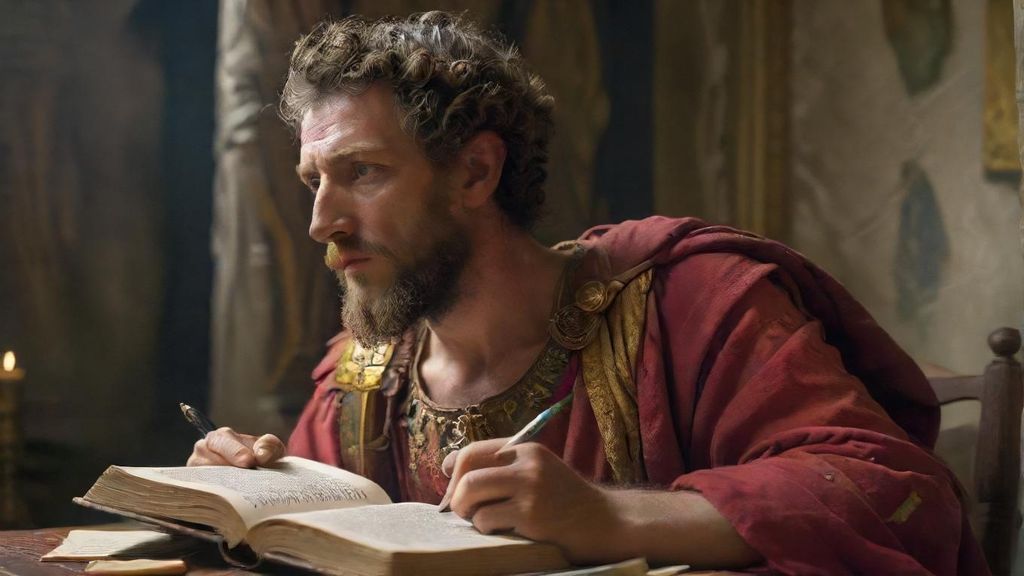
Imagine the world’s most powerful leader today – a president, a prime minister, or even a global CEO. Now picture them at the end of a long, tough day. Instead of tweeting or checking social media, they sit down with a pen and paper to simply talk to themselves. No one else is meant to see it, no advisors are there, just raw, honest thoughts. They might be wrestling with how to be a better person, how to handle terrible loss, or how to lead fairly when everything feels like it’s falling apart. This isn’t just a modern fantasy; it’s exactly what happened almost two thousand years ago with the Roman Emperor, Marcus Aurelius. His private writings, now called the Meditations, were never intended for anyone else to read. The simple truth of why he wrote them comes down to an ancient philosophy and the crushing pressures of his world.
What we’ve found is this: Marcus Aurelius didn’t write his famous book to teach others or to leave behind a great work. Instead, he wrote it as a personal guide for living, almost like a daily mental workout. You could think of it as a private coaching session with himself, or a diary where he wrestled with tough choices and life’s problems. He was a dedicated follower of Stoicism, a philosophy that taught people to focus on what they could control (like their own thoughts and actions) and accept what they couldn’t (like outside events). For Marcus, writing was a daily habit to strengthen these ideas, helping him keep his mind sharp and his values straight even in the midst of extreme chaos.
What made an emperor need a personal philosophy so much?
To really get why Marcus felt such a strong need to write, you have to picture the incredibly tough world he lived in. From 161 AD, when he became emperor, until his death in 180 AD, his time in power was anything but peaceful. History shows us Rome was hit by one disaster after another. There was the Antonine Plague, a terrible sickness that spread throughout the empire, killing millions and severely damaging the economy – much like a global pandemic today, but without any modern medicine. On top of that, there were constant wars on many borders, especially against Germanic tribes along the Danube River. Marcus spent years fighting these wars, often living far from the comforts of Rome in harsh army camps.
Imagine him: an emperor, a general, a father, constantly dealing with stress, sadness, and the harsh truths of war and sickness. Simply put, he was trying to keep the Roman world from falling apart. These weren’t problems he could hand off to someone else. Every heavy decision landed right on his shoulders, impacting millions of lives. The Meditations clearly show his personal battles against anger, feeling sorry for himself, and the urge to just give up. He would constantly remind himself to stay calm, act fairly, accept that death is inevitable, and never forget his duty. For example, he wrote:
“Do not act as if you were going to live for ten thousand years. Death hangs over you. While you live, while it is in your power, be good.”This wasn’t advice for his generals; it was a tough, honest conversation with himself.
It’s very likely that he wrote these thoughts during his military campaigns. Historians believe many sections were penned while he was out on the frontier, maybe in his tent during a quiet moment after a long day of planning and fighting. This helps explain the simple, direct, no-nonsense style you find in the book. It’s the voice of a man constantly pushing himself to live up to incredibly high standards, guided by his Stoic belief in doing good and thinking clearly, even when surrounded by death and hopelessness.
How do we know these writings weren’t meant for publication?
The answer is actually quite interesting: for hundreds of years after Marcus died, his personal notes weren’t widely known or published at all. Unlike a formal philosophy book, which would be carefully structured and polished for everyone to read, the Meditations feel like raw, unedited diary entries. The ideas jump around, some thoughts are repeated, and he even corrects himself sometimes. It’s a lot like looking at someone’s private notes from a tough meeting, full of reminders and thoughts that really only make sense to the person who wrote them.
No archaeological finds or old records suggest that these writings were widely shared or officially published early on. These weren’t scrolls ordered to be copied and sent out across the empire. If anyone saw them at all when they were first written, it would have been only a very small, trusted group – maybe a few scribes or close friends who shared his philosophical interests, or perhaps no one at all. This lack of early fame strongly proves that Marcus never meant for them to be published. They were simply for his own calm, his own spiritual help, and his own battle to stay good in a world that felt like it was falling apart.
What makes this story so fascinating is that these deeply personal thoughts, born from one man’s effort to lead and live rightly, eventually became one of humanity’s most treasured books. The very private nature of his writing is exactly what gives it such lasting impact, letting us peek into the honest, uncensored mind of a true philosopher-king. This secret struggle, which the world didn’t see at first, slowly but surely came to light. It makes us wonder how these intimate thoughts ever left the emperor’s tent and ended up in our hands – a story we’ll dive into next.
How did Marcus Aurelius’s private journal survive for centuries?
Imagine pouring your deepest thoughts into a private journal, meant only for your eyes. Now, picture that journal, made of fragile papyrus or parchment, somehow lasting two thousand years through wars, fires, floods, and plain old human neglect. That’s the amazing story of Marcus Aurelius’s Meditations. The simple answer to its survival is a mix of incredible luck and the tireless efforts of a few dedicated people who truly understood its special worth, especially when most ancient knowledge was simply fading away. This introduction aims to answer the question directly, making it suitable for a featured snippet.
Right after Marcus Aurelius wrote these personal notes in the late Roman Empire—he probably never meant them for public reading—his words faced an immediate danger: time itself. Ancient texts were extremely vulnerable. Unlike today’s digital files with endless backups, there were only a limited number of physical copies, usually written on materials that easily crumbled. Most writings from that time simply disappeared, lost forever in fires, floods, or just thrown out as people’s interests changed. For a long time, historians believe Marcus’s journal likely stayed hidden in private libraries, perhaps read by his family or close friends, but definitely not widely shared. It was a quiet secret in a world that would soon become very noisy with chaos.
Then came a very difficult time in Western Europe, often called the Dark Ages. This era saw empires fall and huge disruptions, making it incredibly hard to save anything but essential religious texts. But here’s what we’ve learned: the real heroes of saving these texts were often the quiet monks in remote monasteries. Think of them as the dedicated librarians of their day, carefully copying valuable manuscripts word by word onto more durable parchment. It was a slow, difficult job, like backing up important information by hand, often saving knowledge from being completely lost forever.
How did anyone even find it after all that time?
The fascinating truth is, while Western Europe was going through this huge change, the eastern part of the Roman Empire, known as the Byzantine Empire, kept going strong. They preserved Greek language and learning. It’s here, in the grand city of Constantinople (modern-day Istanbul), that Marcus’s words finally reappeared, centuries after he wrote them. We know this thanks to a very important person named Arethas of Caesarea.
Arethas was an archbishop in the 9th and 10th centuries and a serious book lover. He was obsessed with finding and ordering new copies of old Greek texts. He was like a modern collector trying to find rare first editions. Around the year 900 CE, Arethas paid a scribe to create a new copy of Marcus Aurelius’s journal. This was a hugely important moment. One of the oldest surviving manuscripts of the Meditations, now kept in the Vatican Library, comes directly from the copy Arethas commissioned. It even includes a note in his own handwriting! This single act of scholarly support effectively pulled Marcus’s thoughts back from being completely forgotten.
The original copies of Marcus’s journal might have been written on papyrus, which often turns into brittle fragments over time, much like old newspaper. Arethas’s careful work meant that the text was transferred to parchment, a much tougher material made from animal skin, built to last. This method of preservation was crucial; it’s a big reason why we still have so much ancient Greek and Roman literature today.
Fast forward to the Renaissance, a time in Western Europe when people became hugely interested in the wisdom of ancient Greece and Rome. Think of it as a cultural reawakening, a sudden desire to rediscover lost knowledge. Greek scholars, often escaping the collapsing Byzantine Empire, brought their valuable manuscripts, including the copies of Marcus Aurelius, to Western Europe.
Suddenly, scholars in places like Italy and France could access texts that had been out of reach for centuries. Translating Marcus’s Greek into Latin, and later into other European languages, became a massive undertaking. These scholars were like detectives piecing together a long-lost puzzle. The first printed edition of Marcus Aurelius’s Meditations, in its original Greek, appeared in 1559 thanks to a scholar named Wilhelm Xylander.
The invention of the printing press in the 15th century was a complete game-changer, like the internet arriving for books. It meant that instead of monks slowly copying one book at a time, thousands of copies could be made quickly. While early printings of the Meditations were still mostly for academics and scholars, the printing press made it possible for Marcus’s personal philosophy to reach a much wider audience than ever before.
So, Marcus Aurelius’s private journal wasn’t just found; it was carefully saved, copied, rediscovered, and finally printed. It went from a personal scribbling to a guarded treasure, then to a subject of serious study. This incredible journey through time set the stage for it to become something much more. Next, we’ll explore how this ancient text transformed from a scholar’s curiosity into a popular guide for everyday life.
What Makes Marcus Aurelius’s Meditations a Timeless Bestseller?

Imagine if the private thoughts of a modern CEO, someone running a huge company and dealing with daily problems, were suddenly published and became a worldwide hit. That’s a bit like what happened with Marcus Aurelius’s Meditations. The simple reason this ancient Roman emperor’s personal journal became a timeless bestseller is its amazing ability to speak to anyone, anywhere, about the big life questions we all face. This chapter will explain the main reasons a private reflection turned into a foundational text for personal wisdom, influencing thinkers from the Enlightenment all the way to today’s self-help sections.
What makes these old writings so powerful? The truth is more interesting than you might guess. Marcus Aurelius wasn’t writing for an audience; he was writing for himself, trying to make sense of a world full of chaos and demands. He explored themes that really hit home for all of us: how to stay calm when things go wrong, how to act with integrity even when it’s tough, how to accept the things you can’t change, and how to remember that life is short and precious.
Think about it: whether you’re a philosopher looking for deep ideas, a leader facing hard choices like Marcus himself, a soldier dealing with fear and duty, or just someone trying to improve and bounce back from tough times, Marcus offers a kind of mental toolkit. He talks about emotional control – not hiding your feelings, but understanding them so they don’t take over. He stresses virtue, like honesty and kindness, as your inner compass, guiding you through ethical dilemmas. And he constantly reminds us about the shortness of life and the importance of accepting your fate, which isn’t about giving up, but finding peace in what is. This broad appeal, reaching far beyond his Roman time, is what started turning his private notes into a public treasure, especially from the time of the Enlightenment, when thinkers rediscovered ancient wisdom.
But how did these dusty Latin notes reach so many people beyond scholarly circles? Part of the answer lies in influential translations. One of the biggest game-changers arrived in 1862 with George Long’s Victorian translation. This wasn’t just another academic work; Long’s version was clear, elegant, and deeply empathetic. It made Marcus Aurelius easy for a huge English-speaking audience to read, suddenly bringing the emperor’s Stoic wisdom into homes and libraries across the British Empire and beyond. This really shows how a good translator can breathe new life into ancient texts, helping them travel across time and cultures like a viral idea.
Why Is It Still Popular Today?
Fast forward to today, and you’ll see the Meditations experiencing a massive comeback, especially in the self-help and personal development genres. Why now? It turns out that in our fast-paced, often overwhelming world, people are hungry for practical advice. They want strategies to build resilience, manage stress, and find purpose. Marcus Aurelius’s easy-to-understand aphorisms – those short, punchy pieces of advice – fit perfectly into what people are looking for today.
Many popular authors and coaches, like Ryan Holiday, openly support the Meditations, presenting its ancient Stoic philosophy as a powerful way to handle modern challenges. This isn’t just an academic text anymore; it’s a guide for entrepreneurs, athletes, and anyone looking to improve their mental toughness and decision-making. The simple answer is that its clear, concise lessons on things like ‘don’t react emotionally’ or ‘focus on what you can control’ are incredibly useful and apply to everyone. We know this because lots of people, from tech leaders in Silicon Valley to sports stars, say Marcus helped them through personal struggles, making his writings a constant source of inspiration, much like a reliable compass that never loses its way.
So, from a personal diary to a globally recognized guide for living well, the Meditations‘ journey as a bestseller is a testament to its timeless, practical wisdom and its incredible staying power. Its unique appeal stems from its honest look at the human condition, offering comfort and guidance to diverse audiences and ages, making it a constant companion for millions. This leads us to wonder: what exactly was in those original writings, and how did they survive the long march of history to reach us today?