
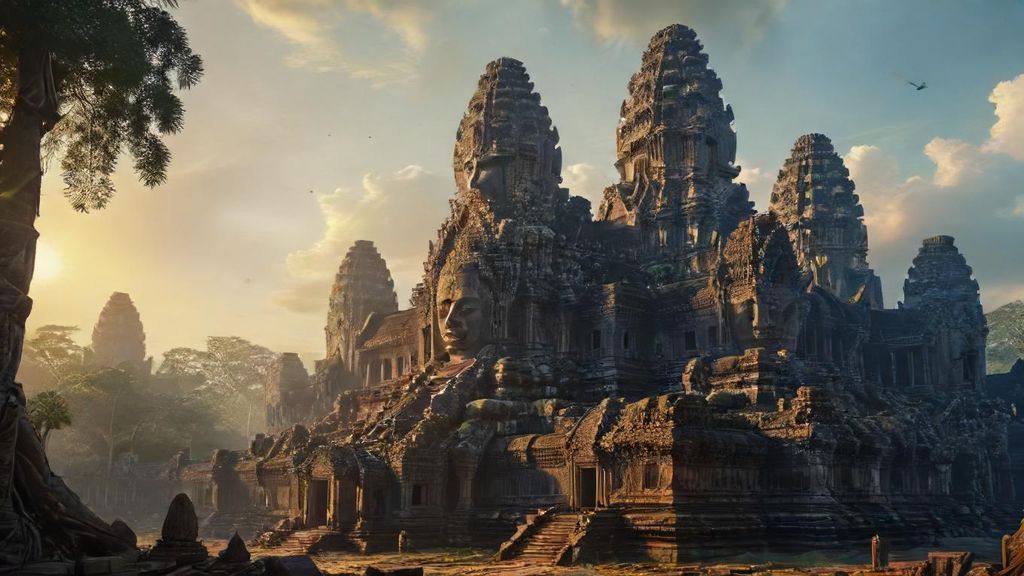
Sure, many people believe King Suryavarman II built Angkor Wat purely out of religious devotion, as a grand gift to the gods. But the truth, as often happens, is far more complex and exciting. King Suryavarman II aimed to build Angkor Wat in the early 12th century for a powerful blend of reasons: to show his immense political power, to solidify his religious legitimacy, and to create a lasting legacy that would make him immortal in the eyes of his people and the gods. It was a massive statement of authority and a personal monument to eternity.
Here’s what we discovered: Suryavarman II became king around 1113 CE, likely after some struggles. The Khmer Empire was strong, but it had faced some tricky times. He needed to make his rule firm, to prove to everyone—his people and his rivals—that he was the rightful, powerful king. Building something as huge as Angkor Wat was the ultimate way to declare this. It was like a modern country hosting the Olympic Games—a monumental display of power, wealth, and amazing organization that loudly announced, “I am in charge, and my reign is blessed!”
What was a Devaraja, and why was it so important?
The answer is deeply rooted in the religious beliefs of that era. For centuries, Khmer kings believed in the concept of devaraja, which essentially meant “god-king.” This didn’t mean the king was literally a god, but rather that he was a living connection between the human world and the divine. Kings would often dedicate temples to Shiva, blending their own spirit with the god’s image to achieve spiritual unity and prove their right to rule. However, Suryavarman II did something different, something quite noticeable: he dedicated Angkor Wat to Vishnu, a less common choice for important state temples at the time.
Choosing Vishnu wasn’t just Suryavarman II’s personal preference; it was a smart, planned religious move. Vishnu is often seen as the preserver of the universe. By linking himself with this god, Suryavarman II was basically claiming responsibility for keeping cosmic order and bringing good fortune to his empire. The temple wasn’t just a place to worship; it was also designed to be his final resting place. There, his spirit, merged with Vishnu, would live forever, ensuring his continued influence and divine protection over his land.
The truth is even more interesting: the very layout of Angkor Wat itself was a carefully planned map of the cosmos. Historians and archaeologists like Eleanor Mannikka have shown how the temple’s direction and measurements likely lined up with astronomical events, reflecting a miniature universe designed to capture divine energy. This wasn’t by chance; it was clever city design on an epic, sacred scale.
The sheer ambition of this vision meant bringing together a huge amount of resources. Imagine a project today needing tens of thousands of skilled workers—carvers, masons, architects, engineers—plus countless laborers, all fed and housed for decades. Strong proof from old inscriptions and the landscape itself tells us that enormous quarries in nearby Phnom Kulen supplied the sandstone. This stone was then moved by river and canals for miles. Timber, laterite, food, and housing for this massive workforce—it was an undertaking as big as building a modern national infrastructure project, but without any of our current technology.
Historical records tell us that the planning stages must have been very precise, involving astronomers, priests, and royal architects working together to pick a site that was not only good for defense but also spiritually important. Placing it near the previous capital hinted at a link to the past while creating a new, even grander center of power. This colossal project wasn’t just about stone and mortar; it was about shaping an entire empire’s future and securing one man’s place among the gods forever.
What makes this so fascinating is how these woven threads of power, faith, and legacy drove such an unimaginable feat. Suryavarman II wasn’t just building a temple; he was constructing his entire identity and securing his afterlife. Next, we’ll see exactly how they turned this grand vision from a royal command into an astonishing reality.
How did ancient Khmer engineers manage to build Angkor Wat with such incredible precision?

Imagine trying to build a structure the size of a small city today, made entirely of stone, without using modern cranes, trucks, or even cement. That’s essentially what the ancient Khmer engineers achieved with Angkor Wat. The simple answer to their amazing precision comes from a mix of brilliant organization, a clever grasp of water power, and a deep knowledge of natural materials. They weren’t just skilled builders; they were master problem-solvers who carefully planned every single step of this huge project, from the quarry to the crowning spire.
The first big challenge was getting enough stone. And the story is more interesting than you might think: Angkor Wat needed an astonishing 5 to 10 million blocks of sandstone, with each one weighing up to 1,500 kilograms (about 3,300 pounds). Where did it all come from? The main source was a mountain called Phnom Kulen, located roughly 50 kilometers (30 miles) northeast of Angkor. This wasn’t some nearby hill; it was a long journey, especially when you’re talking about moving millions of tons of rock.
Here’s what we’ve learned about their logistics: The engineers created a clever network of canals connecting Phnom Kulen to Angkor. Think of it like a giant, ancient shipping lane. During the monsoon season, these waterways would fill, allowing the heavy sandstone blocks to be floated on rafts. It’s a bit like today’s global supply chains, but instead of container ships and semi-trucks, they used rafts and the power of water. Once the rafts reached the city’s edge, elephants and teams of laborers took over. Using wooden rollers and ramps, they slowly pulled the massive stones to the construction site. Recent evidence suggests some blocks might have also been dragged overland using similar techniques, but the canal system was a game-changer for moving such huge amounts.
What made their building techniques so special?
What makes Angkor Wat fascinating isn’t just the quantity of stone, but how they put it all together. They didn’t use mortar, that sticky cement-like substance we rely on today. Instead, they used a technique called dry-masonry. This meant the stones were cut with such incredible precision that they fit together perfectly, like giant LEGO bricks. They held each other in place just by their weight and how tightly they fit. It’s like a master carpenter fitting two pieces of wood so seamlessly you can barely see the joint, but on a massive scale with stone.
According to historians like Jean Boisselier, the surfaces of these blocks were ground flat with amazing accuracy. We know this because archaeologists have found evidence of specialized tools, including iron chisels, mallets, and measuring instruments. Many tools were made of wood and have since disappeared. The organization was huge. Picture an army of tens of thousands of skilled stone carvers, engineers, and laborers, all working under central direction. This wasn’t just raw power; it was a very organized operation, much like a modern-day construction firm managing many different teams at once.
Their careful planning also reached the small details. Building the tall spires and carving hundreds of meters of incredible bas-reliefs – those detailed stories cut into the walls – needed different teams of skilled artists. These artists probably carved the designs after the stones were set for the reliefs, or sometimes beforehand for specific decorations. This made sure the stories looked perfect across many stones. It took careful planning and talking between everyone involved, from digging up the stone to adding the final artistic touches.
It turns out their engineering knowledge was about more than just stacking stones. They understood foundations, drainage, and how to spread weight. This allowed their huge buildings to stand strong for hundreds of years in a tough tropical climate. Their amazing precision showed how dedicated they were to building a sacred place. It honored their gods and kings, becoming a lasting symbol of their power and cleverness.
What’s truly amazing is how much human effort and intelligence went into this, all without any of the modern tools we use today. Their achievements help us understand the incredible structures that supported the entire Khmer Empire.
What was Angkor Wat’s final purpose, and how did it become so enduring?

If you’ve heard of Angkor Wat, you might picture it as just a huge, old temple. But the real story is much more fascinating. It wasn’t simply a place for worship; its final purpose was a clever mix of religious devotion and a king’s grand ambitions. Imagine if a powerful leader today decided to build not only a massive national monument but also their own elaborate tomb, all while showing everyone they were connected to the gods. That’s essentially what King Suryavarman II did. This enormous structure, built surprisingly fast, primarily served as a state temple dedicated to the Hindu god Vishnu. But it was also a magnificent tomb for the king himself. This smart two-part function, along with its incredibly clever design, is a huge reason why it still stands tall and captivates us today.
The main reason Angkor Wat existed was to show how great Vishnu was, a god King Suryavarman II especially honored. The king saw himself as a “deva-raja,” or “god-king,” a living embodiment of the divine. So, building this enormous temple wasn’t just a religious act; it was a powerful statement about his own divine authority and the legacy he wanted to leave behind. Think of it like a modern company launching a super-premium product that also becomes a lasting symbol of its founder’s vision. The entire design of Angkor Wat was meant to look like the Hindu cosmic universe. Its central towers represent Mount Meru, the mythical home of the gods, surrounded by circular walkways and moats that stood for mountain ranges and cosmic oceans. Every detail was carefully planned to strengthen this link to the cosmos, placing the king right at the center of the universe, both during his life and after he died.
How did this ancient wonder survive and transform?
What makes Angkor Wat truly amazing is the rich storytelling carved right into its walls. The famous bas-reliefs, stretching for hundreds of meters along the inner walls, aren’t just nice decorations; they’re like a huge, ancient comic book. They tell stories from epic Hindu myths, such as the Churning of the Sea of Milk, where gods and demons work together to create the drink that grants eternal life. They also show detailed historical accounts of Suryavarman II’s battles and processions. These images were designed to teach, inspire, and remind everyone of the king’s power and his divine favor. According to historians, these reliefs were not only artistic masterpieces but also important political messages, showing off the king’s victories and his special spot among the gods.
Beyond its incredible art, the temple’s long-lasting survival is also thanks to some really smart engineering and a special connection to the stars. Recent discoveries show that Angkor Wat is lined up perfectly with the stars, with the sun rising precisely over its central tower during the spring equinox. This wasn’t accidental; it was a planned design choice that linked the temple, and in turn the king, to the universe’s natural rhythms. This made his divine status even stronger. It’s like building a modern skyscraper that also works as a super accurate calendar, always repeating a deep spiritual message.
The truth about the temple’s surprisingly fast construction is more interesting than you might think. Experts estimate it was built in just 30-35 years, an amazing feat for that time, needing huge amounts of planning and supplies. After King Suryavarman II died around 1150 CE, the temple continued to function. However, as the Khmer Empire eventually declined in the 14th and 15th centuries, Angkor Wat didn’t just crumble. Instead, it changed completely, transforming from a Hindu temple into an active Buddhist one. This wasn’t a sudden, violent change; it was a slow shift. This allowed the building to stay a holy spot, cared for by monks and travelers. This constant religious use is one of the main reasons it survived mostly whole, while many other Khmer temples fell into ruin.
What makes this even more fascinating is that the jungle, often seen as a destructive force, also played a key part in keeping it safe. It protected Angkor Wat from humans who might have damaged it for centuries. Unlike many ancient cities that were taken apart for building materials, Angkor Wat’s far-off location and continued holy importance protected it. This remarkable preservation, combined with its deep artistic and spiritual messages, has made sure it would last as one of the world’s most amazing buildings. But how did this jewel become known to the wider world, and what happened when outsiders “rediscovered” it?