
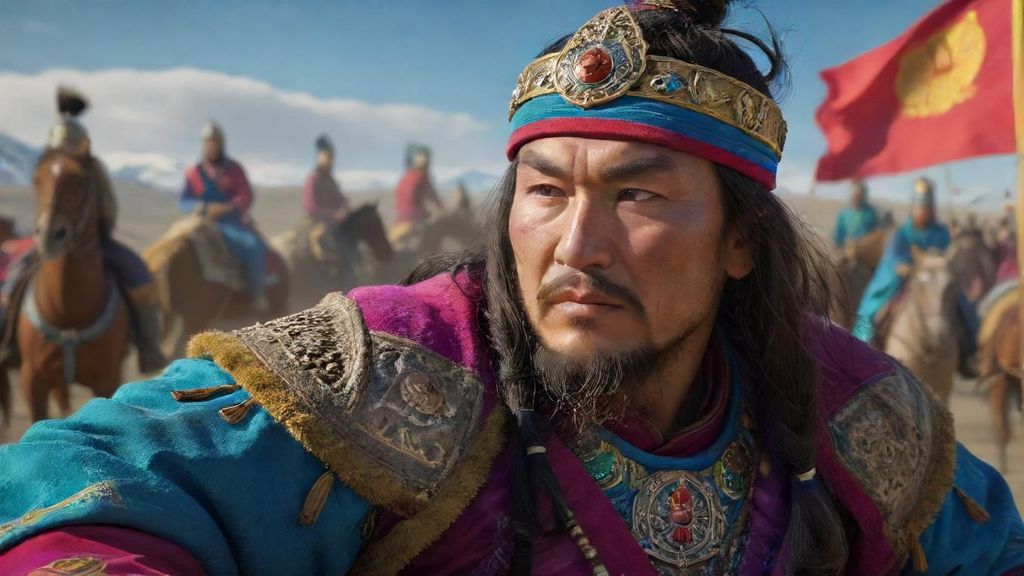
Why was Genghis Khan’s burial kept a secret? Imagine a leader whose death was as powerful as his life, a secret weapon designed to protect his vast empire. That’s exactly what happened when Genghis Khan, the mighty founder of the Mongol Empire, died in 1227. His burial wasn’t just a private affair; it was a ruthless strategy. The main goal was simple: make sure no one, ever, found his tomb. This wasn’t just about a grave; it was about safeguarding the Mongols’ power and ensuring no enemy could ever disrespect the ultimate symbol of their unity.
When Genghis Khan passed away, possibly during a military campaign against the Western Xia kingdom, his closest advisors reacted with an astonishing level of secrecy. Unlike many great rulers who wanted grand monuments, Genghis Khan’s final wish (or perhaps his generals’ clever plan) was absolute anonymity. The answer to “why so secret?” comes from a mix of old nomadic traditions, smart planning, and a touch of the mystical.
How Do We Know About This Great Secret?
You might wonder, if it was such a big secret, how do we know anything at all? That’s a great question! It turns out, the evidence comes from outside observers and the very oral traditions the Mongols tried to control. We piece together the story from writers in Persia, China, and Europe who, while not there, wrote down what they heard about the Mongols’ almost unbelievable secrecy. For instance, the Persian historian Rashid al-Din Hamadani, writing later in the 13th century, shared some of the most detailed (and often scary) stories of the burial procession. He heard tales of the incredible efforts made to make the great Khan’s final resting place vanish.
Here’s what people say happened: Stories tell of a funeral procession that began where he died, making its way back to his homeland, likely near the Burkhan Khaldun mountain in what is now Mongolia. This was not a public event. Instead, every single person who saw the caravan carrying his body was reportedly killed. We’re talking about a long trail of bloodshed – from farmers in their fields to travelers on the roads. It was like a huge secret mission, but on a vast, medieval scale, where anyone outside the immediate burial party simply didn’t need to know.
The Mongols themselves had a nomadic tradition of humble, often unmarked burials. They believed disturbing the dead would bring bad luck. But for Genghis Khan, this practice was taken to an extreme. Think of it like a top-secret military base today, where access is very hard to get, and any unauthorized witness is a huge security problem. The ultimate secret was the location itself, which was not to be known, ever, by anyone who might betray it.
The most dramatic tales involve two key things. First, the legend of the “800 horsemen” who rode repeatedly over the burial site until the ground was completely churned up and looked just like the flat land around it. This would have erased any tracks or signs of a grave. Second, and even more astonishing, are the accounts of rivers being diverted to flow over the burial spot. Picture this: a massive, coordinated effort to make an entire river change its course, creating an inaccessible island or a submerged tomb. While diverting rivers sounds like something out of an epic fantasy, such engineering feats were something people in various ancient civilizations could do, though on this scale, it’s still jaw-dropping.
The smart reasons behind this secrecy are compelling. The Mongols understood that their unity came from their deep respect for Genghis Khan. If an enemy power could find and desecrate his tomb, it could shatter their morale and undermine his successors’ rule. It’s like an enemy hacking into a nation’s core server – a symbolic strike that would hurt the empire’s stability in real life. By making his resting place a place no one could ever find, they ensured that his spirit remained everywhere and his legacy untouchable. This extreme measure successfully created one of history’s greatest unsolved puzzles, making sure the mystery of Genghis Khan’s tomb would be talked about for hundreds of years.
This incredible secrecy, a blend of tradition, strategy, and ruthless execution, solidified the enigma of Genghis Khan’s burial. It started countless legends and the strong belief that somewhere, hidden beneath the earth or even under water, lies the final resting place of the greatest conqueror the world has ever known. It also makes us wonder about the incredible stories surrounding these lost sites.
Did Genghis Khan’s Tomb Truly Get Hidden Beneath a River?

Imagine this: a powerful tech mogul dies, and their final resting place becomes such a huge secret that people believe an entire river was rerouted just to hide it forever. Sounds like something straight out of a movie, right? Well, for the legendary Genghis Khan, that’s exactly the wild, enduring rumor we’re diving into today: the idea that his tomb was deliberately concealed beneath a flowing river.
So, is it true? While it makes for an incredible story, there’s not much solid proof for this specific river burial method. However, the tale itself offers fascinating clues into how the Mongols handled their most sacred secrets and the immense power Genghis Khan held, even in death. This theory isn’t just a modern fantasy; it turns out that some early writings and local whispers actually hinted at this idea.
How Did This Idea Even Start?
The legend of the river burial didn’t just appear out of nowhere. It seems to have grown from a mix of old tales, historical writings, and pure guesswork over time. Historians say the first clues about this secret burial came from Persian writers like Juvayni and Rashid al-Din. They wrote down details of Mongol life and their incredibly secretive burial traditions a bit later.
While these writers didn’t explicitly say “a river was diverted,” their descriptions painted a picture of extreme secrecy. For example, anyone who saw the funeral procession was supposedly killed. This suggested a burial so hidden, it could almost vanish from the earth.
Then there’s the rich tapestry of local Mongolian folklore. Oral traditions often speak of the “Forbidden Mountain,” Burkhan Khaldun, and how sacred places were connected with water. In Mongol culture, water was seen as pure and life-giving, almost a spiritual guardian. So, placing such an important tomb under a river would have immense cultural meaning, symbolizing ultimate concealment and protection, letting the Khan’s spirit rest undisturbed.
What makes this truly interesting is that river burials weren’t completely unheard of in ancient times. The most famous comparison is the supposed burial of Alaric I, the Visigothic king who attacked Rome in 410 CE. Legend says his tomb was hidden under the Busento River in Italy. Slaves supposedly diverted the river, buried him, then sent the water back, and were then killed to keep the secret. This historical parallel shows that the idea of using a river for ultimate concealment was already known to people, giving some believability to the Genghis Khan legend.
Could They Really Have Pulled That Off?
Now, let’s get practical: how on earth do you divert a river in the 13th century? Picture this: you’d need thousands of people digging by hand, using only basic tools, to reroute a significant body of water. Think of it like building a huge, temporary dam today, but without any modern machinery—just sheer manpower and clever engineering.
The sheer amount of planning and engineering needed for such a project would have been absolutely huge. Moving enough earth and rock to temporarily dry out a riverbed, bury someone, and then put the river back—all while keeping it an absolute secret—is mind-boggling. It would be one of the biggest human-made landscape changes ever conceived at that time.
Which rivers are people talking about? The Kherlen River and the Onon River are most often named as potential burial sites. These rivers flow through areas deeply important to Genghis Khan. The Onon is near his birthplace, and the Kherlen cuts through lands central to his early life and rise to power. People who believe these theories often point to how important these rivers were in Mongol culture and how secret the area around Burkhan Khaldun was kept. However, archaeological surveys in these regions haven’t found any definite proof of such an elaborate river diversion or a tomb underneath.
The truth is more interesting than you might think: while the river burial theory is incredibly popular and fascinating, it remains firmly a legend. The lack of strong, documented evidence makes it hard for historians to fully accept. Yet, it perfectly captures the extreme measures taken to protect the Khan’s final resting place and the mystery that continues to surround it. The sheer difficulty of such a feat makes us wonder if it’s more of a powerful symbol of his hidden legacy than a literal description.
This deep desire for secrecy and protection tells us much about Mongol beliefs and Genghis Khan’s unique place in their history. The riddle of the river-hidden tomb, therefore, isn’t just about a physical location; it’s about the lengths to which an empire went to safeguard its greatest secret. But if not under a river, where else could it be? The pursuit of the lost tomb continues, and the next chapter will explore other fascinating theories and the clues left behind.
What Makes Finding Genghis Khan’s Lost Tomb So Difficult for Archaeologists?

Imagine trying to find a single, specific drop of water in the entire ocean. Now imagine that drop was deliberately hidden centuries ago, and a whole nation now considers the ocean sacred, gently but firmly asking you not to disturb it. That, in essence, is the huge challenge facing archaeologists and scientists looking for Genghis Khan’s lost tomb. The simple answer to why it’s so difficult is a powerful mix of ancient, purposeful secrecy, a massive and rugged landscape, and deep cultural respect that makes the search much more complex than just digging holes.
Today, researchers aren’t just guessing; they’re using amazing technology. Think of tools like ground-penetrating radar (GPR), which acts like an X-ray for the soil. This lets scientists ‘see’ what’s hidden beneath the surface without ever disturbing it. Then there’s clear satellite imagery, allowing us to scan huge areas of Mongolia from space, looking for strange patterns or oddities that might point to a hidden site. Magnetometry finds changes in the Earth’s magnetic field caused by buried structures, while DNA analysis could potentially confirm ancient human remains if a site were ever found. Expeditions like National Geographic’s ‘Project Genghis Khan’ and the ‘Valley of the Khans Project,’ notably led by explorer Dr. Albert Lin, have used these high-tech tools to search remote regions, yet the tomb remains hidden.
The answer to the tomb’s location also depends on different theories. Many believe in the ‘sacred mountain’ idea, pointing to Burkhan Khaldun, a peak in the Khentii Mountains that was very important to Genghis Khan. This was his family’s home, a place he vowed to be buried. What makes this fascinating is how it might connect with the river legend we’ve discussed. Perhaps the river was diverted not just anywhere, but specifically near this sacred mountain, making the mountain itself the real secret. The river would then add another layer of trickery to the burial. Ancient records, like The Secret History of the Mongols, talk about extreme secrecy: ten thousand horsemen trampling the burial site, then a forest planted, making sure no one would ever find it. This wasn’t just a burial; it was a purposeful act of historical disappearance, a clever cover-up meant to last forever.
Why is Mongolia So Protective of Its Sacred Sites?
But beyond the clever ancient cover-up and the vast, tough land, the biggest hurdle to finding Genghis Khan’s tomb today is deeply cultural. The truth is more interesting than you might think: for many Mongolians, Genghis Khan isn’t just a historical figure; he’s a highly respected ancestor, the founder of their nation. Disturbing his final resting place is seen as profoundly disrespectful, like messing with a national hero’s grave. It’s like imagining if a foreign expedition wanted to dig up Mount Vernon to confirm George Washington’s burial – it’s simply unthinkable for many. The Mongolian government, knowing how strongly people feel, has placed strict rules on sacred sites, including the Khentii Mountains. They limit access and discourage archaeological digging that could be seen as unwelcome or disrespectful to their religion. This spiritual and political sensitivity often outweighs what scientists want to find out, making it hard to uncover one of history’s most sought-after treasures.
So, we have advanced technology, strong theories, and the sheer size of the huge, rough Mongolian plains and mountains. But on top of all this is the deep cultural importance of Genghis Khan and his final, secret resting place. It’s a classic clash between modern science and ancient traditions, between the desire to discover and the need to respect. This complex mix of factors makes the search for Genghis Khan’s tomb not just an archaeological hunt, but a delicate balancing act across a landscape full of history and deep spiritual respect.
The continuous efforts, even with these huge problems, show how fascinating Genghis Khan and the mystery of his burial truly are. But what if the river legend holds a crucial, often missed part of the puzzle that could lead us closer to solving this ancient riddle? Next, we’ll look closer at the proof and old stories that suggest he’s buried near water, and why that idea still captures researchers’ attention.