
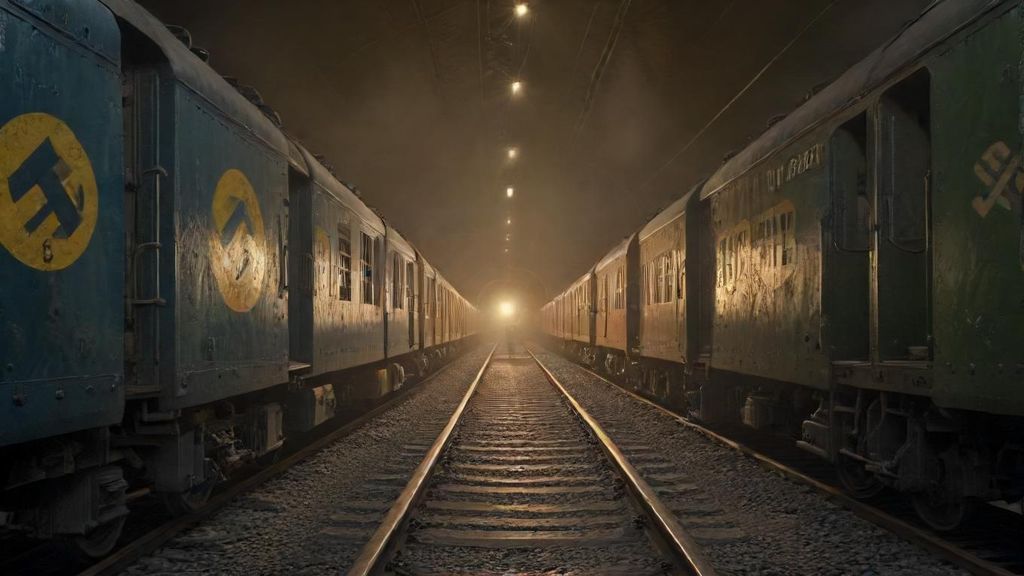
Have you ever heard the captivating whispers about a legendary Nazi gold train supposedly hidden somewhere in Poland? You might think it sounds like something straight out of a movie. But here’s the surprising truth: the idea that the Nazis tried to stash enormous amounts of stolen treasure in secret trains during the chaotic final days of World War II isn’t just a wild story. It’s actually rooted in a very real, very desperate rush by a falling regime to squirrel away all the riches they had illegally taken. So, the short answer is a resounding yes, they absolutely tried to hide their treasures, and trains were definitely part of their plan.
Imagine a giant, organized criminal group that had systematically robbed an entire continent, suddenly facing total collapse. That’s essentially what Nazi Germany was like in late 1944 and early 1945. For years, Hitler’s government had been running what historians call the biggest organized looting operation in history. They stole everything you could imagine: tons of gold from national banks and Jewish victims, priceless artworks from museums and private homes, huge piles of foreign money, precious jewels, and countless personal items taken from those they persecuted. Think of it like a dark, twisted global delivery system, but instead of bringing goods, it was hauling stolen wealth back to Germany.
The sheer amount of stuff they stole was truly mind-boggling. Jewish families, stripped of their homes and lives, had their valuables carefully listed and taken. Entire countries watched their cultural heritage packed up and shipped away. How did they move such an immense haul? They used what they already had: trains. Germany had a massive railway network, and during the war, this became the main way they moved troops, supplies, and, most importantly, stolen wealth. Picture long lines of freight cars, not just carrying war materials, but hidden under tarps, packed with crates of gold, famous paintings, and currency, rumbling across occupied Europe.
As the Allied and Soviet forces closed in during the last months of the war, Nazi officials panicked. The main reason was simple: they couldn’t let their stolen treasures fall into enemy hands. Just like a company going bankrupt might try to hide assets, high-ranking Nazis were desperate to hide or move their loot to safe places – or at least make it hard for anyone else to find. This period, roughly from late 1944 to May 1945, was a time of huge confusion and desperation, especially in areas like Lower Silesia (which is now part of Poland). Routes were cut off, orders were conflicting, and keeping things secret was super important.
How Do We Know This Actually Happened?
The truth is more interesting than you might think. We know this wasn’t just guessing because of strong evidence gathered after the war. According to historians, there are lots of historical records, including Allied spy reports and post-war investigations, that confirm the Nazis tried very hard to hide valuables. These documents describe how treasures were moved and the frantic attempts to keep them safe.
What’s more, many people came forward with their stories shortly after the war ended. Folks like Polish railway workers, who were forced to operate these trains, later talked about seeing wagons filled with mysterious, heavy crates. These personal accounts, combined with official reports of missing inventories and the discovery of hidden stashes, painted a clear picture of a regime trying to cover its tracks and hold onto its ill-gotten gains. Early searches after the war, often based on these very testimonies, further fueled the legend of hidden trains, especially in mountainous areas like Lower Silesia, where tunnels and mines offered perfect hiding spots. Recent discoveries show that many of these searches, even if they didn’t find one big “gold train,” did uncover smaller hidden treasures and confirmed how desperate the Nazis were.
This mix of desperate hiding in a war-torn landscape was the perfect recipe for legends to grow. The specific story of a “gold train” buried deep in tunnels near Walbrzych, Poland, long before the modern news headlines of 2015, came directly from this very real historical situation. It’s like a game of telephone: a very real event – trains carrying treasure – got exaggerated and turned into a specific, mythical object in one location.
So, while the exact whereabouts of the gold train are still a mystery, the historical reality is that the Nazis certainly tried to hide their treasures, and trains played a huge role in those efforts. This background is key to understanding why, even decades later, the thought of a lost Nazi gold train continues to capture our imaginations, making us wonder: what exactly was in these trains, and what ever happened to them?
In August 2015, a quiet Polish town near Wałbrzych suddenly became the center of a global treasure hunt. Two men made a bombshell claim: they had found a legendary Nazi “ghost train,” possibly loaded with gold, jewels, and weapons, hidden deep underground. Imagine your home town, known mostly for its castles and coal mines, suddenly buzzing with talk of secret tunnels and lost riches.
The exciting story unfolded when two treasure hunters, Piotr Koper from Poland and Andreas Richter from Germany, came forward with an astonishing announcement. They said they had located an armored train, buried for decades in a secret tunnel system close to the town. Their tool for this supposed discovery? A georadar, which is a fancy name for ground-penetrating radar – think of it like an X-ray machine that can see what’s hidden beneath the earth without any digging. They even shared blurry images they claimed showed the clear outline of train carriages.
News of this discovery spread incredibly fast, like a viral video. Overnight, Wałbrzych, a town many people had never heard of, turned into a magnet for journalists, history buffs, and fortune-seekers from all over the world. It felt like a real-life Indiana Jones adventure playing out before everyone’s eyes. Local residents, who were initially doubtful, quickly got caught up in the excitement. Imagine your peaceful street suddenly full of news crews and people with metal detectors; it was a huge change for the community.
Polish authorities, understandably, reacted with a mix of caution and growing curiosity. At first, there were the usual doubts you’d expect from government officials. But with so much media attention and Koper and Richter pushing hard, the claims couldn’t be ignored. Then came the moment that really got everyone talking: Piotr Żuchowski, who was Poland’s Deputy Culture Minister at the time, made a huge announcement that echoed around the planet. He declared, based on the radar images and witness accounts, that he was “99% certain” the train existed. This wasn’t just a rumor; it was an official stamp of credibility on a fantastic tale.
How Do We Know This Actually Happened?

That “99% certainty” declaration was a huge moment. Żuchowski’s statement wasn’t just made up on the spot. He explained that he had personally seen images from the ground-penetrating radar, and experts had looked at them too. He even mentioned a story about someone confessing on their deathbed, claiming they helped hide the train during World War II, which made the mystery even deeper. It’s like when a rumor gets confirmed by a respected source, and suddenly everyone believes it.
Koper and Richter believed the train was hidden in a secret tunnel near the Wałbrzych-Świebodzice railway line. They thought it was part of a vast network of underground complexes the Nazis built frantically during the final months of World War II. These big building projects, known locally as Projekt Riese (Giant Project), were kept very secret. This made the train story sound even more believable to many people. Turns out, this area was indeed a hub of wartime building, and much of it is still a mystery.
Because of possible dangers like old bombs or traps from the war, Polish authorities acted fast. The military was called in to conduct an initial check of the suspected site. Their involvement showed how serious the claim was and how risky it could be. It quickly became clear that this wasn’t just a simple treasure hunt; it was a potentially hazardous military operation.
Everyone’s expectations soared. With a government official saying the train was almost certainly real, people started dreaming of incredible wealth. Local businesses in Wałbrzych began selling “gold train” souvenirs, and visitors flocked to the area, hoping to see history unfold. The simple truth is, everyone loves a good mystery, especially one that promises Nazi gold. It’s amazing how fast a speculative claim transformed into a national and international craze.
But at first, there wasn’t much real scientific checking. Koper and Richter had their radar images, but proper ground surveys and deeper investigations still needed to happen. The ‘99% certainty’ was based more on initial impressions and historical stories than on hard scientific proof. All this public excitement and the military’s involvement set the stage for much more serious and detailed investigations. These would either prove the amazing discovery or show that the exciting myth wasn’t true.
So, the claims from August 2015 truly sparked a global craze. A local legend became an international news story, even backed by a Polish government official. The world watched, holding its breath, eager to see if those old rumors about hidden Nazi treasures were finally real. But what exactly did these formal investigations uncover, and did the ‘99% certainty’ hold up under closer examination? That’s what we’ll dive into next.
Has the lost Nazi gold train in Poland ever been found after all these years?

So, has the legendary Nazi gold train in Poland ever been found? The simple, perhaps slightly disappointing, truth is no, it hasn’t. Despite lots of exciting claims and a huge global buzz after an announcement in 2015, years of dedicated searching in Poland have turned up nothing. Can you imagine the massive worldwide news if such a treasure had actually been uncovered? Instead, the time after 2015 became a fascinating, sometimes frustrating, story of surveys, digging, and the slow realization that some amazing legends, even really convincing ones, are still just that: legends. The early hope eventually faded, leaving behind the quiet feeling of a quest that was never finished.
What happened during the extensive searches near Wałbrzych?
The whole story really got going when two treasure hunters, Piotr Koper and Andreas Richter, announced they had found something. They claimed to have used special ground-penetrating radar (GPR) to spot what looked like a buried armored train close to Wałbrzych. Their discovery, shared publicly in the summer of 2015, instantly put this quiet Polish region right into the international news. Suddenly, local officials had a big decision to make: should they brush it off as a wild fantasy, or investigate this exciting possibility? They decided to check it out.
Scientists quickly started their own searches. Teams of geology experts from Kraków’s AGH University of Science and Technology showed up. They used GPR, magnetic, and gravity tools to scan the ground around where the train was supposedly hidden, along the Wałbrzych-Świebodzice railway line. So, what did these experts find? Their report was clear: while they did spot some strange things underground, probably a tunnel, they found “no train.” Dr. Janusz Madej, a professor on the team, simply explained that radar signals can be easily misunderstood. He said it was like trying to find one specific thing in a messy basement with only a flashlight – you might see shapes, but they’re not always what you imagine them to be.
Even though the experts had their doubts, people were just too curious to let the story go. So, in 2016, after getting all the necessary permissions, a massive digging project began. Imagine a huge outdoor archaeological dig, but with much heavier machinery. Volunteers and excavators moved thousands of tons of earth, digging in places suggested by Koper and Richter’s first scans. They dug deep trenches, carefully searching the area for weeks, hoping to uncover some “big construction project” left behind by the Nazis. But week after week, all they found was soil, rock, and bits of old railway lines. The whole operation ended with a clear truth: no train, no gold, and no important Nazi items were ever truly discovered.
Why does the gold train legend endure despite no physical evidence?
Even though no one ever found the train, the story just won’t go away. The reason why is more interesting than you might think. This isn’t just about a train; it’s about the strong appeal of a lost treasure mixed with the deep, dark mysteries of World War II. The Nazis definitely stole a huge amount of wealth, and the idea that some of it is still out there, hidden somewhere, really grabs our imagination. It’s like a big mystery that’s just too thrilling to give up on.
Rock experts and historians have always been really doubtful, and that’s a big part of this story. They pointed out how incredibly hard it would be to secretly bury a whole train. Plus, there are no real wartime papers that ever mentioned anything like it. The fights between Koper and Richter over who would own the train if it were found also kept the story in the news, showing just how much money and fame was on the line if the train turned out to be real.
In the end, the gold train has become much more than just a possible historical object; it’s a strong symbol. It stands for the lasting effects of the war, the dream of sudden riches, and how much people love secrets. It joins other lost Nazi treasures, like the legendary Amber Room, showing a shared memory that mixes real facts with strong hope. So, while the immediate search near Wałbrzych didn’t find anything, the legend itself still draws people in. It helps shape how the local area sees itself and brings in curious visitors. This shows just how powerful myths can be, even when science proves them wrong. We’ll dive deeper into how these historical legends affect our understanding of the past in the next chapter.