
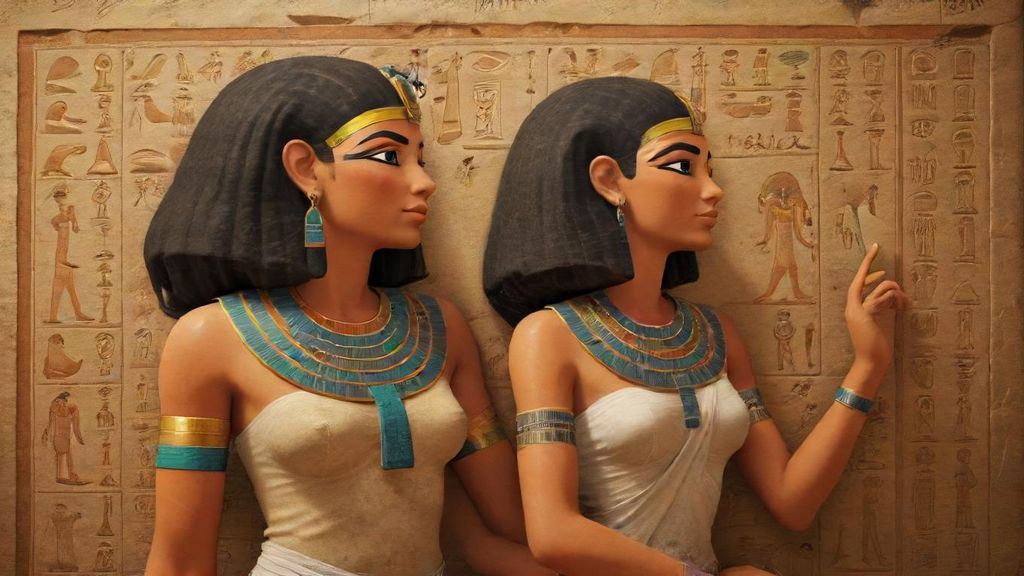
Imagine if, overnight, all your emails, websites, and digital documents suddenly turned into a jumble of meaningless symbols. All our history, our memes, our critical information – locked away, unreadable for centuries. That’s pretty much what happened to ancient Egyptian hieroglyphs. The simple answer to why they became a lost language is that they slowly faded away. This happened as people started using simpler ways to write and as their culture and religions changed dramatically. This amazing writing system, used for over three thousand years, eventually went silent, leaving a huge gap in our understanding of one of history’s greatest civilizations.
For more than 3,000 years, hieroglyphs were the voice of ancient Egypt. They were beautiful and complex symbols. They used pictures, sounds, and even ideas to represent words. You’d see them everywhere, from giant temple walls to important government messages. Think of them as the ultimate “fancy script” – very complicated and sacred, mostly carved on grand monuments and in tombs. But for everyday tasks, Egyptians needed something faster.
So, over many centuries, two simpler versions developed. First came Hieratic, a cursive (or flowing) script used by priests and officials. Then, even later, came Demotic. This was an even faster, more simplified way to write, used for daily life, business, and stories. It was like going from fancy calligraphy to quick shorthand notes; the language itself stayed the same, but how it was written changed a lot to make things easier.
How did a new belief system silence ancient voices?
The real turning point arrived with a new religion: Christianity. As the Roman Empire grew and Christianity spread across Egypt, the old gods, goddesses, and their temples slowly lost their importance. Hieroglyphs were so closely connected to ancient Egyptian religious customs and fancy ceremonies that people started seeing them as pagan or outdated. They were no longer the language of powerful leaders or the gods. This wasn’t a sudden ban, but a slow, quiet replacement.
Historians say that the scribes, who used to spend years learning the complex hieroglyphic system, began to vanish. Why spend so much time learning a complicated script for gods nobody worshipped anymore, and for temples that were falling apart?
The truth is even more interesting: Egyptians themselves started speaking and writing differently. They adopted Coptic. This was still the ancient Egyptian language, but it was written using the Greek alphabet. They even added a few extra letters from Demotic to capture sounds not found in Greek. This was a huge shift! It made reading and writing much easier for the growing Christian population. Coptic became the language for everyday life and, crucially, the language of the church.
The very last hieroglyphic inscription we know of was carved at the temple of Philae in southern Egypt, dating back to 394 AD. Just imagine: over three thousand years of continuous use, ending quietly on a temple wall. After this date, no one carved new hieroglyphs. The knowledge just faded away.
We know this because after the 5th century AD, there’s no record of anyone understanding them. It’s like having a computer program, but the operating system it needs no longer exists. The code is there, but no machine can run it. The final blow came when the Roman Empire began to decline, which made Egypt even more culturally isolated. The very last people who understood the ancient script simply passed away, taking their knowledge with them.
Suddenly, Egypt’s towering monuments, colorful tombs, and countless papyrus scrolls became completely silent. A civilization that had written down its every triumph and sorrow for thousands of years was now mute. Its story was locked behind a language barrier, leaving generations of scholars and adventurers completely confused.
This was the deep mystery that hung over Egypt for more than 1,400 years. It was a silence that lasted until a remarkable discovery offered the first glimmer of hope – a hope we’ll explore next.
How did the Rosetta Stone’s discovery ignite the quest to decipher hieroglyphs?

The Rosetta Stone’s discovery in 1799 ignited the quest to decipher hieroglyphs because it offered a unique, side-by-side translation of the same message in three different scripts, including the long-lost hieroglyphs and familiar ancient Greek. This gave scholars the critical “answer key” they needed to finally crack the code of ancient Egypt after centuries of silence. Imagine a scorching summer day in 1799, deep in the Egyptian desert. French soldiers, part of Napoleon’s big campaign, were busy making an old fort stronger near a town called Rosetta. Suddenly, a lieutenant named Pierre-François Bouchard spotted something amazing: a large, dark slab of stone, broken but covered in strange writing. This dusty find wasn’t just any old rock; it was the Rosetta Stone, and it held a secret that would unlock 3,000 years of Egyptian history.
Here’s what they discovered: The stone was a puzzle, but one that came with its own solution. It showed the same message written in three different ways: the mysterious hieroglyphs at the top, a flowing script called Demotic in the middle, and familiar ancient Greek at the bottom. Think of it like finding a secret message in a language you don’t know, but right below it, you see the exact same message translated into English. The simple answer is, the Greek text was the key. It offered a direct way to compare the confusing Egyptian writings that no one had been able to read for centuries.
This was a huge shift in how people thought. For ages, European scholars had looked at hieroglyphs and believed they were purely symbolic pictures. They thought each drawing represented a whole idea, not individual sounds, like a secret code. If that were true, a side-by-side translation wouldn’t help much. But the Rosetta Stone suddenly offered strong proof that maybe these ancient drawings were more like an alphabet or a phonetic system, much like the letters we use today. This sparked a big intellectual race, a sudden realization that ancient Egypt could speak again after thousands of years of silence.
What Made This Discovery So Special?
The Rosetta Stone quickly became a very valuable prize. When British forces beat the French in Egypt in 1801, the stone, along with other ancient treasures, was given to them as part of the Treaty of Alexandria. It then traveled to the British Museum, where it became hugely famous overnight. This wasn’t just a military trophy; it was the biggest mental challenge of the era. News of this three-language text created fierce competition among Europe’s smartest thinkers. It was like the space race of its time, with scholars across the continent all trying to be the first to crack the code and win huge recognition.
Historians say the stone’s arrival in Europe started a time of endless, often frustrating, research. Leading language experts immediately got to work, even before the British Museum officially received it. One of the first was Antoine Isaac Silvestre de Sacy, a French scholar. He managed to figure out some names in the Demotic writing, mostly by seeing where certain patterns showed up in both the Demotic and Greek parts. This was a key first step, proving that Demotic might use sounds, not just pictures. Building on this, a Swedish scholar named Johan David Åkerblad focused on the Demotic. He correctly identified all the proper names and even figured out the sounds for some of the letters. Imagine trying to understand a strange language with no dictionary, just a hunch!
Then came Thomas Young, a super smart English scientist, sometimes called “the last person who knew everything.” Young made amazing breakthroughs. He saw that the hieroglyphs often put royal names inside oval shapes, which we now call cartouches. He compared the cartouches for “Ptolemy” and “Cleopatra” (found on a different monument, but the idea worked for the Rosetta Stone). This confirmed that hieroglyphs weren’t just pictures; some stood for sounds. He worked out the sounds for several hieroglyphic signs inside these names, proving that some hieroglyphs indeed represented sounds, not just whole ideas. This was a huge discovery, even though he also struggled with the strong belief that hieroglyphs were mostly pictures. He didn’t fully crack the whole system, but his work was like building the first few important floors of a huge skyscraper. He helped us understand that the writing system was complex, using a mix of sounds and symbols, making it trickier than anyone first thought.
The truth is more interesting than you might think: these early tries, even with their limits, set up the vital foundation. They showed that the stone really was a “Rosetta Stone” – a key – and that the ancient Egyptian language, long silent, could actually be brought back to life. This quest, sparked by a broken stone in the desert, would soon find its final hero, leading to the full understanding of a forgotten world.
How did deciphering the Rosetta Stone unlock 3,000 years of Egyptian history?

The deciphering of the Rosetta Stone, primarily by Jean-François Champollion, unlocked 3,000 years of Egyptian history by revealing that ancient Egyptian hieroglyphs were not just pretty pictures, but a clever mix of symbols and sounds. For centuries, this beautiful script had been a complete mystery. Champollion’s groundbreaking work, announced in 1822, finally provided the key, allowing scholars to read thousands of ancient texts and bringing the forgotten stories of pharaohs, gods, and everyday life back to vivid life.
For a long time, experts believed hieroglyphs were just symbols, with each picture meaning a whole idea. Trying to read them was pure guesswork. But Champollion was different. He was a language genius, fluent in many ancient tongues. Most importantly, he knew a lot about Coptic. Why Coptic? It’s the very last stage of the ancient Egyptian language, still used by Egyptian Christians today. Other scholars didn’t pay much attention to it, but Champollion understood Coptic held the sounds and grammar of the pharaohs’ language. He learned to think like an ancient Egyptian, and that was his secret weapon.
How Did Champollion Crack the Code?
Champollion’s approach was very organized and careful. He compared the three different scripts on the Rosetta Stone: Greek (which he could read), Demotic (a later Egyptian writing style), and the Hieroglyphic. He paid close attention to the oval rings, known as cartouches, in the hieroglyphic text. He guessed these rings probably held the names of kings and queens.
Here was his big “aha!” moment: Hieroglyphs weren’t just symbols after all. They were a clever mix. Some symbols stood for whole ideas (these are called ideograms), but many others stood for sounds, just like our letters. This was a game-changer! He started with a cartouche that he believed spelled the name Ptolemy, matching it to the Greek text. Because he knew how Ptolemy sounded in Coptic, he began to figure out what sounds the hieroglyphs inside it made.
Then he tried this method on another cartouche, which was thought to spell Cleopatra. By matching known Greek spellings to the hieroglyphs, he confirmed and built his list of hieroglyph sounds. It was like solving a super tricky word puzzle where finding a few key letters suddenly helps you solve everything else. As Dr. Joann Fletcher, a well-known Egyptologist, explained:
“Champollion’s great genius was understanding that hieroglyphs were not just pretty pictures, but a functional script that conveyed sounds.”
This wasn’t just about figuring out a few words; it was about understanding how the whole language worked. Champollion had essentially created his own sound-based Rosetta Stone, finally giving a voice to those silent pictures.
When this breakthrough was announced in 1822, its impact was huge. Suddenly, ancient Egyptians could speak to us. Their temples, tombs, and papyri – once amazing but silent – now came alive. We could finally read the stories of pharaohs like Ramses II, learn about gods like Osiris, and discover the details of their everyday lives. This discovery changed the study of Egypt from guesswork into a proper scientific field. It opened up 3,000 years of detailed writings, and forever changed how we saw this incredible civilization.
Champollion’s breakthrough truly gave a whole culture its voice back. It showed us a much richer and more complex ancient world than we ever imagined. Next, we’ll see how these newly readable texts completely changed our understanding of Egyptian society and religion.