Imagine your city suddenly booming, drawing hopeful people and desperate workers from everywhere. At the same time, a few powerful individuals get incredibly rich, while everyone else struggles just to survive. That’s a lot like what happened in Chicago in the late 1800s. It quickly turned the city into a powder keg for labor unrest.
So, why was Chicago such a dangerous place for workers? Simply put, it was a rapidly growing city where the gap between the super-rich and the struggling working class became enormous. This huge divide was fueled by brutal factory conditions and a desperate, shared demand for a fairer workday. This chapter will reveal how this chaotic, tension-filled era set the stage for a major explosion.
What Made Chicago So Explosive?
The real story is more captivating than you might expect. Chicago in the late 19th century was like a modern boomtown, but on fast-forward. It grew faster than almost any other city in America. Trains constantly arrived from all directions, bringing raw materials and, more importantly, countless immigrants. These newcomers, from places like Germany, Ireland, and Bohemia, came hoping for a better life. Think of people chasing opportunities in a new tech hub today.
But instead of good jobs, they often found grueling work. They toiled in meatpacking plants, steel mills, and factories for incredibly long hours—often 10 to 12 hours a day, six days a week. And their wages were barely enough to keep them alive.
Life was incredibly harsh. Picture this: dangerous machines ran without safety guards. Ventilation was poor. Workers faced the constant threat of injury or losing their job. There were no safety nets at all. No unemployment benefits. No healthcare. If you got hurt, you were simply out of luck.
This desperate situation naturally pushed workers to unite. They started forming labor unions, believing that together, they could demand better treatment. Their main goal? The eight-hour workday. This wasn’t about being lazy. It was about having a little time for family, for learning, or simply for living beyond endless work. The rallying cry, “Eight hours for work, eight hours for rest, eight hours for what we will!” became a powerful song that united thousands.
As these movements grew, so did more radical ideas. When people feel ignored and unfairly treated, some start looking for big changes. In Chicago, many frustrated workers were drawn to anarchism. Now, don’t immediately picture cartoon bombs and chaos. In simple terms, for many at the time, anarchism was a political idea. It suggested society could organize itself without a powerful, controlling government – especially one they felt was only protecting wealthy factory owners at their expense. Anarchists believed in communities that governed themselves and in taking direct action to bring about change. They were very vocal in Chicago, publishing newspapers and holding rallies that sparked both hope and fear.
The growing tension between these rising labor movements, the powerful factory owners, and the police force created a highly dangerous atmosphere. The police were often seen as the owners’ private army. They frequently broke up strikes, sometimes with brutal force, which only made things worse. It was like a constant tug-of-war where one side held all the power, and the other fought desperately for basic human dignity. Historians say the sheer number of strikes and clashes that plagued the city proves how much the conflict was growing.
This boiling situation reached a breaking point just days before the Haymarket incident. It happened at the McCormick Harvester Works. On May 3, 1886, during a huge strike for the eight-hour day, workers gathered near the McCormick plant. Non-union laborers, often called “scabs,” were still working inside. When striking workers confronted these scabs, police arrived and fired into the crowd. They killed at least two workers and wounded many more.
This wasn’t just another clash. It was a brutal, bloody moment that sparked outrage across the city’s labor community. It immediately led to calls for a protest rally the very next day. This recent violence, combined with years of simmering anger and harsh conditions, made the city a tinderbox ready to explode.
So, Chicago wasn’t just a city with some labor problems. It was a pressure cooker. Rapid industrial growth, desperate immigrants, radical new ideas, and violent clashes had brewed a dangerous storm. This explosive mix of social and economic problems, plus the tragic events at McCormick, set the stage for one of America’s most infamous labor disputes. This volatile atmosphere, where hope and desperation collided, would soon erupt into the fateful events we’ll explore next.
How did a peaceful labor protest turn into the deadly Haymarket bombing?

The peaceful labor protest in Chicago’s Haymarket Square on the night of May 4, 1886, turned deadly when police arrived to disperse the thinning crowd, and someone threw a bomb. What began as a call for an eight-hour workday quickly escalated into chaos, culminating in a sudden explosion and a violent shootout. This shocking event, fueled by rising tensions between workers and authorities, left a permanent mark on American history and changed how people viewed labor activism.
Earlier that evening, the rally was much bigger, drawing thousands to protest recent police brutality against striking workers at the nearby McCormick Reaper Works. The main goal was to fight for the eight-hour workday, something workers desperately wanted after toiling ten or twelve hours a day. Speakers like August Spies and Albert Parsons gave passionate, sometimes fiery, speeches from a flatbed wagon. These powerful voices urged workers to stand up for their rights. Still, the mood remained largely orderly, even festive at times. People listened, chatted, and shared a common purpose, much like a community gathering or a local demonstration today. Despite some strong rhetoric, there was no immediate sign that disaster was about to strike.
What Happened When the Police Arrived?
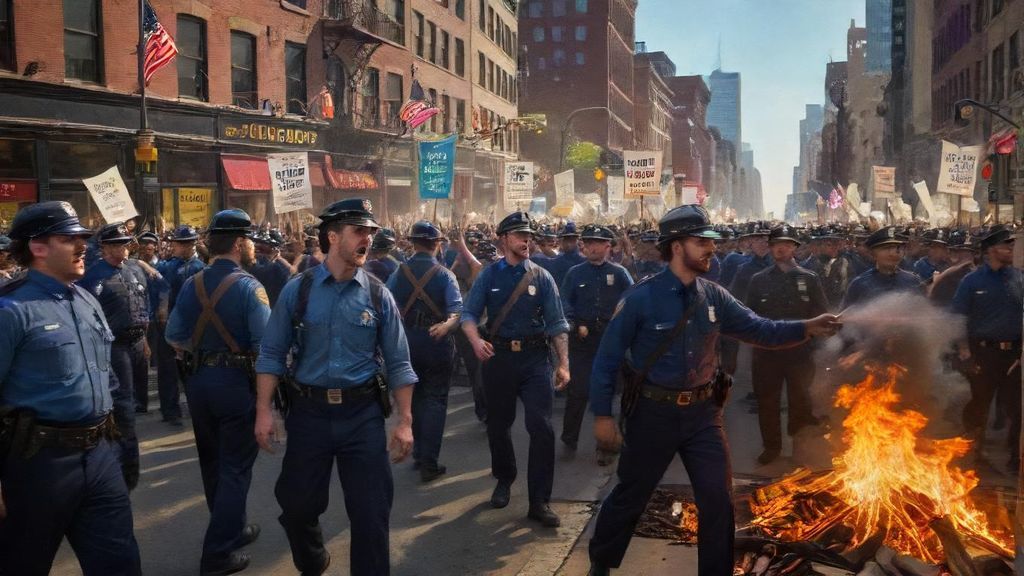
As the night grew later, rain started to fall, and the crowd naturally began to shrink. By the time the last speaker, Samuel Fielden, was talking to the few hundred people left—maybe 150 to 200, most estimates say—the mood was much calmer. Fielden himself was almost done, even telling people they should probably go home. Then came the turning point: a group of 176 police officers, led by Captain William Ward and Inspector John Bonfield, marched into the square. This was no quiet arrival; it was a large, uniformed force moving straight into the dwindling crowd. Imagine a SWAT team suddenly storming a sports event when only a few fans are left after the game – it was that jarring.
Captain Ward then stepped forward and declared:
I command you, in the name of the law, to disperse immediately and peaceably.
Fielden, still on the wagon, reportedly began to reply, saying:
Why, Captain, we are peaceable.
But he never finished his sentence. Because right then, a cylindrical bomb—witnesses later described it as an “infernal machine“—was suddenly thrown from somewhere in the crowd toward the police. It flew through the air and exploded with a huge roar, spraying metal shards and debris into the officers.
Who Was Responsible for the Bomb?
The explosion was deafening, a flash of fire and chaos that instantly threw the square into pandemonium. Records show the blast killed Officer Mathias J. Degan almost at once and wounded many others. What came next was a terrifying burst of gunfire, a chaotic exchange between police, who immediately began shooting into the crowd, and some armed people within the crowd, who shot back. The truth is more complicated than you might think: in all the immediate confusion, nobody knew for sure who threw the bomb or who fired the first shots after it exploded. Amidst the screams and smoke, people desperately tried to run, trampling over each other in a desperate scramble for safety. Several more police officers later died from their injuries, making the total seven. An unknown number of civilians—some guess four, others say more—were also killed or badly hurt in the chaos. This sudden, violent turn left a deep scar of horror and an immediate demand for answers.
The scene was one of unimaginable terror and overwhelming confusion. Lives were lost, and the events were truly tragic, but figuring out who was really responsible was far from clear right away. This shocking incident sparked an intense hunt for those accountable. It turned a local tragedy into a national scandal and led to a harsh crackdown on labor activists, a story we’ll dive into in the next chapter.
How Did the Haymarket Bombing Impact American Labor Movements and Justice?

Imagine one act of violence at a protest completely changed how your country saw a whole movement, totally shifting the fight for basic rights. That’s exactly what happened after Chicago’s Haymarket bombing in 1886. Right away, fear swept through the city, leading to quick and often unfair actions. This deeply hurt the American labor movement and made people question what justice truly meant. That chaotic night didn’t just stop a protest; it started a long legal battle that would delay workers’ rights for years. It also became a powerful symbol of struggle and unfairness, but surprisingly, it eventually sparked a global holiday too.
After the bomb exploded, panic took over Chicago. Everyone desperately wanted someone to blame. Police didn’t just look for the person who threw the bomb; they rounded up well-known anarchist and labor organizers, even those who weren’t even at the square when the blast happened. These eight men, soon called the Haymarket Eight, became the public face of a scary new threat to many Americans. It quickly became clear that authorities weren’t really trying to find the bomber. Instead, their goal was to shut down radical voices pushing for an eight-hour workday and better working conditions. It was a clear case of blaming people just because of who they knew or what they believed.
The trial that followed was, to say the least, a huge show of unfairness. Historians agree that the prosecution hardly even tried to link the defendants directly to the bombing. There was no strong proof any of the accused threw the bomb or knew who did it. Instead, the whole case focused on their speeches, writings, and their anarchist beliefs—which was a really scary new idea back then. The prosecutor even openly said:
Law is on trial. Anarchy is on trial. These men have been singled out and indicted because they are leaders. They are not more guilty than the thousands who follow them.
You can think of it like this: it wasn’t really about a crime; it was about putting an entire way of thinking on trial. This showed how easily justice could bend under public fear.
What Happened Next? The Harsh Sentences
Even with so little direct proof, seven of the eight men were sentenced to death, and one got a 15-year prison term. Four of them—August Spies, Albert Parsons, Adolph Fischer, and George Engel—were hanged on November 11, 1887. Louis Lingg sadly took his own life in his cell the day before. These incredibly harsh punishments, given mostly because of their political beliefs and not their actions, sparked intense fear and hatred against anarchists all over the country. Think about it: what if a strong political opinion you posted online today could lead to such a terrible fate without any proof of violence? Suddenly, anyone who wanted big changes was seen as a dangerous, bomb-throwing anarchist out to destroy society.
This intense fear badly hurt the growing American labor movement. The push for an eight-hour workday and better conditions mostly fizzled out. Unions, worried about public anger and legal trouble, pulled away from anything that seemed too radical. It’s like a new company losing all its funding overnight because a rival faced a scandalous, unfair accusation. The movement didn’t vanish, but it went quieter, slowly trying to rebuild its reputation. This major setback delayed important labor changes for decades, holding back the dreams of countless working families.
But the story didn’t end with those executions. The clear injustice of the trial became a call to action. Six years later, in 1893, Illinois Governor John Peter Altgeld did something very brave. He pardoned the three remaining defendants (one had died in prison), saying the trial was a mockery of justice and that the men were innocent. Altgeld’s decision was incredibly controversial, but it confirmed what many already suspected: the Haymarket trial was a political witch hunt, not a fair legal process.
Haymarket left a complicated and lasting impact. While it first badly hurt the American labor movement, it also grew into a strong symbol of workers fighting against unfairness. It directly led to International Workers’ Day, or May Day, which people still celebrate worldwide every May 1st. This yearly holiday, born from the fight for the eight-hour day and remembering the Haymarket martyrs, represents workers everywhere standing together for their rights. Haymarket taught us a tough lesson: justice can be very delicate when fear takes over. It showed that legal systems can be used against ideas, not just actions, and that fair treatment at work is closely tied to our basic freedoms.
In the end, Haymarket left a permanent mark on American labor and how people understood justice. It showed just how powerful public opinion can be, and the terrible results of ignoring fair legal steps for political gain. The truth is more interesting than you might think: this one event, born from chaos, still matters today. It makes us keep thinking about what real justice looks like. Its lessons can still be heard in today’s talks about free speech, workers’ rights, and the tricky balance between keeping order and allowing people to protest, long after the smoke cleared from that fateful Chicago night.