
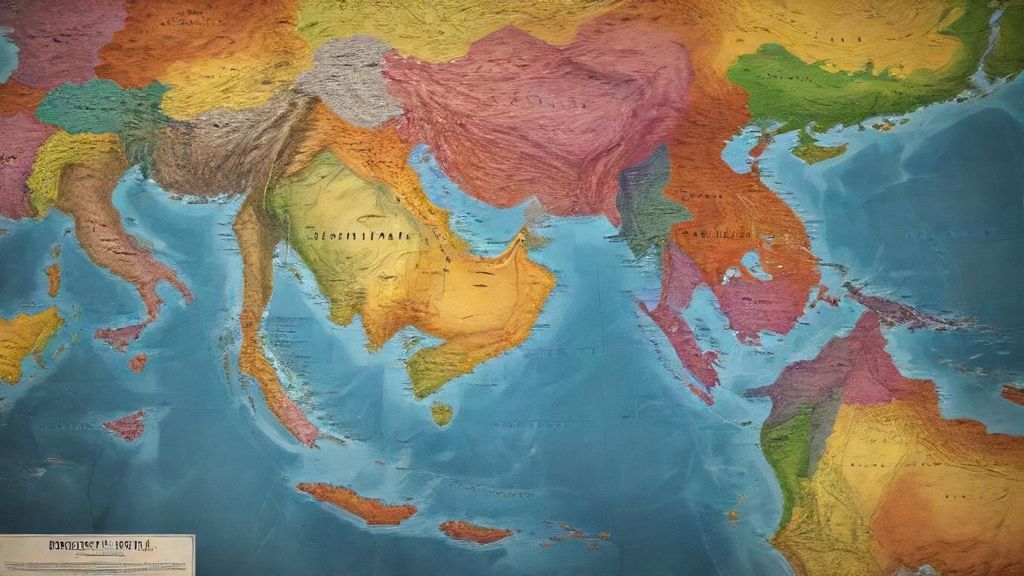
British India split into the independent nations of India and Pakistan in 1947 due to a combination of factors. These included growing demands from Indians for freedom, the British government’s strategies to maintain control, and a tragic increase in distrust between Hindu and Muslim communities, who held very different ideas about their future. Imagine trying to untangle a knot that had been tightening for nearly a century, with many hands pulling in different directions – that’s a bit like what happened.
What led to the growing divide?
The British had a clear strategy. For centuries, India was ruled by the British Raj, and their approach was a classic example of ‘divide and rule.’ Think of it like a clever boss who encourages different teams to compete, stopping them from ganging up on management. It was easier for the British to control such a huge and varied population if they highlighted existing differences, especially between the larger Hindu and significant Muslim communities.
Historians agree this wasn’t by chance. The British often created policies specifically to keep political groups separate. For example, in 1909, they introduced “separate electorates.” This meant Muslims voted for Muslim leaders, and Hindus for Hindu leaders. This made political groups feel more distinct rather than encouraging a shared Indian identity.
As Indian nationalism grew strong in the early 20th century, leaders like Mahatma Gandhi and the Indian National Congress championed a dream: a united, independent India. Gandhi, with his belief in non-violence, imagined a diverse nation where people of all religions could live together peacefully. But as the call for independence got louder, some Muslim leaders began to worry about their community’s future in a country where Hindus would be the majority.
This growing concern found its strongest voice in Muhammad Ali Jinnah, who led the All-India Muslim League. Jinnah had initially supported Hindu-Muslim unity. However, he became convinced that Muslims needed their own separate country to protect their rights and way of life. He argued that Hindus and Muslims were two distinct ‘nations’ that couldn’t live together peacefully in one state. His vision was a completely separate nation called Pakistan.
In contrast, Jawaharlal Nehru, a key leader in the Congress party, shared Gandhi’s ideal of a secular, unified India. He believed that a person’s religion shouldn’t decide national borders.
The 1940s brought immense pressure. After the huge cost of World War II, Britain was broke and desperate to give up its empire. They wanted out, and quickly. But the political standoff between Congress, pushing for one united India, and the Muslim League, insisting on Pakistan, seemed impossible to break.
Many negotiations took place, including the important Cabinet Mission Plan of 1946, which tried to find a middle ground—maybe a loose grouping of states. However, these efforts failed. This was mostly due to deep mistrust and different understandings of the proposals.
What’s striking is how quickly things got worse. In August 1946, Jinnah called for “Direct Action Day” to push for Pakistan. Tragically, this led to widespread violence between communities, especially in Calcutta, where thousands died. This event deeply increased the fear and division, making the idea of a united India seem more and more impossible.
Faced with growing violence and an urgent need to leave, the British government, led by Prime Minister Clement Attlee, decided that splitting the country was the only possible, though tragic, solution. Recent discoveries show the British decision wasn’t just about doing the right thing. It was also practical: they simply didn’t have the money or the desire to keep order in a region that was quickly falling apart.
So, the split in 1947 happened because of several major factors: the British legacy of ‘divide and rule,’ the different ideas of powerful leaders like Gandhi, Nehru, and Jinnah, and the frightening outbreak of violence between communities. This violence convinced the British that a quick division was their only way to make a fast exit.
This set the stage for one of history’s largest and most heartbreaking movements of people—a story that continued long after the new maps were drawn. We’ll explore those immediate, painful consequences next.
How did the 1947 Partition of India unfold on the ground?

Imagine your town suddenly split in half by a new line, dividing homes, families, and even fields, with almost no warning. That’s a bit like what happened during the 1947 Partition of India, but on a much bigger scale than you can really picture. Simply put, it exploded into chaos, fear, and terrible violence. It wasn’t a careful split, but more like a sudden, explosive break-up that left millions desperately trying to survive. The real story is far more compelling, and heartbreaking, than many people know about the creation of two new countries.
The whole thing started with an impossible deadline. Sir Cyril Radcliffe, a British lawyer who’d never even visited India, was given mere weeks to draw the new borders for India and Pakistan. He had to decide the future for millions using old maps and numbers, often without truly grasping the mix of cultures and religions in the area. Imagine asking someone to design a whole country’s highway system with only a tourist map and no local experience. The result was the notorious Radcliffe Line. Historians confirm it cut through villages, farms, and even individual houses without much thought. Communities that had lived together for hundreds of years suddenly found themselves on the “wrong” side of this rushed border, causing instant panic.
What’s truly striking is how totally unprepared everyone was for the massive number of people who would have to move. The new governments of India and Pakistan, barely able to stand on their own, just didn’t have the basics—no police, no army, no functioning government—to handle such a huge shift in population or to keep things orderly. It was like trying to run a marathon without any water or medics along the way. Right after the Partition, everything fell apart. There was a total loss of control, leading to one of the biggest movements of people ever seen in history.
What evidence supports the scale of this chaos?
Historical records, especially the heartbreaking stories from survivors, paint a clear picture. We know that between 10 and 20 million people suddenly became refugees. They moved across the quickly drawn borders in both directions: Muslims went towards Pakistan, while Hindus and Sikhs headed for India. They walked for miles in huge groups, rode on dangerously overcrowded trains sometimes called “trains of the dead,” or squeezed onto bullock carts. Many accounts describe these journeys as incredibly dangerous, turning into terrifying ordeals. The violence wasn’t just one way; it was a brutal cycle of riots, attacks, and terrible acts committed by Hindus and Sikhs against Muslims, and by Muslims against Hindus and Sikhs. Villages were set on fire, women were kidnapped, and entire families were wiped out. Newer studies suggest the death toll was anywhere from one to two million people, though the exact numbers are still argued over.
Historical accounts show how cities like Amritsar and Lahore, once lively and diverse, became war zones. When law and order collapsed, unofficial armed groups and angry mobs stepped in, filling the void and unleashing focused violence. The human price for this rushed division was enormous, leaving deep wounds that still affect people today. Whole generations grew up haunted by being forced from their homes, by loss, and by seeing terrible acts of cruelty.
This brings us to a big question: how did two new countries, created from so much suffering, manage to get started? The next chapter will look at the immediate problems faced by the brand-new governments of India and Pakistan as they tackled the huge job of building nations out of the wreckage of Partition.
What long-term impact did the 1947 Partition have on India and Pakistan?

Imagine two close neighbors, suddenly forced to draw a jagged line right through their shared garden, their homes, and even their families. That’s a bit like what happened with the 1947 Partition of India. It wasn’t just one event; it started a chain reaction that still shapes millions of lives, politics, and feelings in India, Pakistan, and Bangladesh today. Simply put, the Partition created new countries. But it also left deep, lasting scars on how people saw themselves and their nations. It made their politics unstable and created a legacy of division and unsolved problems that still affect everyone.
The immediate fallout was obvious, but its long-term effects have been truly massive. Right away, it changed what it meant to be Indian or Pakistani. India, led by figures like Jawaharlal Nehru, famously picked a path of secular democracy. This meant it aimed to be a home for people of all faiths, no matter how different they were. This choice, made right after the terrible religious violence of Partition, became a core part of India’s national identity. Pakistan, created as a homeland for Muslims, struggled with its own identity. It kept debating how much religion should be part of its government. This fundamental difference in their founding principles is like two companies starting from the same seed but with completely different core values and mission statements from day one.
How did Partition create lasting fault lines?
Maybe the most obvious and painful lasting effect is the ongoing land arguments that have ruined their relationship for many decades. The most famous one, naturally, is Kashmir. Kashmir isn’t just land; it became the biggest symbol of Partition’s unresolved problems. What’s truly interesting is that this fight wasn’t cleanly resolved when the borders were first drawn. This led to constant diplomatic arguments and even actual wars. History books and records show us this with the Indo-Pakistani Wars of 1947, 1965, 1971, and the Kargil conflict in 1999. All these fights were tied to Kashmir in some way. The presence of the Line of Control (LoC), which divides Kashmir, is a constant, stark reminder of this unresolved wound, much like a permanent fence between two feuding families that never gets taken down.
But it wasn’t just about wars. The human cost was absolutely huge. The Partition caused one of the biggest forced movements of people ever recorded. An estimated 14-16 million people were torn from their homes. These weren’t just statistics; they were real families who lost everything and became refugees in a single night. This massive shift didn’t just end after a while. It completely changed the social and economic future of both India and Pakistan. Cities like Delhi and Karachi suddenly saw huge numbers of new people arrive, which changed their populations, cultures, and economies. Think of it like a sudden, massive disruption to a supply chain, but instead of goods, it’s millions of lives being rerouted, often without any safety net.
Lastly, the deep emotional wounds and memories of Partition still affect the culture and politics of the region today, passed down from one generation to the next. It’s not just something that happened in the past; it’s a living memory, shared through family stories, books, and art. Historians and countless personal stories tell us that the tales of violence, loss, and betrayal created a deep feeling of mistrust and hatred. For example, a lot of Urdu literature from the mid-1900s onwards directly deals with the huge impact of Partition, showing a shared, deep wound. It’s surprising how often these strong, often sad, memories pop up in political talks. They can either deepen divisions or, sometimes, even hint at a way to make peace. The truth is, it’s more gripping than you might imagine: the echoes of 1947 still shape daily life and news. This shows that some wounds take generations to heal – if they ever do. These lasting memories and divisions are still super important in deciding how these countries act towards each other and run their own affairs. They truly set the stage for whatever complicated story comes next in their shared past.