
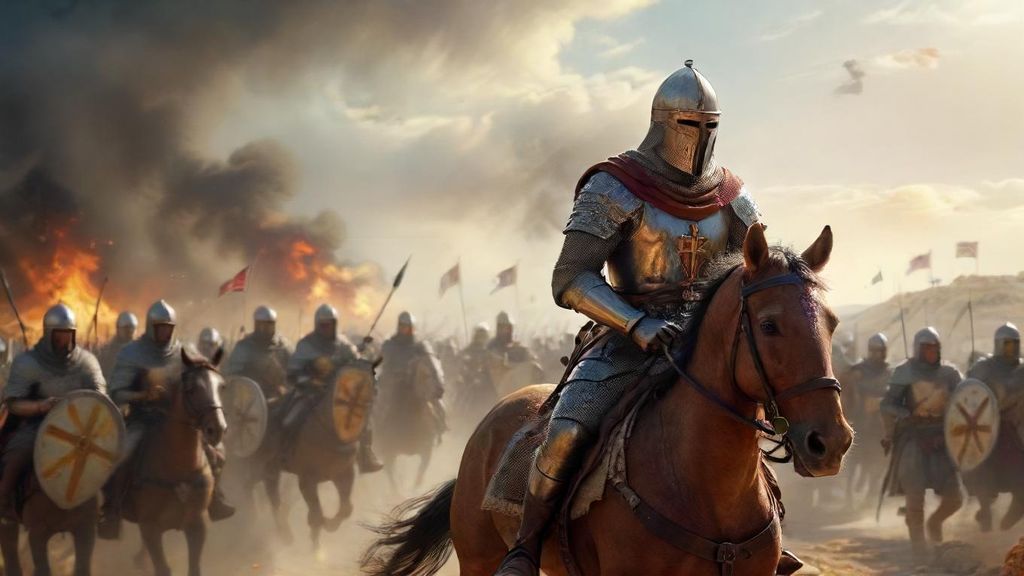
Imagine planning a massive road trip for years, crossing continents, with no idea if you’d ever make it back. Now, picture doing all that while expecting to fight deadly battles, believing it was God’s direct command. That’s a glimpse into how Crusader knights got ready for and survived the incredibly long journey to the Holy Land.
Unlike today’s armies, they didn’t prepare with standardized boot camps. Instead, their commitment was deeply personal, fueled by faith. Their training wasn’t a special course; it was simply a part of their entire life, from childhood.
The idea of a Crusade really took off after a powerful speech by Pope Urban II in 1095, delivered in Clermont, France. He told knights to stop fighting each other and instead use their fighting skills to take back Jerusalem. Many answered this call because of a huge promise: a “plenary indulgence.” This meant all their sins would be completely forgiven.
Think of it like a spiritual get-out-of-jail-free card, guaranteeing them a place in heaven. For warriors who lived by the sword and often committed violent acts, this was an incredibly tempting offer – a direct path to saving their souls. They weren’t just soldiers; they were holy pilgrims making a sacred promise.
Taking the cross was a serious, public promise. A knight would literally sew a cross onto his clothes, showing everyone he was a Crusader. This was no casual choice; it meant leaving behind his lands, family, and wealth. Knights often sold or mortgaged everything they owned just to pay for the journey.
This deep commitment changed him from a local lord into a warrior for Christ. Imagine it like a binding contract that completely reshaped his life and future, with serious consequences for his soul if he broke his promise.
What Was Their “Training” Like, and What Did They Carry?
Unlike today’s soldiers who go through tough, official boot camps, medieval knights prepared differently. Their military training began when they were just boys. Noble kids learned from a young age how to ride, fight with swords, lances, and shields, and wear heavy armor. They picked up these skills through constant practice, pretend battles, and jousting tournaments.
So, when the call to Crusade arrived, most knights were already highly skilled individual fighters. However, they weren’t necessarily part of a big army that trained together as one team.
Their main gear was surprisingly basic, but also very expensive. A knight wore a heavy chainmail shirt, called a hauberk, which protected him well from cuts. He also carried a helmet, a shield, a long sword, and a lance. Crucially, he needed at least one warhorse for battle and travel, plus often several packhorses.
But here’s the fascinating part: the huge problem of managing everything else. They had to bring all their supplies – food, tools, spare weapons, and often a whole group of squires, servants, and even people who weren’t fighters. Imagine trying to move a small village across dangerous lands!
The journey itself was a huge, terrifying ordeal. For the First Crusade (1096-1099), most people traveled by land across Europe, through the Balkans, and into what is now Turkey. Picture tens, sometimes hundreds of thousands, trying to move through areas with not much food or water. They often faced unfriendly locals or even outright bandits.
Here’s a surprising fact: disease, starvation, and just being out in the elements killed more crusaders during this march than actual battles. Water was hard to find, food quickly ran out, and order often fell apart. It was like trying to organize a massive group of refugees, constantly watching for ambushes, all without modern radios or ways to get supplies.
Later Crusades sometimes used sea routes, but this wasn’t much easier. Ships were cramped, illnesses spread fast, and storms could destroy whole fleets. The cost of renting ships was also huge, meaning only certain people could afford to travel this way. What’s surprising is how many still chose to go, despite the massive problems and almost certain hardship.
This journey wasn’t just a physical walk; it was a test of faith and toughness that’s hard for us to imagine today. The crusaders arrived in the Holy Land exhausted, fewer in number, and weaker. Yet, they were often still driven by a powerful belief that they were doing God’s work.
Next, we’ll explore what it was like when these tired, determined fighters finally reached the battlefields in the Middle East.
How Did Knights Actually Fight and Survive the Brutal Realities of Crusader Warfare?

Imagine your daily job involving a constant threat of death, not just from fighting, but from the very ground you slept on. That’s a good peek into what it was like for a knight in the Crusades. So, how did they actually fight and survive such brutal realities? The simple answer is this: they often mixed raw, disorganized force with surprising moments of clever planning, all while battling extreme heat, widespread diseases, and constant shortages of everything.
The truth is more fascinating than you might think, challenging the romantic pictures we often have of noble knights. In the heat of battle, whether it was a long, tiring siege or a chaotic open-field clash, survival was a brutal lottery. Siege warfare was an incredibly tough test of endurance for both attackers and defenders. Picture this: for weeks, sometimes months, knights would live under makeshift shelters, digging tunnels, building huge wooden towers, or smashing down stone walls with enormous catapults. We know this because chroniclers like William of Tyre, writing in the 12th century, carefully wrote down what happened. Take the famous Siege of Antioch in 1098. It wasn’t just about breaking down gates; it was about surviving starvation, waiting for help, and then, when they finally broke through, fighting hand-to-hand in narrow, bloody streets.
Open-field battles were just as terrifying. Unlike the neat lines you might see in movies, a cavalry charge, though powerful, quickly turned into many small, individual fights. Knights, dressed in their heavy chainmail and later plate armor, were incredibly tough. Their main weapon, the lance, was used with huge impact, but once it broke, they switched to swords, maces, and axes. This was intense, sweaty work under the Middle Eastern sun. They faced many different enemies, often fast-moving Turkic horse archers who would pepper them with arrows. It must have felt like fighting a swarm of bees – deadly and frustrating. The key was often sticking together in a tight group, which was incredibly difficult to do in all that chaos.
How Did Knights Cope with the Horrific Climate and Sickness?
What makes this so fascinating is how much of their suffering came not from enemy swords, but from the environment itself. The harsh desert climate was a constant, invisible enemy. Think about how draining a hot summer day can be; now imagine wearing 60 pounds of metal armor and fighting for hours in temperatures that could soar above 100 degrees Fahrenheit. Dehydration and heatstroke were common killers. New findings show that diseases like dysentery, malaria, and typhoid fever swept through camps with terrible speed, often killing more knights than battles did. It’s like when a bad flu season hits a modern military base, but without any real medicine or sanitation.
Historians say that daily camp life was a harsh reality. Food was often scarce and boring, fresh water was a luxury, and hygiene was terrible by today’s standards. Latrines were basic pits, attracting flies that spread disease even further. A lack of proper nutrition weakened men, making them more likely to get sick. It turns out that simply existing between battles was a battle in itself. Historical records tell us that the loss of life from these conditions was huge, leading to a constant need for reinforcements from Europe.
The constant threat of disease and lack of supplies made for a grim picture of knightly life. Surviving meant not just being a skilled warrior, but being incredibly lucky, resilient, and often, extremely religious, clinging to faith as a source of strength. This leads us to think about the deep mental and spiritual damage these campaigns took on the men who went through it all. Next, we’ll see how this intense pressure shaped their beliefs and their very identity.
What Was the Psychological Toll of Crusading, and Did Knights Really Fight for God?
When we picture knights in the Crusades, we often imagine unwavering faith and courage. But the true experience was far more human and complex. The simple answer to whether knights truly fought for God is a clear yes, but this deep belief came with an immense psychological and spiritual toll. They weren’t just soldiers; they were pilgrims on a sacred, yet terrifying, quest. Imagine carrying the weight of your eternal soul while facing death daily—it was like the ultimate high-stakes mission, where failure meant eternal damnation.
Perhaps the hardest thing to carry was the constant, nagging fear. Knights lived with the constant worry of not just dying, but of suffering a truly horrible end. They fretted over serious injuries on battlefields with no real medicine; even a simple wound could lead to a slow, painful death from infection. Then came the horror of capture. Being taken alive by their Saracen enemies often meant a fate worse than death: torture, slavery, or a humiliating ransom that might never arrive. Writers from that time, like the anonymous author of the Gesta Francorum, described this fear clearly. They wrote about the despair men felt when supplies ran low or when they faced too many enemies. What’s amazing is how they pushed through this terror, often driven by their deep belief.
What Did Crusaders Themselves Say About It?
Historical records show that faith wasn’t just a rallying cry for Crusaders; it was like the air they breathed in the Holy Land. They saw their struggle as a direct command from God, a way to make up for their sins, and a guaranteed ticket to heaven if they died in battle. But this strong belief also created tough moral problems. How do you make sense of God’s love when war demands such brutality? For example, the First Crusade’s capture of Jerusalem in 1099 involved mass killings that even people at the time found shocking. Imagine having to justify such violence in the name of a loving God. Letters and accounts from Crusaders often dealt with these conflicting feelings, showing a deep internal struggle. They truly believed they were doing God’s work, but what they actually did was often horrifying.
What we’ve found is that the idea of a holy war, or bellum sacrum, helped them see their enemies not just as opponents, but as enemies of God. This helped them deal with the violence, but it didn’t remove the human price. Think about how modern soldiers deal with the mental effects of war; though the situations are different, the deep emotional scars are surprisingly alike. The long-term effect on those who survived and came home was often huge. Many suffered from what we now call severe post-traumatic stress. Back then, they might have called it ‘melancholia’ or thought it was a spiritual failing. They saw terrible things, did acts they once thought impossible, and lived with the memories of friends they lost.
Evidence shows that many Crusaders who came home were changed men, often quiet or unable to settle down. Some became very religious monks, looking for peace in deep devotion. Others struggled to fit back into their old lives, haunted by the terrible things they’d seen and the constant nearness of death. The truth is more interesting than you might think: fighting for God was not a simple, clear-cut path to glory. It was a difficult journey that tested every part of a knight, leaving lasting marks on their spirit and mind. Understanding these mental challenges helps us truly get the sacrifice and complexity of the Crusades, moving past just simple stories of heroes.
This look into their minds makes it clear that crusading was a severe test for their souls. It changed not only what they did, but also how they saw faith and humanity. Next, we’ll see how these intense experiences affected how knights actually fought on the battlefield, looking at their tactics and equipment.