
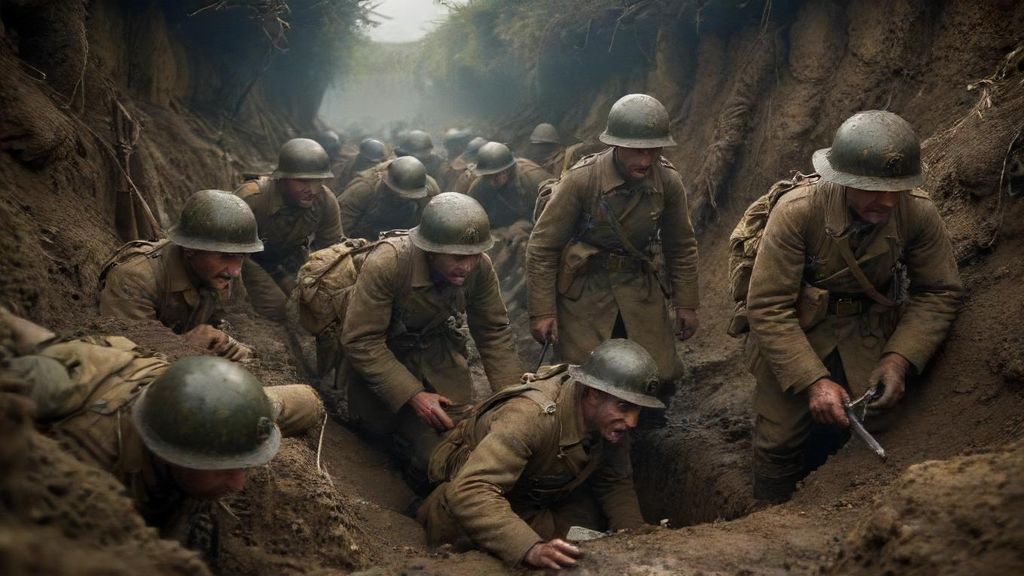
Imagine if your home suddenly became a constantly flooded ditch, crawling with bugs, reeking of death, and always under threat of exploding. That’s probably the closest we can get to understanding the shocking reality of a World War I trench for the soldiers who lived there. What was it like? It was an immediate, brutal attack on every single sense, making mere survival a daily, agonizing fight against the environment itself. When a new soldier arrived, the first shock wasn’t just the enemy, but the very ground they stood on – a hostile landscape built for defense but devastating to human life.
From the moment soldiers reached the front lines, they stepped into a carefully built but utterly dreadful world. These trenches weren’t just simple holes; they were complex, zigzagging systems, often reaching 10 to 12 feet deep, complete with barbed wire, wooden walkways (duckboards), and dugouts. But all that careful planning often fell apart with the first rain. The constant problem of mud and water turned into a living nightmare, transforming the trench floor into a treacherous, sucking bog. It was like trying to live for weeks in a muddy construction site, only far, far worse. Soldiers often found themselves wading through ankle-deep, sometimes even waist-deep, freezing water and slime. This constant dampness directly led to a notorious condition called ‘trench foot,’ where feet would swell, go numb, and eventually rot, often needing amputation. It was a debilitating injury that wasn’t from combat, yet it took thousands of men out of the fight.
How Do We Know About This Pervasive Misery?
We know just how terrible these conditions were thanks to a mountain of evidence: countless letters soldiers sent home, official war diaries, and later, the vivid memories of survivors. These personal accounts, often quickly scribbled during brief moments of rest, all paint a consistent picture. For instance, Private George Coppard of the Machine Gun Corps described the mud in 1916 as “so awful that men were drowned in it.” This wasn’t an exaggeration; it was a common, terrifying reality. Recent archaeological digs of old trench lines also uncover layers of personal items, broken equipment, and unexploded shells, all preserved within the very mud and water that tormented the soldiers.
Beyond the mud, the trenches were a thriving ecosystem for disease and infestation. Think of the worst bug problem you’ve ever had, then multiply it by a thousand. Rats were everywhere, growing fat on dead bodies and discarded food. They scurried over sleeping soldiers, bold and fearless, spreading germs. As Private Henry Gregory of the 1st Battalion, Welsh Guards, remembered, “The rats seemed to have no fear of us at all… they grew to an enormous size.” Even worse were the lice, tiny creatures that burrowed into uniforms and skin, causing unbearable itching and transmitting diseases like trench fever. Soldiers would try to “cootie hunt” by passing candles over their clothes, hoping to burn the pests out, but it was a losing battle.
Lack of proper hygiene was another severe issue. Fresh water was hard to find, baths were nonexistent, and latrines were often very basic, if they existed at all. This unsanitary environment, combined with exhaustion and poor nutrition, made soldiers incredibly vulnerable to illnesses like dysentery, typhus, and influenza. The extreme weather only made the suffering worse; men endured freezing winters where fingers and toes froze, and scorching summers where the smell of death and decay intensified under the sun. Your senses were constantly overwhelmed: the awful stench of rotting flesh, human waste, stale water, and chlorine gas mixed with the endless booms of artillery shells, the chatter of machine guns, and distant rifle shots. It created an ever-present sense of dread, even during supposed “quiet” times. What’s truly fascinating is how quickly human beings adapted to—or, more accurately, endured—such a suffocating environment, where every moment felt like a challenge just to breathe.
The truth about survival in such a place is more interesting than you might think. It wasn’t just courage that defined these men, but an incredible, if terrifying, resilience to physical misery. This ceaseless attack on their senses and bodies meant that simply existing in the trench was a never-ending struggle, a fight against the very ground beneath their feet. Next, we’ll explore how soldiers found ways to cope mentally and emotionally with this daily nightmare, even as their physical selves were pushed to breaking point.
How Did WWI Soldiers Endure the Daily Grind of Trench Life?

Imagine your most boring job, but with the constant threat of instant death hanging over every single task. That’s a bit like living day-in and day-out in a World War I trench. Beyond the initial horror of the mud and the stench, the real question is: how did soldiers keep going, mentally and physically? Every moment was a mix of mind-numbing routine and terrifying danger. The answer lies in a rigid daily structure, essential morale boosters, and a powerful human capacity for dark humor and camaraderie.
Life in the trenches was far from random. It followed a surprisingly strict schedule designed to keep everyone alive and the defenses strong. The most crucial times were ‘stand-to’ at dawn and dusk. Picture this: every soldier, tired or not, had to be awake, armed, and ready. They peered over the trench edge as the sky changed color. Why? Because these were prime times for surprise attacks, when visibility was tricky. It was a tense moment of shared anxiety, repeated twice a day, every single day.
Between these intense moments, the daily tasks never seemed to end. It wasn’t just about fighting; it was about maintaining the trench itself. Soldiers spent hours bailing out water, which constantly flooded the bottom of the trenches. This was especially true in muddy places like Flanders. Think of it like an endless, soggy chore list. They filled countless sandbags, patched up collapsed sections of the trench, and repaired barbed wire defenses in no-man’s-land under the cover of darkness. It was back-breaking, monotonous work, always mixed with the terrifying quiet of sentry duty, listening for anything.
How Did Small Comforts Make a Big Difference?
Amidst the constant dampness, boredom, and sudden fear, small comforts became incredibly important. Food rations, often meager and unappetizing, were vital for energy and for morale. Hot tea or a bit of stew could offer a moment of genuine relief. Then there was rum. Given out daily, a small tot of rum was more than just a drink. It was a mental shield, offering a brief escape from the cold, the fear, and the sheer exhaustion. Private Frank Richards, a British soldier, often wrote in his memoirs about how much these small comforts mattered, saying a warm drink could sometimes feel like salvation.
Perhaps the most powerful morale booster, however, was mail from home. Imagine getting a letter from your family or a sweetheart after weeks of silence. It was like a direct link to the real world, a reminder of what they were fighting for. It offered a temporary escape from the harsh truth. These letters, often read aloud, were passed around, shared, and discussed, creating a strong bond and shared purpose among the men.
But how did they cope with the constant dangers? Gas attacks, signaled by alarms or the tell-tale smell of chlorine, meant a frantic scramble for gas masks. It was a terrifying race against time. Sniper fire could come at any moment, turning a simple movement into a deadly risk. And shells exploded randomly, a constant reminder that death could strike at any moment. These threats shaped every interaction. Officers and comrades became more than just colleagues; they were their protectors and the only ones who truly understood.
The truth is more interesting than you might think: soldiers developed a deep understanding of what each other was going through. They bonded over the strange mix of boredom and terror. Dark humor, often sharp and even a bit gruesome, became a way to cope. It was a way to laugh in the face of the absurd and horrific. This powerful camaraderie wasn’t just friendship; it was a survival tool. As historians like Lyn Macdonald have detailed, these bonds allowed soldiers to face incredible stress together. It showed how amazing people are at adapting and connecting, even when things are unbelievably tough. This shared suffering and gallows humor created connections that, for many, lasted a lifetime.
What makes this fascinating is how ordinary people, placed in extraordinary circumstances, found ways to not just survive, but to find some sense of normal life and purpose. The routines, the small comforts, and especially the deep bonds of friendship were crucial. But even these couldn’t erase the deep psychological scars. The lasting impact of living in constant dread is exactly what we’ll talk about next, as we look at the long-term mental and physical effects of trench warfare.
Why Was Going ‘Over the Top’ So Terrifying for WWI Trench Soldiers?

Imagine being told your job for the day is to run across an open field, knowing thousands of machine guns, snipers, and artillery shells are all aimed right at you. This wasn’t a game; it was the terrifying truth for World War I trench soldiers ordered to go ‘over the top.’ The simple reason this act was so terrifying? It was almost always a death sentence, or at best, an experience that would break you, body and mind.
Before an attack, soldiers faced a terrifying waiting game. For hours, sometimes days, deafening artillery would smash the enemy lines. This wasn’t just loud; it shook the ground and rattled your bones. Its goal was to ‘soften up’ the enemy – to rip apart barbed wire, smash trenches, and crush their will to fight. But this massive bombardment also told the enemy exactly when the attack was coming. So, for the attacking soldiers, waiting in their trenches became an agonizing countdown. They gripped their rifles, fixed bayonets, and got ready as the ground literally shook beneath them. The air reeked of explosives, filled with unspoken fear. Then, through all the noise, came the sharp, unforgettable blast of the officers’ whistles – the signal to leave the small safety of their trench.
Then came the moment to go. Soldiers, weighed down by heavy gear, would scramble up ladders or muddy steps, leaving their underground trenches for ‘no man’s land.’ This wasn’t neutral ground; it was a horrifying, crater-filled wasteland. Often, it was shorter than a football field, but it stretched for miles, choked with barbed wire and littered with bodies from earlier failed attacks. The instant you showed your head, enemy machine guns – which often survived the artillery barrage – would start firing. Imagine trying to run across a busy highway, but instead of cars, you’re dodging an invisible storm of bullets, each one able to rip through you. Even after heavy shelling, these machine gun nests were incredibly tough, often hidden in concrete bunkers. Their fast, sweeping fire could mow down entire lines of attacking soldiers in seconds. This is why so many soldiers died; sometimes, 80% of an attacking force was wiped out before they even got close to the enemy lines.
How Did Survivors Cope with Such Horror?
For the few who somehow made it through the hail of bullets and past the barbed wire, the horror changed to fighting hand-to-hand. If you reached the enemy trench, the battle became brutal and basic: bayonets, rifle butts, knives, and fists in dark, tight spaces. It was pure chaos, and the only goal was to stay alive. The sheer violence of these fights left a lasting scar.
But what about those who got hurt? Trying to evacuate the wounded and give them medical help in all that chaos was another level of horror, and often, it was pointless. Stretcher bearers faced the exact same machine-gun fire as the attacking soldiers, frequently risking their own lives for men they knew might not survive. Many died in no man’s land, bleeding to death, their shouts for help drowned out by the constant shelling.
For those who survived, whether physically hurt or seemingly untouched, the war didn’t end when they left the front lines. The deep and lasting physical and mental scars were huge. We now know that ‘shell shock’ – a common problem back then, which we call Post-Traumatic Stress Disorder (PTSD) today – wasn’t cowardice, as some wrongly thought. Instead, it was a severe and crippling illness. It came from the constant stress, terror, and trauma of endless bombardments and seeing things no one should ever see. Famous British poet Siegfried Sassoon, for example, spoke out against the idea that ‘shell shock’ was a weakness, showing how deeply it affected soldiers’ minds. Going back to normal life was incredibly hard. Many veterans couldn’t sleep, battled nightmares, tremors, and felt disconnected from the world they once knew. They were a generation changed forever, carrying the heavy weight of the trench experience with them for the rest of their lives.
This horrifying experience, a mix of extreme courage and sheer terror, forever changed how we see war and what it does to people. Our next chapter will explore the unsung heroes of the trenches: the doctors and nurses who fought their own desperate battles behind the lines, trying to mend shattered bodies and minds.