
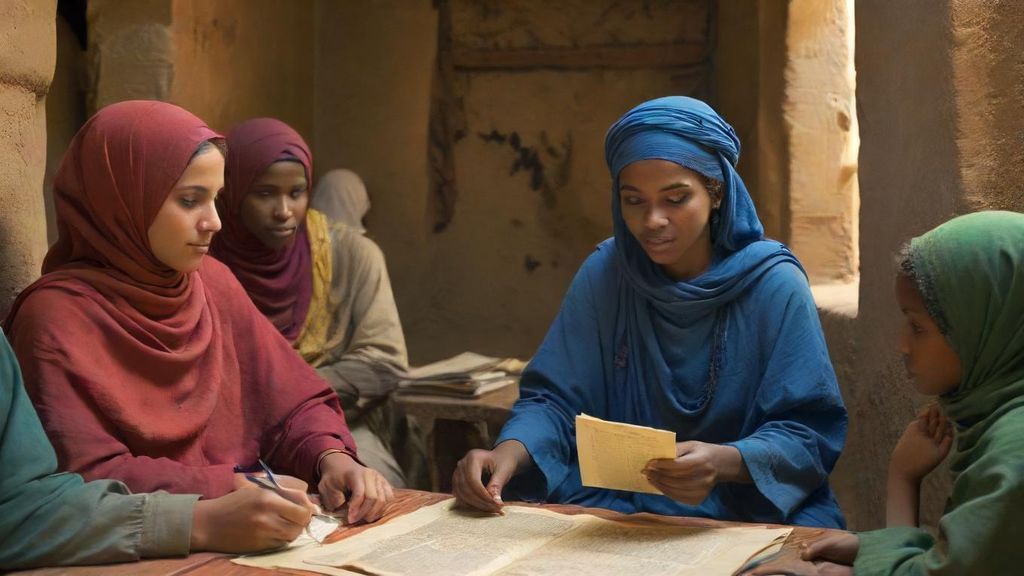
Many people picture Timbuktu as just a dusty, faraway place, full of mystery and forgotten stories. But the real story is much more fascinating. Imagine a busy modern city, like a huge port or a bustling internet hub, that also turns into a world-famous center for top-notch education. That’s pretty much exactly what happened with Timbuktu.
Timbuktu didn’t become a buzzing intellectual center by magic. Instead, it was all thanks to its amazing location. Imagine a city sitting right at a major bend in the Niger River, exactly where the river meets the huge Sahara Desert. This spot made it the perfect meeting point for the famous trans-Saharan trade routes. For hundreds of years, trading caravans carrying gold from the south would meet others bringing valuable salt from the north. All these merchants brought wealth, of course, but they also brought a constant flow of new ideas, different cultures, and — most importantly — books!
What’s interesting is that even before Timbuktu became known for its learning, it was already a big trading post. It drew in not just merchants but also early Islamic scholars and teachers. These smart people didn’t just pass through; they saw a chance to do something great. They set up simple Quranic schools, often right next to mosques, to teach the local people and the merchants’ kids. These early schools, known as madrasas, were the small beginnings of what would grow into a huge system of learning.
What’s truly amazing is how powerful empires saw this growing promise. The Mali Empire, which became strong in the 1200s, played a huge role. Its most famous leader, Mansa Musa, went on an incredible journey to Mecca in 1324, showing off his massive wealth to the world. But he didn’t just bring back riches; he also brought back scholars and builders. He invested heavily in Timbuktu, building impressive mosques and libraries, like the well-known Djingareyber Mosque. This support from the king made the city more important and told everyone in the Islamic world that Timbuktu was a serious spot for education.
What Led to This Thirst for Knowledge?
After Mali, the Songhai Empire picked up where they left off. It was strongest in the 1400s and 1500s and kept encouraging Timbuktu’s growth in learning. Under leaders like Askia Muhammad I, the city really took off. Imagine a government today pouring money into science and new ideas, making it a place where the smartest people want to come together. This strong government and financial help meant that families dedicated to learning could settle down, building traditions of knowledge that lasted for many generations.
A great example of this is the Aqit family. They weren’t just rich; they were also extremely devoted to learning and actively started and funded schools. Their impact was so huge that one of Timbuktu’s three major universities, Sankore, is often directly linked to their hard work. These families became the backbone of the city’s smart community, passing down knowledge, traditions, and huge personal libraries from father to son for generations. Imagine a family today where every single member, for hundreds of years, was a top professor or scientist – that’s the kind of commitment we’re talking about!
This special place for learning grew mostly because of a bustling culture around handwritten books. Timbuktu wasn’t just home to schools; it became a worldwide hub for making copies, buying, selling, and studying books. Thousands upon thousands of handwritten texts poured into the city, covering every topic you can imagine: from how stars move and complex math to laws, medicine, and deep thinking about life. People paid good money for these texts, which meant copying books and being a scholar could actually be a good way to earn a living. This strong desire for knowledge, mixed with the city’s wealth and support from the empires, turned Timbuktu into an unmatched center for brilliant minds.
New findings show that Timbuktu was far from isolated. In fact, it was deeply connected to intellectual trends across Africa, the Middle East, and even Europe. It truly was a mixing pot of ideas, which set the stage for its golden age. During this time, learning wasn’t just about religious faith; it was about pushing the limits of what people knew and understood. Next, we’ll explore what daily life was like for students studying in this incredible city.
How did students learn and live at Timbuktu’s legendary centers of learning?

At Timbuktu’s legendary learning centers, students experienced education in a truly unique way: without tuition fees, huge dorms, or even formal graduation ceremonies. It was a deeply personal, community-driven adventure focused entirely on building profound knowledge and strong character, very different from today’s institutional approach to learning.
The core of Timbuktu’s education featured a remarkably wide range of subjects. Students didn’t just pick one major; they explored many different areas of study. They delved deep into the Islamic sciences, carefully studying the Quran and thousands of sayings and traditions of the Prophet Muhammad, known as Hadith. They mastered Fiqh, or Islamic law, learning how to understand and use its rules in daily life. But it wasn’t all religious study. The curriculum also included important topics like Arabic language and literature – crucial for reading texts – along with mathematics, astronomy, medicine, history, and logic. Imagine a modern liberal arts degree combined with expert job training, all rolled into one.
The teaching methods were just as special. Forget large lecture halls; instead, learning happened in small, personal groups, often in a scholar’s home or a mosque courtyard. The teacher-student relationship was incredibly close, more like learning from a master or having a guide. Students would sit at their teacher’s feet, listening intently, asking questions, and getting direct advice. A huge part of this was memorization, especially of the Quran and vast collections of Hadith. Think of it as building a human database, making sure knowledge was not just understood but deeply known by heart and ready to be recalled easily.
What made Timbuktu’s teaching so effective?
The answer lies in a mix of strict methods and a strong sense of community. Knowledge flowed primarily through oral tradition, making sure the texts and their complex meanings were passed on exactly right. But it wasn’t just rote learning. Students regularly engaged in energetic discussions and debates, called munazara or disputation. Imagine a fierce but respectful academic seminar where students would argue points of law, philosophy, or theology, making their minds sharper and better at thinking deeply. It was an intellectual workout, much like a modern debate club, but with much higher stakes for truly understanding the truth.
The ultimate goal wasn’t a fancy certificate to hang on a wall, but an Ijaza. This was a personal license to teach, given by your scholar when they thought you were truly ready. It was a spoken approval, a handwritten note, or even a simple nod. It showed that you had mastered the material and could now teach it to others. Think of it as a highly personalized, widely accepted proof that you were ready to be a scholar in your own right.
Timbuktu’s academic strength was also helped by an incredible abundance of books. Old records, and new discoveries by organizations like the Mali Manuscript Project, show that rich families and scholars built huge private libraries, some holding tens of thousands of manuscripts. These libraries were the city’s real treasures. Students spent countless hours in these libraries, not just reading, but carefully copying manuscripts by hand. This hard work, which could take months for a single book, was like their way of publishing. But it was also a deep learning experience, helping them remember and understand the text really well.
Daily life for students was organized around learning and prayer. Days often started before dawn with prayers, followed by long study times and listening to scholars. Students rarely lived in dedicated dorms like today. Instead, they were often hosted by local families, becoming a direct part of the community. This created strong friendships and offered a much-needed community support system, making sure students had food, lodging, and a sense of belonging. This meant Timbuktu’s diverse student population, coming from all over West and North Africa and even further away, truly became part of the city.
This special mix of personal teaching, serious discussions, many books, and strong community ties made Timbuktu an academic powerhouse. It changed how people thought about what a “university” could be, proving that deep learning could happen without the usual buildings and rules we see today. The scholars and students of Timbuktu didn’t just gather knowledge; they lived it, loved it, and shared it, shaping how people thought for hundreds of years. But what kind of lasting impact did this amazing center of learning leave behind?
What was the lasting impact and legacy of Timbuktu’s intellectual golden age?

Imagine if one of today’s great university towns, like Oxford or Stanford, suddenly had its smartest people and their huge libraries scattered across an entire continent. That’s a bit like what happened with Timbuktu. The simple answer to its lasting impact is this: Timbuktu wasn’t just a city; it was a powerful source of knowledge that spread ideas, laws, and culture far and wide. It set the intellectual stage for much of West Africa and beyond. Its influence, it turns out, was much bigger and reached further than many people realize.
Here’s what we discovered: The scholars, judges, and religious leaders who trained in Timbuktu’s busy schools didn’t just stay put. They traveled, carrying their expertise like precious cargo. These graduates spread out across the vast Songhay Empire and into neighboring regions like Hausaland (modern-day Nigeria) and even as far as North Africa. They became important advisors to kings, shaping laws, making sure justice was served, and helping communities with religious questions. Think of them as ancient consultants and knowledge workers, setting up new schools and spreading the well-developed Islamic legal system, or Sharia law, which was key to running things well. This movement of minds helped different groups of people feel like they belonged to the same culture, much like how shared technical standards allow different computers to communicate today.
What makes this fascinating is how widely these thinkers spread. According to historians, Timbuktu’s scholars played a huge role in convincing many local leaders to become Muslim, not by force, but by showing them the benefits of an organized legal and government system. For example, during the 16th century, the city produced many highly respected judges called qadis, who were in high demand to make sure laws were fair in distant towns. It was a ripple effect, where one great learning place led to many smaller ones.
What Caused This Golden Age to End?
The truth is more interesting and tragic than you might think. Timbuktu’s power as a center of ideas faced huge problems that eventually led to its downfall. The worst hit came in 1591 with the Moroccan invasion. The Battle of Tondibi, where Moroccan forces armed with firearms easily defeated the Songhay army, marked a cruel turning point. The invaders attacked Timbuktu and looted it, destroying countless manuscripts and sending many important scholars into exile or executing them. One of the most famous figures to suffer was Ahmed Baba, a renowned scholar whose huge personal library was taken, and who himself was forced to leave for Morocco. This wasn’t just a military defeat; it was a total breakdown of its system for learning and thinking, like burning down a university and scattering its entire faculty.
After this invasion, Timbuktu never fully recovered its top spot. Later, colonial pressures from European countries in the centuries that followed further broke up its old ways of learning and trade routes, disconnecting Timbuktu from its traditional connections. Fights among local leaders also took away the stability needed for new ideas to grow. It was a perfect storm of outside attacks, political chaos, and changing world events that slowly dimmed the light of this once-brilliant center of knowledge.
However, the story doesn’t end there. Recent evidence shows incredible efforts today to preserve what remains of this amazing history. Today, new projects are working hard to save and turn into digital files the priceless Timbuktu manuscripts that survived centuries of turmoil. Institutions like the Ahmed Baba Institute and the Mamma Haidara Commemorative Library are leading the way, carefully listing and scanning hundreds of thousands of documents. These ancient texts cover everything from astronomy and mathematics to law, medicine, and poetry, written in beautiful Arabic writing. It’s like finding a hidden archive of humanity’s shared knowledge.
These efforts show how important Timbuktu still is as a strong symbol of Africa’s brainy past. They help fix the old idea that important learning only happened in certain parts of the world. By making these manuscripts accessible, Timbuktu continues to add to what the world knows, offering new ways to look at African history, science, and culture. It reminds us that we all work together to create knowledge, and its story is far from complete.