
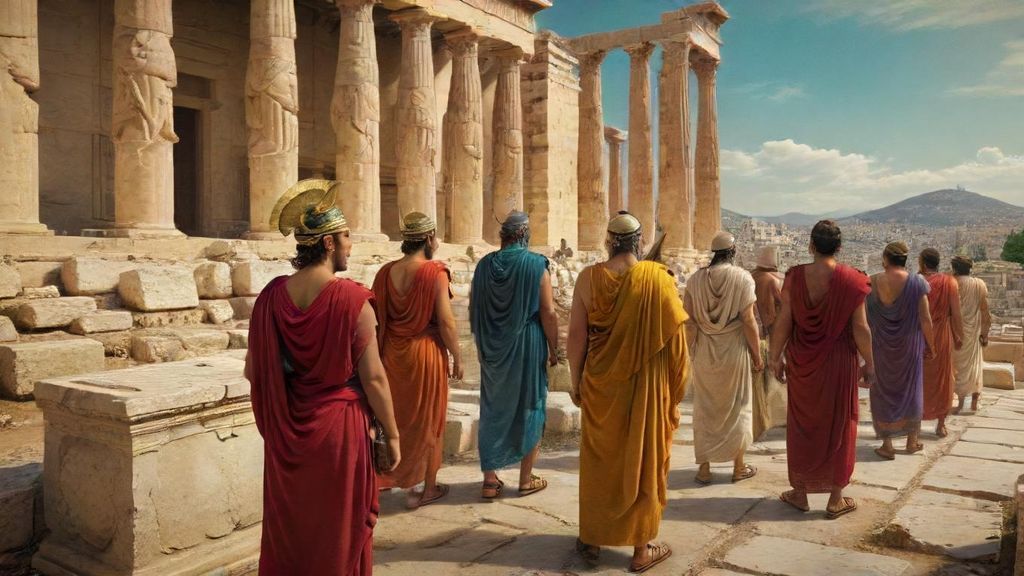
Imagine democracy, the idea of ‘the people’ ruling, starting not with everyone included, but with a surprisingly tiny group. That’s exactly what happened in ancient Athens, the world’s first true democracy. Simply put, only a small, specific group of free, adult men whose parents were both Athenian citizens could vote. Everyone else – and that was most people – was purposefully left out of politics. Think of it like a very exclusive club where membership wasn’t about money, but about your family history and social standing, all tied to a strong sense of being truly Athenian.
The real story is more interesting than you might guess, and it really makes us rethink what ‘democracy’ meant back then compared to what we think it means now. For the ancient Athenians, ‘the people’ meant a much smaller group than it does for us today. The reason why comes down to their very strict rules for who counted as a citizen, rules that became really firm around the mid-400s BCE.
So, Who Counted as an Athenian Citizen?
So, who were these special people? To be a full Athenian citizen – and that meant you could vote in the big Assembly where all the important decisions were made – you needed to meet a few key requirements. First, you had to be a free man, not someone who was enslaved. Second, you had to be an adult, usually around 20 years old, after finishing your military training. But here’s the most important part, the one that really cut down the numbers: both your mother and your father had to be Athenian citizens. This wasn’t always the case, but it became a strict law in 451 BCE, strongly supported by the famous leader, Pericles.
This law changed everything. It essentially made political power something you inherited, like a family heirloom. Imagine a family business that only direct blood relatives can take over. The main goal was to protect what made Athens special and keep those privileges for true Athenians. As historian Cynthia Farrar explained,
Athenian democracy was an intense form of self-government for a very limited citizen body.This rule made sure that the land, the culture, and who held power remained within what they saw as the authentic Athenian family line, keeping it safe from outside influence.
Because of this, a huge part of the population – easily more than half, and some guess up to 80-90% – was totally excluded from politics. This group included all women, enslaved people, and free foreign residents called metics.
Why Did Athens Exclude So Many People?
It wasn’t by accident that so many people were left out; it was a core part of their entire system. Let’s look at why. When it came to women, the general belief was that their place was in the home. They managed the house and raised children who would become future citizens. Legally, they relied on their male relatives and weren’t thought to have the logical thinking or public role needed to get involved in politics. It wasn’t that they were seen as ‘unqualified’ in our modern way, but rather that they had a totally separate and fixed role in society.
Next were the enslaved people. Slavery was very common in the ancient world, and Athens was no different. Enslaved individuals, whether born into slavery or captured in battle, were seen as property, not as people with rights. They did much of the hard work, which helped the economy and allowed citizens to focus on politics and serving in the military. They were excluded simply because the law didn’t see them as people at all.
Lastly, there were the metics. These were free people from other places who lived and worked in Athens, sometimes for many generations. They paid taxes, fought in the military when asked, and often helped the city’s economy a lot as traders, craftspeople, and artists. But even so, because both their parents weren’t Athenian, they could never become citizens. It’s similar to someone living permanently in a country today, paying taxes and working, but still unable to vote because they don’t meet the rules for full citizenship. The main reason they were kept out was simple: they weren’t seen as having the same deep family roots or a strong enough personal stake in Athens’ future compared to a ‘true’ citizen.
So, because ‘the people’ meant such a small group, voting wasn’t just a basic right; it was a huge privilege and responsibility, closely linked to family, land, and loyalty. Knowing these strict rules helps us really understand what democracy meant when it first started. It wasn’t about everyone getting to vote, but about a small, chosen group carefully governing themselves. Next, we’ll explore what it was truly like to be one of those few, stepping right into the lively center of Athenian politics.
Imagine if, instead of voting for representatives, you had to show up to a massive outdoor meeting with thousands of your fellow citizens to decide every single law, budget, and even who gets kicked out of the city for a decade. That’s pretty much what it was like for eligible men in ancient Athens. The simple answer to how Athenians voted and made decisions is that they gathered in a direct democracy, making choices through a fascinating mix of public debate and various voting methods.
This wasn’t some quiet library discussion. Picture the Ecclesia, the citizen assembly, meeting on the Pnyx hill. This was a natural amphitheater, carved into a hillside just a short walk from the Acropolis. It was their “town square” for democracy, a place where, depending on the era, anywhere from 6,000 to sometimes over 10,000 citizens would cram together. The sheer scale of it is fascinating, and it might change what you imagine about ancient politics. Think of it like a massive, open-air concert, but instead of music, it was all about making serious civic decisions, often with a boisterous and lively crowd.
How Did Decisions Actually Get Made on the Pnyx?

Before any decision could be made, it had to be put on the agenda. This important job fell to the Boule, also known as the Council of 500. Think of them as the city’s executive committee, a group of 500 citizens chosen by lot each year. They prepared proposals, called probouleumata, for the larger assembly to consider. It’s a bit like a corporate board that sets the quarterly goals for the entire company; the general employees still vote on major initiatives, but the board sets up the conversation.
Once a proposal was presented on the Pnyx, the real action began: debate. This was where the influence of persuasive speakers, known as orators, truly shone. These weren’t always professional politicians in the modern sense, but often respected or particularly vocal citizens who could sway the crowd with their words. Imagine a passionate social media influencer or political pundit, but in real-time, convincing thousands face-to-face. A strong argument, delivered with conviction, could really change public opinion right there on the spot. Aristotle, a famous ancient Greek thinker, wrote about how these procedures worked in his book, Constitution of the Athenians. This gives us clear evidence of how these debates unfolded.
For most legislative matters and official decrees, voting was done by cheirotonia, a simple show of hands. There were no electronic counters or secret ballots. An official called a herald would ask for votes “for” and then “against” the proposal. It turns out that judging the majority in a crowd of thousands by eye was a skill in itself, but it was how most laws were passed. This method was quick and public, so everyone knew how their neighbors voted. This also meant that accountability was immediate.
However, there was one truly unique and surprising voting method: ostracism. This wasn’t about passing a law; it was about exiling individuals considered too powerful or dangerous to the democracy. Here’s what happened: once a year, citizens had the chance to vote on whether to hold an ostracism. If they agreed, a special assembly was held a few weeks later. Instead of raising hands, citizens would write the name of the person they wished to exile on a piece of broken pottery, called an ostrakon. We have archaeological evidence showing thousands of these actual pottery shards, like one found with the name Themistocles, a prominent general, on it. If at least 6,000 votes were cast, and a person received the most votes, they would be exiled for ten years. They wouldn’t lose their property or citizenship rights; it was more like a political time-out. This was a powerful way to protect their democracy from anyone gaining too much control – a direct “cancel culture” mechanism, but with physical exile for a fixed term.
What makes this all so fascinating is the mix of practical, simple voting methods and the amazing power held by the citizens. From raising hands for daily decisions to scratching names on pottery, Athenian democracy was incredibly direct, often noisy, and always dynamic. It shows us a political system that needed everyone to be involved all the time, very different from the representative democracies we have now. This leads us to wonder about the daily lives of these citizens and how their involvement shaped their society in other ways, a story we’ll explore next.
What Were the Challenges and Responsibilities of Voting in Ancient Athens?

Imagine your week wasn’t just about work or family, but also about actively running your country. That’s a pretty good idea of what life was like for eligible male citizens in ancient Athens. For them, voting wasn’t a quick trip to a ballot box; it was a big part of their lives, often demanding a lot of effort and coming with huge responsibilities and unique challenges. In short, being part of the world’s first democracy meant giving serious time and energy, which is very different from how most of us think about civic duty today.
Why was it like this? It all came down to the nature of their direct democracy. Citizens weren’t just choosing leaders; they were the government. This meant they had to regularly attend the Assembly, or ekklesia. This gathering met often, sometimes several times a month, on a hill called the Pnyx. Thousands of men would meet there to discuss and vote on everything: whether to go to war, make peace, change laws, or spend public money. Imagine a never-ending series of town hall meetings, but where the future of their entire city was at stake.
But it wasn’t just the Assembly. Citizens also had jury service. Athenian juries, known as dikasteria, were enormous. We’re talking hundreds, sometimes even over a thousand, citizens who would sit all day, listening to arguments and making decisions on tricky legal issues. Think of it like being on a huge, important jury that met all the time, often with just common sense as their guide, not special legal training. Citizens were chosen for these jobs by sortition – basically, a lottery system – which meant almost anyone could end up with a lot of power. And while there was a small payment (misthos) for attending the Assembly or jury duty, it wasn’t enough for most people to live on. So, this system really demanded a huge personal commitment, almost like having a tough part-time job you couldn’t just walk away from.
What Were the Downsides of All That Power?
With so much power directly in the hands of ordinary people, ancient Athens also faced some tough problems. One big danger was something called demagoguery. Imagine a speaker who’s brilliant at stirring up feelings, convincing thousands with strong words instead of clear facts. This could lead to quick, emotional decisions, which sometimes led to terrible results. This kind of “mob rule,” where strong emotions could win out over careful discussion, was a constant threat. Historical writings, like those from the historian Thucydides, often tell how the Assembly could be easily influenced by passionate speakers, causing them to change their minds very quickly.
Another problem was the chance of corruption and groups fighting among themselves. Even though they had ways to stop people from getting too much power, like ostracism (where they’d send someone away for ten years), bribes and clever political tricks were still common. Historians like Aristotle, who studied many different political systems, noted that the Athenian system was always fighting against rich or powerful people trying to influence decisions for their own gain. It’s a bit like today’s political lobbying, but picture every citizen being right there, ready to be directly convinced or swayed.
Even with these clear limits—especially since only a small part of the population (free-born adult men) could take part—the huge power held in the collective decisions of Athenian voters left a deep and lasting mark. Their system, despite all its demands and imperfections, created the base for democratic ideas, inspiring countless thinkers and movements over hundreds of years. What makes this fascinating is that the Athenians, through their direct participation, weren’t just shaping their present; they were accidentally creating a political ideal that would be talked about for centuries.
So, here’s what we learned: voting in Athens was a challenging, hands-on activity that needed constant effort. It was a system that, for the first time, truly gave political power to the people, though it came with real dangers and responsibilities. Next, we’ll look at how other ancient civilizations handled ruling, giving us a new look at the special path Athens created.