
Think you know about women in ancient Greece? Most people picture them stuck at home, quiet and invisible, with no say in public life. For many citizen women in a city like Athens, that was often true. But then there was Aspasia. She was so smart and important that people said she even taught the famous philosopher Socrates! Her real story is far more interesting, showing a surprising way to gain power, from a busy port city all the way to Athens’ intellectual core.
So, where did Aspasia come from and how did she become so well-known in ancient Athens? Her unusual background and the unique social scene she moved through hold the answers. She wasn’t born in Athens, which, strangely enough, gave her freedoms most Athenian women could only dream of.
What Was Aspasia’s Hometown Like?
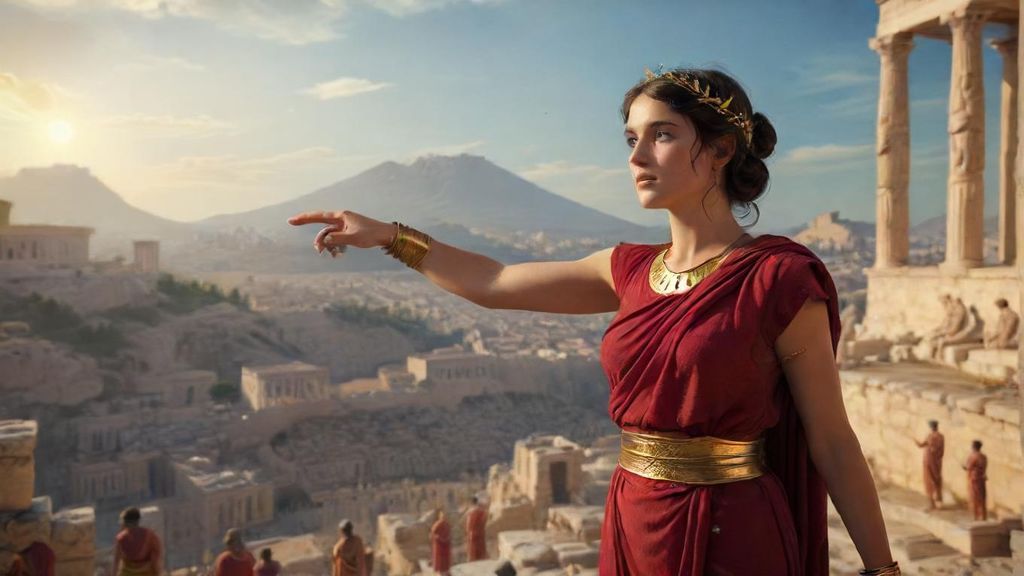
Aspasia came from Miletus, a lively Greek city on the coast of Ionia, which is now part of modern-day Turkey. Imagine Miletus as the Silicon Valley of its time – a real hotspot for new ideas and global business around 470 BCE, when Aspasia was born. It was famous for its thinkers, scientists, and modern ideas. People there openly debated fresh perspectives, almost like a lively online forum today. What’s especially interesting is that Miletus was known for giving women more freedom and access to education than most other Greek cities. Unlike the strict rules in Athens, Miletan women often played more public roles, especially in religious festivals and even some businesses.
It was in this exciting, intellectual setting that Aspasia likely received an amazing education. While girls in Athens learned how to run a household, Aspasia probably studied the arts of rhetoric (which is persuasive speaking and argument) and philosophy (deep thinking about life and the world). Picture a young Aspasia not just reading books, but actively discussing ideas, sharpening her critical thinking, and learning to explain complex thoughts clearly and charmingly. This was like attending an elite university, but for a woman, at a time when formal education was mostly for men. According to historians like Plutarch, who wrote about her much later, this early training prepared her for the intellectual debates she would later have with some of the greatest minds of her era.
How Did Being a ‘Metic’ and ‘Hetera’ Shape Her Path?
We don’t know the exact reasons why Aspasia moved to Athens. However, it’s fair to say that a smart and ambitious woman like her would find many more opportunities in the bustling capital of the Greek world. Sometime in the mid-5th century BCE, she arrived in Athens. She wasn’t a citizen, but a metic. Simply put, a metic was a resident foreigner – someone who lived and worked in Athens but didn’t have full citizenship rights. They couldn’t vote or own land. However, they could own businesses, be part of trade, and move around more freely than citizen women. It was a bit like having a long-term work visa in a foreign country today; you’re part of the economy but not fully in the political system.
This metic status, which might seem like a disadvantage, actually gave Aspasia surprising freedom. It allowed her to live outside the strict social rules that kept Athenian citizen women shut away. Even more important to her rise was her likely role as a hetera (the plural is heterai). This word often gets wrongly translated as just ‘prostitute.’ But for women like Aspasia, it meant something far more significant. A hetaera was a highly educated, independent companion, often skilled in music, dance, and, most importantly, smart conversation. Think of them less as a modern escort service and more like elite social hostesses or influential public figures of their day, running exclusive social networks for the city’s powerful men.
Unlike citizen wives, who were expected to be modest and stay at home, hetaerai were trained to discuss politics, philosophy, and art with men. They could attend banquets, host gatherings, and use their sharp minds and wisdom to influence important people. For Aspasia, this role was her ticket to the inner circles of Athenian power and intellect. She wasn’t just beautiful; she had a brilliant mind. Her status as a hetaera allowed her to use that mind in ways totally unavailable to Athenian citizen women. It turns out that sometimes, marginalized roles provide unique chances for remarkable individuals.
Her establishment in Athens, then, wasn’t by accident but by careful planning. She entered an intellectual world full of thinkers, politicians, and artists, all eager for stimulating conversation. Her background from liberal Miletus, combined with her special education and the unique freedoms of her social status, perfectly prepared her to captivate and influence the most powerful men in the city. She was ready to leave her lasting mark.
How Did Aspasia Shape Athenian Intellectual Life and Influence Figures Like Socrates?
Aspasia played a huge role in Athenian intellectual life by hosting a famous ‘salon’ in her home. This gathering spot brought together the city’s smartest people, deeply influencing figures like Socrates and even the powerful leader, Pericles. It turns out this amazing woman wasn’t just Pericles’ partner; she was a teacher, a master of public speaking, and a true intellectual guide. She quietly helped shape new ways of thinking and speaking that are still important today.
During Athens’ Golden Age, Aspasia, a brilliant woman from Miletus, arrived and quickly became famous not just for her looks, but for her sharp mind. She formed a close and very important relationship with Pericles, who was the city’s most powerful man. Think of them as a modern-day power couple running a hugely successful, forward-thinking group. Their home wasn’t just where they lived; it was the heart of Athenian intellectual life. It was a high-level meeting place that attracted thinkers like Anaxagoras, the sculptor Pheidias, playwrights such as Euripides, and, very importantly, a young Socrates. There, they would discuss everything from how the universe worked to the best way to run a city.
How Do We Know This Actually Happened?
Now, you might be asking, “How can we be sure this is true, considering how long ago it was?” The fact is, much of what we know about Aspasia comes from what other people wrote, often colored by their own opinions. But the evidence is strong. Historical records show that ancient writers like Plato and Xenophon, both students of Socrates, talked about her influence. For example, in Plato’s dialogue Menexenus, Socrates himself credits Aspasia with teaching him his skill in rhetoric – the art of speaking persuasively. He even joked (or maybe he wasn’t joking at all) that she wrote Pericles’ famous Funeral Oration, a speech considered a masterpiece of Athenian public speaking.
“Indeed, my own teacher in rhetoric was Aspasia…”
Plato, Menexenus
What’s really interesting is that old stories always show her teaching rhetoric, which is the art of persuasive speaking, and dialectic – basically, how to argue and think deeply by asking questions. Picture this: a woman, in a time when most women stayed hidden away at home, teaching the very person who would become known as the father of Western philosophy how to debate and think sharply. It’s like finding out that today’s most famous tech innovator learned their basic coding from a brilliant, unusual mentor working outside the normal system. More recent findings show that her students would practice logical reasoning, building arguments, and taking ideas apart, all skills that became central to Socrates’ unique way of doing philosophy.
Beyond her influence on Socrates, there’s solid proof of her help with Pericles’ public image and policies. Many historians believe Aspasia helped make Pericles’ speeches better, not just by adding elegance but also by giving strategic advice. Her role wasn’t just to look good; she was a key figure in Athenian intellectual discussions, shaping the very words that moved the Athenian assembly and inspired its citizens. She was, simply put, a co-creator of the Golden Age’s intellectual world, a powerful mind guiding the city’s brightest stars.
This paints a picture of Aspasia as much more than just Pericles’ partner. She was a leading intellectual, a pioneering educator who went against the rules of her time by openly joining philosophical debates and teaching public speaking to the very people who would shape Athens’ future. Her salon wasn’t just a social gathering; it was like an academy, a place where new ideas were formed and future leaders were trained. Her sharp mind left a lasting mark through Socrates’ teachings and Pericles’ actions as a statesman, shaping Western thought forever. But her importance also made her a target, which we’ll explore next.
What Made Aspasia Such a Controversial Figure and How Is She Remembered Today?

Imagine trying to be a brilliant, influential public figure in ancient Athens, but you’re a foreign woman. That’s exactly what Aspasia faced. Her intelligence, independence, and close relationship with the powerful leader Pericles simply scared many Athenians. She refused to fit into the traditional, quiet role expected of women. This made her a target for the worries and deep-seated biases of her time. People didn’t just talk about her; she faced serious legal threats, showing how powerful she was, yet how easily her position could be taken away.
Here’s what actually happened: Aspasia faced real legal trouble, called lawsuits, in Athens. One charge was for asebeia, which basically meant “disrespecting the gods.” This was a very serious charge, often used to silence people with unpopular ideas or political opponents. The other accusation was for procureia, which means “pimping.” Think about that for a second. These weren’t just nasty rumors. These were official charges meant to ruin her reputation and could have led to her being sent away or even executed. It’s like a powerful public figure today being hit with fake legal claims just to discredit them or their influential partner.
How Do We Know This Actually Happened?
The truth is more interesting than you might think, because these lawsuits were probably political attacks. They were aimed at Pericles, using Aspasia as the target. According to the ancient Greek writer Plutarch, the famous playwright Hermippus brought these charges against her. This wasn’t a small disagreement. Plutarch tells us that Pericles, who deeply loved Aspasia, even cried during her defense, begging the jury to clear her name. His strong emotions prove how serious the situation was and how much she meant to him. His help likely saved her, showing that even with powerful friends, she was still vulnerable.
What’s fascinating is how differently Aspasia was shown in ancient writings. On one hand, funny playwrights like Aristophanes, in plays like Acharnians, often painted her as a tricky, manipulative person. They even blamed her for the Peloponnesian War! They made her seem like a brothel owner or a woman with loose morals, using rough jokes to attack her influence. It was like an ancient version of “cancel culture” for a woman who didn’t follow the rules.
On the other hand, philosophical conversations by great thinkers like Plato and Xenophon show a completely different person. In Plato’s Menexenus, Aspasia is shown as a brilliant speaker, so skilled that she supposedly taught Pericles how to give speeches and even wrote his famous Funeral Oration. Socrates himself, in Xenophon’s writings, talks about learning from her, discussing philosophy and rhetoric with admiration. These two very different pictures — a tricky courtesan versus a brilliant intellectual — show just how much her presence challenged Athenian society.
Today, historians, feminists, and scholars still look at Aspasia’s story from new angles. Many now see her as a symbol of defying traditional gender roles in a world where women were mostly ignored. Feminists view her as strong proof of female intelligence and influence, challenging old stereotypes and sparking modern discussions about women’s place in public life. She was like an ancient rule-breaker in a very strict, traditional system. Aspasia remains a mysterious, incredibly important, and truly pioneering woman whose story still makes us talk about power, gender, and what people leave behind.
The debate about Aspasia’s true character and impact continues today. Her story makes us question who gets to write history and whose voices are remembered. Next, we’ll look at the specific philosophical contributions people said Aspasia made, exploring the ideas and teachings that made her such a respected intellectual.