
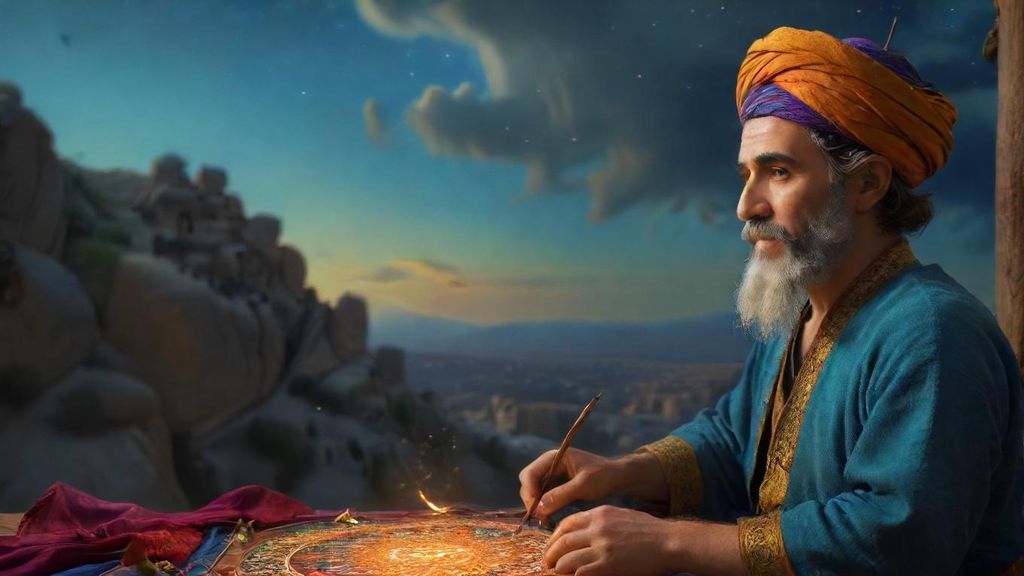
Before Rumi became the world-famous mystic and poet, he was a child from a privileged, scholarly family in a vibrant city. His early life was far from solitary; he grew up surrounded by brilliant thinkers and spiritual guides, essentially part of a medieval “rockstar” family. This rich upbringing gave him a deep understanding of learning and spirituality, all before a massive disaster changed everything he knew.
Picture a city bursting with culture and knowledge, like a huge university campus combined with a spiritual retreat, all wrapped up in a busy trading center. This was Balkh, the main city of Khorasan, where Jalāl ad-Dīn Mohammad Balkhī – the person we now know as Rumi – was born around 1207 CE. It wasn’t a quiet little village. Balkh was a shining star of the Persian world, a key stop on ancient trade routes linking East and West. Think of it like a global tech hub today, drawing in the smartest and most creative people of its era.
What’s truly amazing is that his family wasn’t just in this important world; they were at its very heart. Rumi came from a highly respected line of scholars and spiritual leaders. His father, Baha al-Din Walad, was a hugely influential person. Imagine him as a superstar professor and spiritual teacher, drawing massive crowds and earning respect from kings and everyday people alike. People called him the ‘Sultan of Scholars,’ which shows just how important he was.
Baha al-Din Walad was more than a teacher; he was a deep Sufi master, someone very connected to the mystical side of Islam. This meant Rumi, even as a young child, wasn’t just playing with toys. Instead, he spent his earliest years watching serious spiritual talks, seeing deep devotion, and soaking up wisdom from an truly special mind.
The world Rumi grew up in was a vibrant mix of Islamic learning, Persian stories, and Sufi wisdom. Here, poetry wasn’t just for fun; it was a way to dig into the universe’s deepest secrets. Imagine your home always buzzing with smart people discussing big ideas, sharing poems, and looking for a connection to the divine. This constant experience, you could say, first sparked Rumi’s own spiritual interest. He didn’t just hear about spirituality; he saw it happening every single day, right in his own house. It’s like growing up in a tech-savvy family where everyone codes – it just becomes a natural part of your world and shapes what you find interesting.
How Do We Know This Actually Happened?
You might ask how we can know so much about Rumi’s childhood from so many centuries ago. Well, we actually have many life stories written by his students and close friends. They put these together soon after Rumi’s time. These aren’t just fuzzy old tales; they are detailed accounts, much like historical records or personal journals we have today, carefully kept by generations of scholars and followers.
Historians say that early biographers, like Shams al-Din Aflāki, carefully wrote down Rumi’s life story. This includes his younger years, his father’s lessons, and his family’s travels. Also, discoveries from old sites show that Balkh was indeed a busy hub for culture and learning back then. This matches the lively descriptions in the old writings. So, even though we weren’t there, we have solid proof – like finding an old family photo album and a detailed diary – that paints a very clear and consistent picture.
But this wonderful, scholarly life couldn’t last. A dark threat was growing, a force that would change the whole world: the Mongol invasion. Imagine it like a huge, unstoppable natural disaster heading straight for your city. News traveled slowly back then, but stories of the Mongol armies, led by Genghis Khan, were terrifying. They were taking over huge areas, leaving destruction wherever they went.
For a learned family like Rumi’s, dedicated to keeping knowledge and spiritual customs alive, staying put was no longer safe. The main reason was simple: survival. To protect his family and the priceless spiritual wisdom he carried, Baha al-Din Walad made the incredibly tough choice to leave his cherished Balkh. This was a complete shift, from a settled life of study to being forced to move constantly.
It wasn’t an adventure. It was a desperate escape for survival, a mass movement much like refugees leaving war zones today, carrying their most valued things and their hopes. Their leaving marked the start of a huge journey west, a long, winding path that would eventually guide Rumi to a future he never could have pictured.
So, before Rumi grew into the famous mystic and poet known worldwide, he was a privileged child. He lived in a city full of spiritual and intellectual energy, guided by his brilliant and respected father. His early years were like a top-tier education in Sufi ideas and classic Islamic learning. But the growing danger of the Mongols ripped his family away from this rich life, forcing them to move.
This forced departure didn’t end his spiritual path. Instead, it built the groundwork for the deep experiences that would change him forever. Next, we’ll explore that amazing journey, seeing how their travels across many lands helped shape the young Rumi even more.
How Did Rumi’s Family End Up in Konya and What Did He Study There?

Imagine your family, known for being incredibly smart and spiritual, suddenly having to pack up everything. They’d leave on a long, dangerous journey across many countries, running from a huge disaster, right? Well, that’s pretty much what happened to young Rumi and his family. So, how did they end up in Konya, a lively city in modern Turkey? It was all about escaping the Mongol invasion and finding a safe spot where smart people could get support. Here’s what we found out about their amazing journey and Rumi’s early education.
Their big journey started around 1218 when Rumi was just a boy, about twelve years old. His father, the respected scholar and spiritual leader Baha al-Din Walad, decided to leave their home city of Balkh (which is in present-day Afghanistan). The real reason is more interesting than you might think. While the immediate threat of the advancing Mongol armies was a huge factor, old records also hint at some trouble brewing with local officials. Baha al-Din Walad was a powerful spiritual figure, and his influence didn’t always get along with the local government.
This wasn’t a quick move; it was a huge journey. The family traveled a lot, pausing in several important Islamic cities. Each stop added to Rumi’s early learning. Think of it like a traveling school, with the whole world as their classroom. They first went west to Nishapur. There, stories say, young Rumi met the legendary Persian poet Attar, who supposedly gave him a book of his own poetry and predicted a bright future for him. Next, they moved on to Baghdad, a massive center for learning at that time, much like a world capital for universities today. In Baghdad, Rumi would have seen firsthand the lively discussions and many different kinds of studies going on.
After Baghdad, the family took a spiritual side trip, making the pilgrimage (Hajj) to Mecca. This sacred journey would have been a really important experience that shaped Rumi, making his connection to Islamic traditions much stronger. They kept traveling through cities like Damascus, another place known for its smart thinkers, where his father continued to teach him very strictly. During these years, with his father, Baha al-Din Walad, as his main teacher, Rumi deeply studied the core Islamic subjects. This included things like fiqh (Islamic law), kalam (theology), Hadith (the sayings and actions of Prophet Muhammad), and he learned all about the complex Arabic language and its literature. This is strong proof that Rumi received a full, traditional religious education from a very young age.
Why Did Konya Become Their New Home?
So, after all that wandering, what brought them to Konya in Anatolia? The simple answer is stability and opportunity. While much of the Islamic world suffered greatly from the Mongol attacks, the Seljuk Sultanate in Anatolia had managed to keep things fairly peaceful and successful. They were eager to find smart people.
The Seljuk Sultan Ala al-Din Kayqubad I, a known supporter of art and learning, heard about Baha al-Din Walad’s arrival. His father was already celebrated as a famous scholar. The Sultan officially invited the family, offering them protection, resources, and a respected position. This kind of support was like getting a top-notch scholarship today, drawing the smartest scholars to the Sultan’s court and schools. Konya itself was a busy, successful city, a place where many cultures and ideas mixed, and far safer than the lands they had left behind.
When they settled in Konya around 1228, Baha al-Din Walad was given an important job as a professor at one of the city’s madrasas (religious schools). Rumi, still a young man, continued his intense studies there, adding to the huge amount of knowledge his father had already shared. It was during these important early years in Konya that Rumi also began starting his own family. He married his first wife, Gevher Hatun, and they soon welcomed their first son, Sultan Walad. This period marked a big change: he went from a wandering student to a settled scholar and family man, setting the stage for his future life as an independent teacher.
This long migration wasn’t just a physical journey; it was a learning period for his mind and soul that helped make him the poet he would become. What makes this fascinating is how these early, challenging years prepared him for a future nobody could have predicted. Next, we’ll explore how Rumi’s life took an unexpected turn after the loss of his father and the arrival of a mysterious stranger.
What Kind of Respected Scholar and Preacher Was Rumi Before Meeting Shams?

When most people hear the name Rumi, they picture a whirling dervish or a poet whose words share deep feelings of love and spiritual yearning. But what if everything you thought you knew about him started much later in his life? Imagine Rumi, before he became that world-famous mystic poet, was more like a highly respected university professor, a wise judge, and a popular public speaker—all rolled into one! The truth is, for decades, Mevlana Jalal al-Din Rumi lived a very normal, incredibly successful life as a key leader in his community. This was long before he became the mystic figure we know. He wasn’t born a wandering dervish; he was born into a family of brilliant thinkers.
After his family settled in Konya, a busy city in modern-day Turkey, Rumi followed right in his father’s footsteps. His father, Baha al-Din Walad, was already a hugely important scholar and preacher, often called the “Sultan of Scholars.” When his father passed away in 1231, a young Rumi, still in his early twenties, took over. This wasn’t just a simple job change; it was what everyone in society expected him to do. It’s like inheriting a family business that’s also a deeply respected public organization, and everyone expects you not just to keep it going, but to make it even better.
But Rumi didn’t just take on his role without effort; he worked hard to truly earn and grow his spiritual and intellectual standing. His father’s former student, Sayyid Burhan al-Din Muhakkik Tirmidhi, became Rumi’s teacher. Imagine Sayyid as Rumi’s tough but incredibly smart graduate school professor. For about nine years, Sayyid led Rumi through a deep period of learning, guiding him into more intense spiritual practices. At the same time, Sayyid made sure Rumi had a strong understanding of traditional Islamic teachings. This wasn’t about suddenly writing poetry; it was about serious, focused study.
To make his mind even sharper, Rumi traveled to major centers of learning, much like eager students today might go to top universities. He spent time studying in the great intellectual cities of Aleppo and Damascus. These places were like the busy tech hubs of the medieval Islamic world—centers where scholars discussed and shared ideas. While there, Rumi deeply studied fiqh (Islamic law) and became a respected legal expert, called a faqih. He also studied kalam (theology), becoming skilled in the complex discussions about God and the universe. These were serious scholarly tasks, and they built his reputation for careful thinking and deep knowledge.
What Evidence Supports This Traditional Scholar Image?
It’s natural to wonder how we know all this, especially when the Rumi of poetry is so famous in people’s minds. The answer comes from old records and the writings of his own students and biographers. These writers carefully recorded his life both before and after his big change. These aren’t just vague tales; they are detailed life stories that give us a clear picture. For example, his student and the one who followed him, Sultan Walad, wrote a lot about Rumi’s early life as a scholar. We know Rumi gave public talks, often from his father’s teaching stand, charming listeners with his powerful way of speaking.
Historical records show he taught at madrasas—which were like medieval universities—where he lectured on law, theology, and Sufi ideas. People saw him as a brilliant scholar who could hold his own in any deep discussion. One writer from his time called him a “master of sciences” and “an ocean of knowledge.” He didn’t just recite poetry; he carefully explained holy texts and made legal decisions. He was, truly, a respected leader in the community, the person people went to for spiritual advice and legal smarts. This shows he was a man of great importance and traditional honor.
Imagine a well-known religious leader today, famous for their powerful speeches, their scholarly books, and their work in the community. That’s exactly the kind of person Rumi was in Konya. He wasn’t on the sidelines; he was right at the center of the religious and social world. His life was organized, easy to predict, and highly valued. He had a family, students, and a group of followers who looked to him for direction. This was a life of steady, normal success, one that many would want, completely separate from the groundbreaking mystic he would soon become.
This picture of Rumi as a respected scholar and traditional preacher is vital because it sets the stage for what happened next. It shows us that the huge change in his life wasn’t just because he was starting to feel artistic. Instead, it was a massive shake-up to a life that was already settled and successful. He wasn’t searching for his way; he was already on a very good path. His world was steady, predictable, and highly honored, which makes the upcoming change even more amazing. We’ll explore that in the next chapter when a mysterious stranger arrives in Konya.