
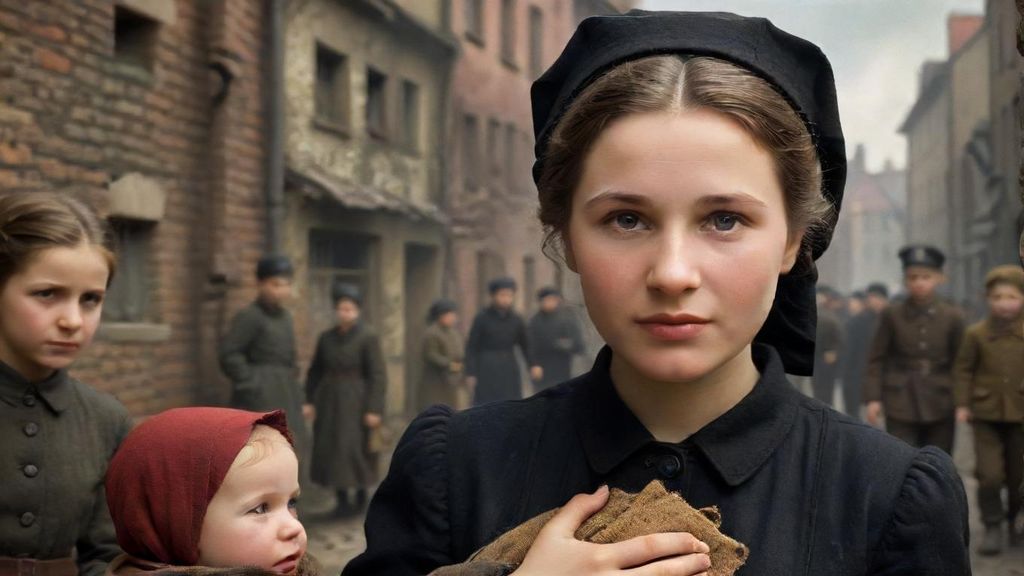
Imagine your safe world suddenly turning into a nightmare. You’d hope someone would help. For Irena Sendler, a Polish social worker in Warsaw during World War II, hoping wasn’t enough. She risked everything to save children from the Nazi-created Warsaw Ghetto due to a powerful mix of deep empathy, a strong belief in justice, and a quiet, unshakeable courage. Facing immense evil, her early life had actually prepared her to become the savior these desperate children would one day need.
Irena’s story isn’t just about being a hero during the war; it’s about the strong moral beliefs she developed long before the fighting started. Born in 1910, she grew up in Poland at a time when antisemitism was around, but it hadn’t yet become the deadly government policy it would later be. Her father, a doctor, taught her something truly important: helping others, especially those in great need, wasn’t just part of a job – it was a basic human duty. He treated poor Jewish patients whom other doctors ignored, and he taught young Irena that people should be judged by what they do, not by their family background or religion. You could say it was a family tradition of quiet service, a powerful guide for how to live her life.
After studying Polish literature, Irena became a social worker, using her skills to help the most vulnerable people in Warsaw. She focused on children and families struggling with poverty and illness, years before the war began. So, when the Nazis invaded Poland in September 1939, her caring nature was already a huge part of who she was. She wasn’t just an average person suddenly facing terrible times; she was a woman whose whole life was about helping others. This meant she noticed suffering more than most.
How did the Nazis create such a crisis in Warsaw?
The Nazi invasion completely changed life in Poland. What began as a military takeover quickly turned into a cruel system aimed at wiping out Jewish people. The Nazis wasted no time isolating Jewish residents, transforming the once busy city of Warsaw into a terrifying prison. In October 1940, they created the Warsaw Ghetto, forcing over 400,000 Jewish residents into a small, brick-walled area. This wasn’t just a walled-off neighborhood; it was a death trap, deliberately set up for starvation, disease, and hopelessness – something the world had never witnessed before.
Outside the ghetto walls, Polish citizens faced a terrible choice. Working with the Nazis meant survival, but at what price? Helping Jewish people meant instant execution, a risk very few dared to take. Still, for some, the desperate cries from inside the ghetto were impossible to ignore. History shows us that conditions inside were horrific: widespread hunger, freezing winters, and diseases like typhus spread quickly through the packed streets. Jewish children, especially, suffered the most. Their small, starving bodies wandered the streets, begging for food, their innocent eyes showing incredible pain. It’s like imagining a generation of children living in today’s war zones, but with no chance of escape.
For Irena, seeing these children was a truly heartbreaking experience that stirred her to her core. Her background as a social worker meant she didn’t just see nameless victims; she saw real individuals, each deserving of safety and respect. Testimonies collected after the war confirm that the sight of starving children, often separated from their parents or left without them, was the final push she needed. She simply couldn’t do nothing. This led to her first, incredibly risky decision: she began bringing food and medicine into the ghetto, pretending it was part of her regular social welfare duties. This gave her limited access inside.
Her first attempts were full of immediate danger. Every trip involved going through heavily guarded checkpoints, facing suspicious Nazi soldiers, and risking being caught. She first joined a small group of Polish social workers who were allowed into the ghetto to fight diseases like typhus, which the Nazis worried would spread outside the walls. This became her perfect cover. She started small, secretly bringing in basic supplies, but soon understood that simply giving aid wasn’t enough. Here’s something interesting: her early work, while appearing official, was already a cover for a much bigger, more dangerous mission she was planning. She realized that for these children to have any hope, they had to get out. This understanding, driven by deep empathy and incredible courage, pushed her into a secret operation that would ultimately save thousands of lives and prepare the way for the bold plans she was about to put into action.
How did Irena Sendler manage to save 2,500 children from the Warsaw Ghetto?

Imagine trying to run a top-secret, high-stakes operation, where every single move could get you killed on the spot. That’s essentially what Irena Sendler accomplished. She managed to rescue thousands of Jewish children from the Nazi-controlled Warsaw Ghetto. The simple answer to how she did it lies in her incredible courage, brilliant organization, and the strong dedication of a huge network of ordinary people who became extraordinary heroes. She didn’t just pull children out of danger; she built a clever system designed to outsmart one of history’s most brutal regimes.
The truth is more interesting than you might think. Sendler wasn’t working alone. Her mission was secretly approved by Żegota – the Polish Council to Aid Jews. Think of Żegota like a secret government group focused on survival, and Irena was their main person in charge of saving children. She used her real job as a social worker with the Warsaw Social Welfare Department as a perfect disguise. This gave her easy, unchallenged access to the terrible conditions inside the ghetto walls, where starvation and disease were just as deadly as the Nazi guards.
How Did They Keep So Many Secrets?
It turns out that pulling off such a huge escape required an almost unbelievable level of teamwork and clever ideas. Irena knew she couldn’t do it alone. So, she carefully built a network of selfless individuals from all walks of life. This included other social workers, doctors, nurses, priests, and incredibly brave nuns who ran orphanages and convents outside the ghetto. They were like the hidden gears in a vast, ticking clock, each playing a crucial part.
The ways children were smuggled out sound like something from a spy novel, but they were tragically real. Picture this: children were given medicine to sleep and then hidden in ambulances, supposedly sick with contagious diseases. They were rushed past guards who feared infection. Smaller children were tucked into toolboxes, potato sacks, or even coffins (empty, thankfully, but still terrifying). One of the scariest routes involved navigating the complex, dirty sewer system underneath Warsaw. They would sometimes emerge miles away in safer areas. Other times, they used hidden compartments built into trams that regularly moved in and out of the ghetto. They relied on the drivers’ nerve and quick thinking.
Each escape was a desperate race against time and the constant danger of being discovered by the Gestapo, Hitler’s secret police. The problems to solve were huge: forging fake identity papers, finding new non-Jewish Polish families willing to risk their lives by hiding children, getting money for bribes, and arranging food and clothing. Every single action, from whispering a plan to passing a child, could mean death. History tells us that Irena herself was once captured by the Gestapo in 1943. She survived torture thanks to Żegota’s quick action to bribe her guards. This allowed her to escape and continue her vital work.
What makes this fascinating is not just the escape, but what happened next. Irena understood that these children, once safe, might lose their connection to their heritage. So, she performed another act of quiet heroism: she kept detailed records. She wrote down each child’s true name, their new false name, and where they were placed. She tucked these important slips of paper into glass jars. These jars were then secretly buried under an apple tree in a friend’s backyard. It was like a very old-fashioned, buried database, except this one was made to save lives and history.
The amazing bravery of her collaborators, from humble nuns like Sister Matylda, who opened her orphanage doors, to the many Polish families who risked everything, is astounding. They created a lifeline, a small light of hope in the darkest of times. We know this because many of the rescued children, now adults, were later reunited with their families thanks to Sendler’s buried records. This proved the incredible success of her operation.
This clever mix of trickery, courage, and careful planning saved over two thousand lives. It shows us that even in the face of terrible evil, ordinary people can build strong networks of resistance. This brings us to an important question: What happened to Irena Sendler and her network after the war, and how did her incredible story eventually come to light?
How was Irena Sendler’s heroic story finally recognized after World War II?

It’s truly astonishing, but Irena Sendler’s incredible story—the one where she saved 2,500 children from the Nazis—stayed mostly unknown to the world for over 50 years after World War II ended. Can you imagine? For decades, this quiet hero simply lived her life, her extraordinary courage hidden from everyone. Her story was finally recognized when a remarkable history project by some American high school students in the late 1990s brought her quiet heroism into the spotlight, leading to a huge wave of global recognition and many awards.
The truth is even more interesting than you might think. After the war ended in 1945, Irena didn’t stop her important work; she just changed what she focused on. Her first mission was deeply personal and heartbreaking: trying to reunite the children she had saved with their real families. Picture this: she had buried those important lists of children’s names and their true identities in jars, knowing they might be needed someday. Now, she carefully dug them out of the ground to get them back.
What challenges did Irena Sendler face after the war?
After the war, here’s what she did: Irena tirelessly visited orphanages, homes, and even train stations. She tried to match names from her lists with any parents or relatives who were still alive. It was like searching for a needle in a haystack, but thousands of times harder. Many parents had died in the Holocaust, leaving their children completely alone. For these children, Irena then worked to find loving new homes, making sure they were cared for and could live a normal life. This was a huge job in a country completely destroyed by war.
Still, even with all these amazing efforts, most people around the world didn’t know about her incredible bravery during the war. The main reason was the political situation in Poland after the war. Under communist rule, the government preferred to highlight how groups of Poles resisted, often playing down individual acts of heroism, especially if they didn’t fit their official story. Plus, Irena herself was incredibly humble. She never looked for fame or recognition, often saying:
Every child saved is the justification of my existence on Earth, and not a title to glory.
This quiet strength meant her story stayed mostly secret, known only to a small group of survivors and fellow rescuers.
How did a school project bring her story to light?
It turns out the person who would finally bring her story out of the shadows wasn’t a historian or a journalist. Instead, it was a teacher in rural Kansas. In 1999, high school teacher Norman Conard asked his students at Uniontown High School to find unsung heroes of the Holocaust. One student, Megan Stewart, stumbled upon a tiny mention of Irena Sendler in a magazine article, which said she had saved 2,500 children. The students, at first skeptical of such a huge number, started what they called the ‘Life in a Jar’ project.
They researched her story, wrote a play, and eventually, with great determination and help from Polish-American contacts, they managed to connect with Irena herself. She was already in her late 80s by then. Can you imagine that conversation? These American teenagers, many years later, were bringing her story to life. This project, which eventually toured across the United States and even to Poland, truly highlighted Irena’s incredible courage.
Once her story became known, the recognition came quickly. In 2003, Irena Sendler received Poland’s highest award for civilians, the Order of the White Eagle. She was also named Righteous Among the Nations by Yad Vashem, Israel’s official memorial for Holocaust victims. This special title is given to non-Jewish people who risked their lives to save Jews during the Holocaust. Even more importantly, she was nominated for the Nobel Peace Prize in 2007. While she didn’t win, the nomination itself was a powerful way to honor her lasting example of courage, kindness, and human dignity.
Her story, once buried like her lists of names, finally touched people all over the world. It reminds us that even in the darkest times, individual acts of deep kindness can truly change history. What makes this even more fascinating is how such a world-changing tale was only discovered by a diligent group of teenagers, proving that heroes can be found in the most unexpected places. Next, we’ll dive deeper into the real impact of her legacy and the lessons her life offers us today.