
Imagine, for a moment, being a tiny independent coffee shop that just broke away from a massive, old-school corporate chain. You’ve fought hard, won your freedom, and now you’re right next door to your old boss, who still holds a grudge and seems to want your corner property back. That’s a bit like the tight spot Finland found itself in before World War II. The simple answer to why Finland felt so threatened by the Soviet Union boils down to a hard-won independence, a dangerous neighbor, and a brutal invasion that left deep scars.
To understand Finland’s fear, we need to know its past. Becoming its own country was a very new and delicate thing for Finland. For over a hundred years, it had been controlled by the Russian Empire. But then, in the chaotic year of 1917, Russia was thrown into its own massive revolution. Finland saw its chance. They declared independence, a brave move that unfortunately led to a bloody civil war right there in Finland. This civil war was partly sparked by the growing spread of communism from revolutionary Russia. This fight for freedom wasn’t just about politics; it created a deep, lasting suspicion of Russia, and later the Soviet Union, in the hearts of the new Finnish nation.
How did Finland gain its freedom, and what did it lose?
Finland’s new independence was like a tiny plant trying to grow right next to a huge, ancient oak tree. Even though they were free, Finland shared a very long, hard-to-defend border with the growing Soviet Union. The Soviets openly wanted to spread communism and believed they needed to grow bigger to protect themselves. For them, Finland was an important protective area, especially because Finland’s border was uncomfortably close to Leningrad (today called St. Petersburg), one of their most vital cities.
History shows that Soviet leaders were always worried about other countries using Finland as a place to launch attacks against them. This wasn’t just a baseless fear; it was a real weak spot on the map for the Soviets. Because of this, Finland became something the Soviets watched very closely, often with aggressive intentions.
Finland’s fear grew stronger because of the constant demands from the Soviets. Throughout the 1930s, the Soviet Union kept pushing for Finland to give up parts of its land, claiming these areas were needed for Soviet defense. Finland, a proud and newly independent country, always said no. This growing tension finally exploded into something truly terrifying in November 1939, just a few months after World War II had officially started in other parts of Europe.
What was the “Winter War,” and why did it matter so much?
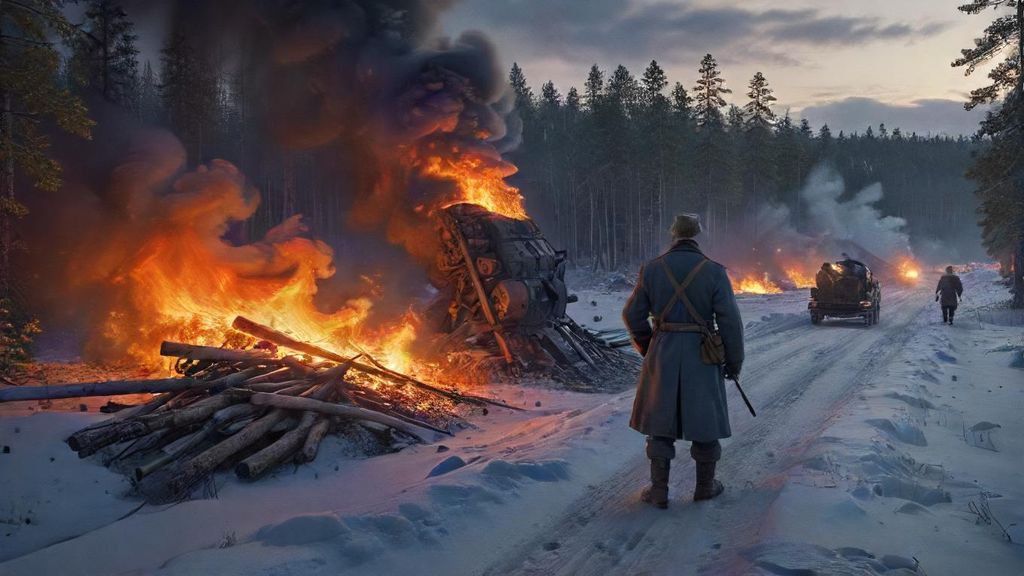
So, here’s what happened next: the Soviet Union launched a huge, unprovoked attack on Finland. This event became known as the Winter War (1939-1940). It was truly a classic David-and-Goliath story, but sadly, David didn’t fully win this time. Finland, with its small army, was up against the enormous power of the Red Army. What makes this war so remarkable is Finland’s amazing, almost unbelievable, resistance. They cleverly used the brutal winter weather and their deep knowledge of the land to their advantage. They famously used “Motti” tactics, which meant surrounding much bigger Soviet groups and then breaking them apart. It was a brave defense that shocked the world, showing their incredible determination against overwhelming odds.
Even with their heroic efforts, Finland simply couldn’t stand up to the Soviet Union’s huge numbers and endless supplies forever. After 105 days of intense fighting, Finland was forced to sign a terrible peace treaty in March 1940. They had to give up large parts of their land, including the important Karelian Isthmus and their second-largest city, Viipuri. This land loss meant hundreds of thousands of Finns had to leave their homes, and it was a deep wound to the country’s spirit.
The Winter War made it absolutely clear to Finland that the USSR was a danger to their very existence. It wasn’t just a powerful neighbor; it was a country that had clearly shown it was ready to invade, conquer, and steal Finnish land by force. This experience left Finland feeling incredibly vulnerable and alone as the world quickly headed towards more war. They desperately needed a strong balancing power, a powerful friend to stop any future Soviet attacks. This desperate search for security, even an unlikely one, is where our story truly begins to twist.
How did Finland justify fighting alongside Nazi Germany during the Continuation War?

Finland fought alongside Nazi Germany in the Continuation War (1941-1944) not out of shared beliefs, but primarily to reclaim territories lost to the Soviet Union in the earlier Winter War. It was a desperate fight for survival and independence, not an ideological alliance. Imagine if you’d just lost a piece of your home, and the bully who took it was still eyeing the rest of your property. That’s a bit like what Finland faced after the crushing Winter War in 1940. Many people might assume Finland simply joined forces with Nazi Germany because they believed in the same things, becoming another one of Hitler’s allies. But the real story is much more complicated and, honestly, quite desperate. Simply put, Finland saw this as its own separate war. Their only goals were to get back the land they’d lost and protect their freedom from the powerful Soviet Union.
Here’s what we discovered: the Winter War left deep scars. Finland had fought bravely but ultimately lost a lot of land in its eastern regions to the Soviet Union. This peace wasn’t comfortable; Finns lived in constant fear of another Soviet invasion. With no help coming from Western powers, who were either busy fighting their own battles or simply couldn’t help, Finland felt alone and vulnerable. Then came Germany, gearing up for its own massive invasion of the Soviet Union, known as Operation Barbarossa. Suddenly, Finland saw a possible partner, even if it felt very wrong. It was like a small business on the brink of collapse, accepting a lifeline from a much larger company with very questionable ethics because it was the only option to stay afloat.
How Do We Know This Wasn’t About Shared Beliefs?
The evidence shows that Finland’s war aims were very limited. Unlike Germany, Finland wasn’t dreaming of taking huge parts of Soviet land or creating a new racial system. Finnish leaders, including the influential Marshal Mannerheim, made it clear they only wanted to reclaim the land lost in the Winter War. They also aimed for a few key areas to protect themselves from future Soviet attacks. What’s really interesting is that Finland refused to attack the important city of Leningrad (now St. Petersburg), even when Germany pressured them. Think about how much that would have helped the Germans! But Finnish forces mostly stopped at the old pre-Winter War borders, clearly showing they had different goals.
Think of it this way: While German troops were pushing deep into Soviet territory, driven by goals of expanding their empire and spreading their ideas, Finnish forces mostly stopped once they got their lost lands back. This wasn’t an act of defiance against their German partners, but a clear demonstration of their distinct, defensive reasons. Historical records tell us that Finnish leaders like President Risto Ryti and Prime Minister Jukka Rangell often said their goals were limited in their communications. According to historians, these actions clearly show what Finland really wanted. They weren’t in it for ideology; they were in it for national survival and to fix the unfairness of the Winter War.
Finland really needed Germany’s military help, and this was a huge part of Finland’s war plans. Finland simply didn’t have enough tanks, planes, food, or fuel to fight the Soviet Union on their own. Germany supplied these crucial materials, so the alliance was about practical needs and tactics, not shared ideas. This meant trying to keep their democratic government running while fighting with a totalitarian regime, which was incredibly difficult. Finnish society didn’t adopt Nazi ideas about race or their political beliefs. For instance, Finland protected its Jewish population throughout the war, even as its soldiers fought alongside German troops. This was a tricky balancing act, almost like trying to keep your own values intact while having a very uncomfortable but necessary business deal with someone you disagree with deeply.
The truth is more interesting than many realize: Finland was fighting its own war, within a larger conflict, driven by a unique situation and a strong will to survive. This leads us to wonder how Finland managed to maintain its democratic identity and avoid being completely swallowed by its powerful, and ideologically dangerous, ally. Next, we’ll see how this risky situation ultimately shaped Finland’s future during and after the war.
Did Finland remain allied with Nazi Germany until the end of World War II?

The common belief might be that Finland, having fought alongside Nazi Germany, stuck with them until the bitter end. But here’s the truth: it’s far more interesting than you might think, revealing a desperate, calculated move to save a nation. The simple answer to whether Finland remained allied with Nazi Germany until the end of World War II is a resounding no. This chapter explains Finland’s incredible balancing act, showing how they not only broke ties with Germany but actually turned their guns on their former “allies” in a fight for survival and peace.
Finland’s partnership with Germany was always a practical agreement, not one based on shared beliefs. It grew out of Finland’s desire to get back land it had lost to the Soviet Union. As the war clearly turned against Germany, especially after the terrible Battle of Stalingrad in early 1943, Finland found itself in an impossible situation. Think of it like a business partnership gone terribly wrong: one side is collapsing, and the other desperately needs to get out before they’re dragged down too. The Western Allies, especially the United States and Great Britain, began to push Finland hard, urging them to find a way to leave the German side. They understood Finland’s unique trouble, caught between two powerful enemies.
The situation became critical in the summer of 1944. The Soviet Union launched a massive attack on the Karelian Isthmus, pushing Finnish forces to their breaking point. This intense pressure made it clear that continuing to fight was suicidal. It turns out that Finland was already secretly trying to arrange a peace deal, but couldn’t openly break with Germany for fear of immediate punishment. According to historians, the Finns were playing a dangerous game of cat and mouse, trying to negotiate an end to the fighting without making Hitler launch a full-scale invasion.
What Evidence Supports This Dramatic Turn?
The clearest proof of Finland’s dramatic change came in September 1944, with the signing of the Moscow Armistice. This wasn’t just a ceasefire; it was a complete pivot. The terms were harsh: Finland had to give up more territory, pay huge war reparations to the Soviet Union, and, most importantly, immediately kick all German troops out of its country. This last demand led to one of the most astonishing parts of the war, a conflict known as the Lapland War (1944-1945).
Picture this: for years, Finnish and German soldiers had fought side-by-side against the Soviets in northern Finland. Suddenly, after the armistice, these former comrades were sworn enemies. The Germans, caught off guard by Finland’s change of sides, weren’t exactly eager to leave their important positions in Lapland. They began a scorched-earth retreat, destroying everything in their path as they went, which added to Finland’s problems after the war. The Finnish army, still exhausted from fighting the Soviets, was now forced to launch an attack to push the Germans out. It’s like two estranged business partners after a bitter breakup, where one is forced to physically remove the other from the shared office space, even if it means destroying some of the furniture in the process.
This unique conflict highlights how Finland’s wartime partnership was purely a business arrangement. There were no shared ideas, only shared immediate enemies. Once that usefulness ended, so did the alliance. Finland managed to fight its former German allies, eventually forcing them completely out of Finnish territory by April 1945.
The post-war peace terms, confirmed by the Paris Peace Treaty in 1947, were really harsh. Finland lost about 11% of its land from before the war, including the important Petsamo region with its valuable nickel mines, and parts of Karelia. They also had to lease the naval base of Porkkala to the Soviet Union for 50 years (though it was returned early, in 1956). The financial payments were huge, worth hundreds of millions in today’s money, and they had to pay it back over many years. This was a heavy financial burden for a small nation.
Despite these significant losses, what makes this story fascinating is that Finland ultimately managed to keep its freedom. Unlike its Baltic neighbors, Estonia, Latvia, and Lithuania, which were absorbed into the Soviet Union, Finland remained an independent country. It was a close call, and the nation faced big political and money problems after the war, leading to its famous policy of neutrality during the Cold War. The truth is more interesting than you might think: Finland’s final actions in WWII were a desperate gamble for survival, a gamble that paid off, but it cost them a lot.