
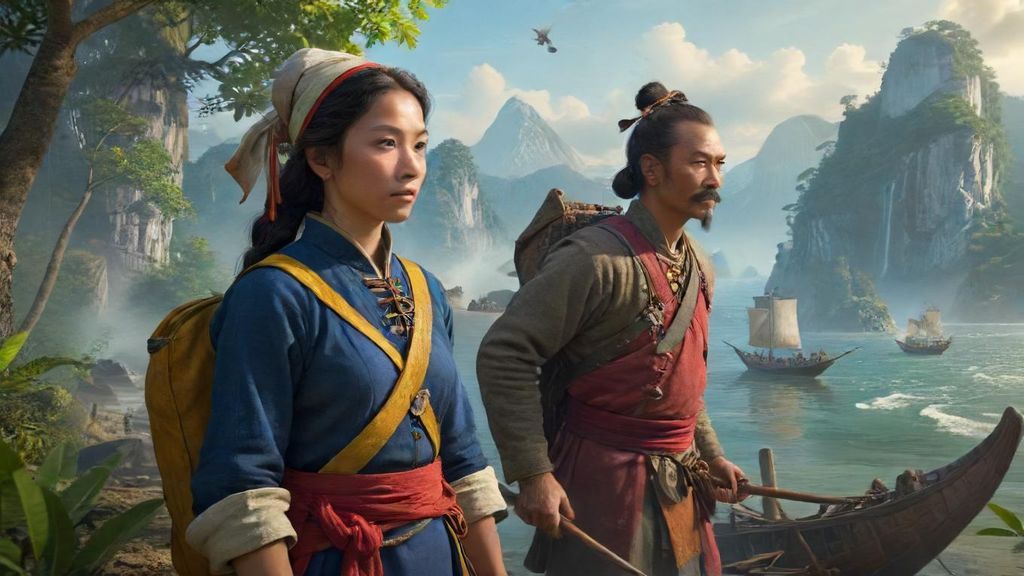
Imagine if suddenly all your favorite imported goods – your coffee, your smartphone, that cool gadget you ordered online – could only be bought from one highly protective seller. And this seller not only charged incredibly high prices, but their shipping routes were also constantly risky, or sometimes they just refused to sell to you at all. This gives you a pretty good picture of the big problem Europe faced in the 15th and 16th centuries.
The simple truth of why early European explorers needed a shortcut to Asia comes down to a powerful drive for money and influence. They craved the amazing, exotic treasures from the East and desperately wanted to get around the existing trade routes, which were completely controlled by others.
The main reason was all about trade – very expensive, highly sought-after goods. Back then, things like spices (pepper, cinnamon, nutmeg), silks, dyes, and precious jewels from places like India, China, and the “Spice Islands” (now Indonesia) were incredibly valuable. They weren’t just fancy items; spices were crucial for keeping food fresh, making bland meals taste better, and even used in medicines. Silk was the ultimate sign of wealth and importance. Europe had a massive demand for these items, and this demand powered the age of exploration.
What Made Asian Goods So Valuable?
The real story is more interesting than you might think. Getting these goods from Asia all the way to European tables was a long, dangerous journey, which made them incredibly expensive by the time they arrived. The traditional routes, often called the Silk Road, wound overland through deserts and mountains. Other routes mixed sea travel through the Red Sea with land journeys across the Middle East. These routes weren’t just long; they were dangerous, full of bandits, bad weather, and the constant threat of sickness.
But the biggest headache? Control. Powerful empires and city-states largely controlled these routes, especially the Ottoman Empire after Constantinople fell in 1453. The Ottomans, sitting right between Asia and Europe, essentially had a tight grip on trade. They charged heavy taxes, limited who could use the routes, and often favored certain merchants. All of this pushed prices even higher. It was like a single internet provider controlling all data, demanding huge fees from everyone else.
Other European countries also jumped into the game of controlling trade. Portugal, for example, famously sailed all the way around Africa in the late 15th century, setting up its own dominant sea route to Asia. This new route was long and risky, but it allowed them to bypass the Ottomans. Spain, after Columbus’s voyages west, also wanted to build its own global empire, creating more competition and tightening control over existing pathways. These nations essentially created their own “private clubs” for trade, making it super hard for other countries, especially England, France, and the Netherlands, to get their share of the Asian riches.
Historians tell us that this frantic search wasn’t just about money; it was also about national pride and getting a strategic upper hand. A country that could secure its own direct path to Asian markets would gain immense wealth. This money could fund bigger armies, stronger navies, and boost its influence around the world. It was like today’s race for who has the best technology or controls the most important supply chains.
This desperate need for a different route – one that didn’t involve sailing thousands of miles around Africa or paying big tolls to rivals – sparked a wild idea. What if there was another way? What if, as some old maps and persistent rumors suggested, there was a navigable passage right through or around the newly explored landmass of North America? This belief, often fueled by guesswork and incorrect maps, led to the mythical “Straits of Anian” – a legendary western passage that promised a shortcut to Asia, a competitive advantage, and untold wealth.
The first expeditions into North America weren’t just about finding new lands; they were mainly about finding that hidden shortcut. Explorers like Giovanni da Verrazzano (sailing for France in 1524) and Jacques Cartier (also for France in the 1530s) didn’t set out to colonize what we now call the United States and Canada. Their main goal was to find a sea-level passage, a “Straits of Anian,” that would cut straight through the continent and lead them directly to the Pacific Ocean and the treasures beyond. They were essentially trying to “game” the global trade map, desperate to find their own direct route to the East.
This urgent need turned into an obsession, a non-stop hunt for what seemed like the ultimate economic prize. The promise of direct trade, free from rivals and their taxes, was a dream too tempting to ignore. It set the stage for centuries of exploration, hardship, and a completely new understanding of the world.
This deep-seated economic and geopolitical desperation reveals the true reason behind the early push into the unknown waters surrounding North America. It wasn’t just curiosity; it was a ruthless business decision. Next, we’ll dive into the specific challenges these explorers faced and how North America’s geography kept thwarting their dreams of an easy passage.
How did the hunt for the Northwest Passage become a national obsession?

Imagine if countries today spent billions on a mission as tough and seemingly impossible as landing humans on Mars. But instead of just science, the goal was a game-changing trade route. That’s a bit like what happened with the Northwest Passage. By the 1600s, what started as a simple search for a quick way to Asia’s riches became something much bigger. It grew into a powerful mix of national pride, exciting scientific discoveries, and intense competition between countries. It wasn’t just about making money anymore; it was about showing who was the best, the bravest, and the most advanced in the world.
At first, explorers like Henry Hudson in the early 1600s were simply looking for a quicker way to get spices and silks from the East. Think of it like trying to find a new, super-fast global shipping route today. But as one journey after another came back with only stories of ice and hardship, the goal changed. The Passage was so incredibly hard to find that discovering it became a huge mark of honor. This was especially true for Great Britain, who saw itself as the world’s top naval power. They acted like a big company today, putting massive money into a “moonshot project” to get ahead of everyone else.
The British government, in particular, poured huge amounts of money and effort into finding this route. For example, records show that in 1745 and again in 1818, Parliament offered a massive £20,000 reward to anyone who could find a way through. To understand how big that was: it was a truly enormous, life-changing sum back then, worth several million dollars today. This wasn’t just a small prize; it was a clear sign that the country saw this quest as a top priority, much more important than just making money.
What fueled Britain’s relentless pursuit?
Britain truly had so much to gain, and even more to prove. If they controlled this route, their ships could sail from the Atlantic to the Pacific without going around dangerous southern capes or through waters controlled by rival nations. This would give them a huge upper hand. Think of it like owning the world’s fastest internet cables in the early days of the internet. It meant incredible power. Also, the 1800s were a time of great scientific discovery. Mapping the Arctic, figuring out its magnetic fields, currents, and land features became a massive scientific challenge. These journeys weren’t just about finding a path; they were about collecting information, expanding what humans knew, and claiming new lands for the British Crown.
During this time, explorers like William Parry and John Ross made big progress, mapping huge parts of the Canadian Arctic. Their trips often didn’t find the complete passage, but they still added vital information to the world’s map. However, this grand ambition came with severe dangers and heartbreaking human losses. The Arctic was a harsh, merciless place, and many sailors died from scurvy, hunger, and being crushed by ice.
The most famous, and perhaps most tragic, example of this growing dedication was the Franklin Expedition, which left in 1845. Sir John Franklin commanded two cutting-edge ships, the HMS Erebus and HMS Terror, with 128 men, into the Arctic. When they vanished, it became a huge international story. This disappearance launched an enormous search effort unlike any before, lasting for years. This wasn’t just another lost ship; it was a national tragedy that sparked public outrage and sent dozens more expeditions to look for them. It made the Passage seem not just a goal, but a mysterious, powerful enemy that had taken Britain’s best.
The level of commitment was astounding, similar to countries today combining resources for a huge global health project or a joint space mission. Even after the Franklin disaster showed just how deadly the Passage was, its appeal didn’t fade. Finding Franklin, or at least figuring out what happened to him, became mixed with the original hunt, making the national obsession even stronger. What’s really fascinating is how a practical wish for trade turned into a symbol of national strength and scientific curiosity, even though the Passage remained stubbornly out of reach and more and more dangerous.
This time firmly placed the Northwest Passage in people’s minds as the greatest geographical challenge. The money, lives, and scientific knowledge poured into finding it left behind a rich, though often sad, history. The fact that the Passage remained so difficult to find, despite all this effort, only seemed to make it more appealing. This then set the stage for even more desperate tries to conquer it, which we’ll talk about next.
What is the Northwest Passage actually used for today?

Most people imagine the Northwest Passage as a busy shipping highway, a quick route through the Arctic, full of giant cargo ships. But here’s the surprising truth: for over a hundred years after explorers first found it, it was practically useless for that very purpose. Even after someone finally sailed all the way through, the dream of a profitable shortcut remained just a dream. So, what exactly is the Northwest Passage used for now?
Today, the Northwest Passage is mainly used for specialized scientific research, adventure tourism, and increasingly, as a potential shipping route as melting ice makes it more accessible. Its current use is a direct result of global climate change, which has dramatically altered the Arctic landscape.
To understand this, let’s look back at the early 20th century. After hundreds of years of brave attempts and heartbreaking failures, a Norwegian explorer named Roald Amundsen finally sailed the entire Passage between 1903 and 1906. He did it in a small, tough fishing boat called the Gjøa. It took him three years, but he proved that, yes, you could technically get through. However, Amundsen’s journey, while a huge win for exploration and science, wasn’t a practical guide for commercial shipping.
Why did it take so long for the Northwest Passage to actually be useful?
The main reason was simple: ice. Even in the short summer months, the Passage was packed with thick, multi-year ice, often several feet deep. Imagine trying to drive a delivery truck through a mountain range constantly buried under fresh avalanches – it’s just not practical or safe for regular travel. The extreme weather, unreliable maps, and the huge challenge of supplying ships in such remote areas meant that even after Amundsen’s success, the Northwest Passage stayed mostly for specialized research vessels, icebreakers, and the occasional adventurous yacht for decades. It was a route for people seeking adventure or scientific knowledge, not for moving goods quickly around the world. Experts say the financial risks were far too great to make any time savings worth it.
For decades, the Passage stayed mostly frozen, its potential for business locked away. But recent discoveries show a complete shift in how people think about its future. This brings us to today, where a powerful, undeniable force is literally melting away the old problems: climate change. Picture a major highway, closed for centuries, suddenly clearing up because of a global change in conditions. That’s essentially what’s happening in the Arctic.
How is climate change reshaping the Passage’s future?
The Arctic ice cap is shrinking, and the Passage is becoming open for longer stretches each year. This isn’t just a minor thaw; it’s a huge environmental change that’s creating new challenges between countries. Nations like Canada, the United States, and several European countries are now stuck in complicated sovereignty disputes, arguing over who owns and controls these waterways. Canada, for example, sees the Passage as its own internal waters, while the U.S. and many others argue it’s an international strait, open to all ships. It’s like a debate over who owns the new internet superhighway that just appeared through a previously impassable region.
This opening also brings new opportunities, causing both excitement and concern. We’re seeing more international shipping trials, as companies look for a chance to cut journey times between Asia and Europe by thousands of miles, saving fuel and money. Tourism is also growing, with luxury cruise ships now venturing into waters once only for tough explorers, giving passengers a look at a rapidly changing Arctic. Then there’s the big potential for resource extraction – imagine huge amounts of oil, natural gas, and minerals that were once too hard and expensive to get. Exploration activities are picking up, bringing both economic promise and significant dangers to the environment.
The long-lasting impact of that early fascination with the Northwest Passage is truly captivating. What started as a hunt for a shortcut, driven by hopes of making money and the urge to explore, has now come full circle. Those old dreams might actually become reality, but in a totally new and complicated way. The Passage is no longer just an old story; it’s an active, changing gateway. It’s shaping Arctic exploration, how we understand our planet, and even global politics in ways those early explorers could never have imagined. Next, we’ll dive into how specific technologies shaped the race to conquer the Passage, changing the game for good.